
If you’re writing a message such as “You can call me any time after 6 p.m.,” you may wonder whether any time after should be written as two words or anytime after as one. The confusion happens because both forms are used in English, and they often have the same meaning. However, their grammatical functions are slightly different. This guide explains when to use each form and which choice is safest in formal writing.
Quick Answer
Both “any time after” and “anytime after” can be correct, but they are not identical in grammatical function.
| Form | Correct? | Typical Function | Example |
| any time after | Yes | Noun phrase | You can call me any time after 6 p.m. |
| anytime after | Yes | Adverb | You can call me anytime after 6 p.m. |
| at any time | Yes | Prepositional phrase | You can call me at any time. |
| at anytime | No | Incorrect standard usage | You can call me at anytime. |
The safest choice when you are unsure is any time after, especially in formal or carefully edited writing. However, anytime after is also found in standard English. Cambridge lists anytime as an adverb meaning “at any time” and gives examples such as “anytime soon.”
You can learn expressive similes for being scared to describe fear more vividly in everyday English.
Meaning and Definition
Meaning of Any Time After

Any time after means at any unspecified point following a particular time, date, event, or situation.
For example:
You can call me any time after 6 p.m.
This means you can call at 6 p.m. or at any later time.
The expression can refer to a specific starting point:
- any time after noon
- any time after Monday
- any time after the meeting
- any time after dinner
- any time after the deadline
Here, time remains a noun, while any modifies it and after introduces the point from which the period begins.
Definition of Any Time After
Any time after is a phrase referring to an unspecified time that occurs later than a stated time or event.
The phrase is particularly clear when after is followed by a specific time, date, or event.
For example:
The office is available any time after 9 a.m.
The sentence means that the office is available at 9 a.m. or at any point later in the day.
Meaning of Anytime After
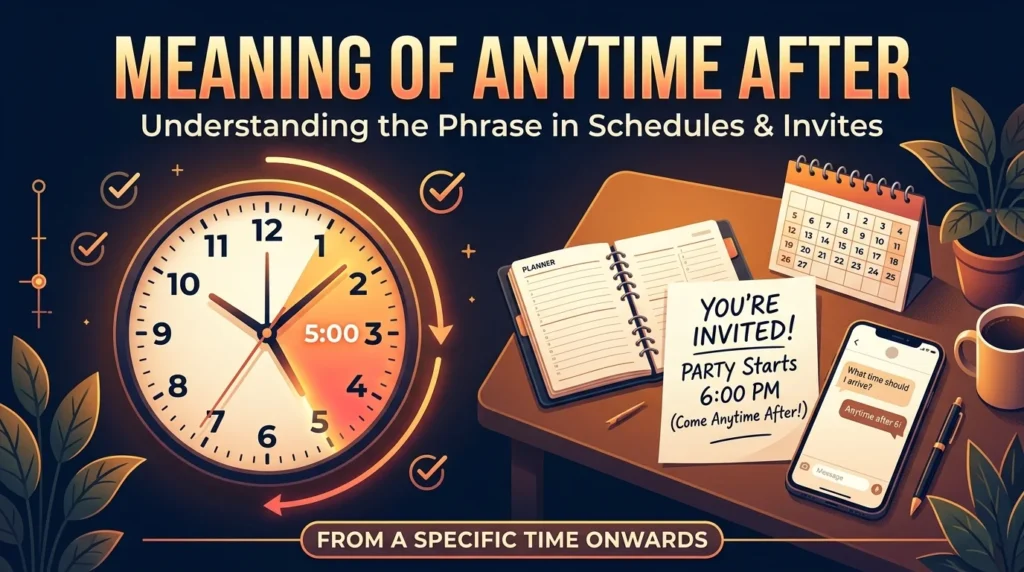
Anytime after uses anytime as an adverb. It means that something can happen at an unspecified time after a particular point.
For example:
You can submit the application anytime after Friday.
The meaning is essentially the same as:
You can submit the application any time after Friday.
Cambridge recognizes anytime as an adverb and defines it as referring to a time that is not decided or does not need to be decided.
Definition of Anytime After
Anytime after is an adverbial expression meaning at any time following a particular time or event.
The important point is that anytime functions as an adverb here rather than as a noun phrase.
For example:
We can meet anytime after lunch.
The expression tells you when the meeting can occur, but it does not specify an exact time.
Main Difference
The main difference is grammatical function, not meaning.
Any time consists of the determiner any and the noun time. Anytime is a single adverb. In many sentences, both forms communicate the same basic idea.
Compare:
You can call me any time after 6 p.m.
You can call me anytime after 6 p.m.
Both sentences mean that you can call at 6 p.m. or later.
The distinction becomes much clearer in other constructions.
| Expression | Function | Example |
| any time | Noun phrase | I don’t have any time today. |
| anytime | Adverb | You can call me anytime. |
| any time after | Noun phrase + prepositional phrase | Call me any time after 6 p.m. |
| anytime after | Adverbial expression | Call me anytime after 6 p.m. |
| at any time | Prepositional phrase | You may leave at any time. |
| at anytime | Not standard | Incorrect: You may leave at anytime. |
The crucial rule is that anytime cannot normally follow the preposition at. In “at any time,” time is the noun that follows the preposition.
Dictionary.com likewise distinguishes any time as a noun phrase from anytime as an adverb.
Which One Is Correct?
Any time after is correct. Anytime after can also be correct.
It would be inaccurate to say that anytime after is always wrong. Modern dictionaries recognize anytime as a standard adverb, and actual usage includes constructions where anytime appears before after.
For example, both of these are acceptable:
You can contact me any time after 5 p.m.
You can contact me anytime after 5 p.m.
If you want the more conservative and transparent choice, particularly in professional or formal writing, any time after is a good option.
However, don’t treat anytime after as an automatic grammatical error.
Strengthen your vocabulary by exploring expressive comparisons about the ocean for creative writing and everyday descriptions.
Grammar and Usage
The grammar becomes easier once you identify the role of time.
Any Time as a Noun Phrase
In any time, the word time is a noun.
Examples include:
I don’t have any time today.
Do you have any time this afternoon?
We need any time we can get.
Because time is functioning as a noun, it remains separate from any.
Anytime as an Adverb
In anytime, the entire word functions as an adverb.
For example:
Call me anytime.
You can visit us anytime.
I don’t expect him to arrive anytime soon.
Cambridge specifically classifies anytime as an adverb in American English and also notes any time as a British alternative.
Any Time After a Specific Time
When you say:
You can come any time after 4 p.m.
the expression establishes 4 p.m. as the starting point. Any point from 4 p.m. onward is possible.
You can use the same pattern with dates and events:
- any time after Tuesday
- any time after the exam
- any time after lunch
- any time after the holiday
- any time after the meeting
Anytime After a Specific Time
You can also write:
You can come anytime after 4 p.m.
Here, anytime functions adverbially. The expression still communicates an unspecified time following 4 p.m.
This is why the difference between the two forms is sometimes difficult to notice. In this construction, the meanings are practically identical.
How to Use Any Time After
Use any time after when you want to express flexibility about when something can happen following a particular point.
After a Clock Time
Please call me any time after 7 p.m.
The manager is available any time after 2 p.m.
You can collect the documents any time after 10 a.m.
After a Date
You may submit the application any time after June 15.
The new schedule will be available any time after Monday.
After an Event
We can discuss the issue any time after the meeting.
You can visit any time after dinner.
The children can play outside any time after their homework is finished.
In all of these examples, any time after clearly identifies a flexible period beginning after something else.
How to Use Anytime After
Use anytime after when anytime functions naturally as an adverb.
In Casual Communication
You can call me anytime after 6 p.m.
Stop by anytime after lunch.
We can talk anytime after the class.
When the Meaning Is “Whenever”
You can often replace anytime with whenever:
Call me anytime.
Call me whenever you want.
Similarly:
You can visit anytime after 5 p.m.
means approximately:
You can visit whenever you want after 5 p.m.
This adverbial function is what separates anytime from the noun phrase any time.
Examples
Examples of Any Time After
- You can call me any time after 6 p.m.
- We can meet any time after lunch.
- The report can be submitted any time after Monday.
- Please visit the office any time after 9 a.m.
- You may schedule the interview any time after the holiday.
- We can discuss the contract any time after the meeting.
- Students may register any time after the results are announced.
- The package should arrive any time after Friday.
- You can pick up your order any time after noon.
- The appointment can be changed any time after tomorrow.
Examples of Anytime After
- You can call me anytime after 6 p.m.
- We can meet anytime after lunch.
- Feel free to visit anytime after the ceremony.
- You can send the documents anytime after Monday.
- I’ll be available anytime after 3 p.m.
- We can discuss the project anytime after the presentation.
- You can submit your response anytime after the deadline is extended.
- She said we could arrive anytime after dinner.
- Contact the support team anytime after 8 a.m.
- We can arrange another meeting anytime after next week.
Common Mistakes
Mistake 1: Writing “at anytime”
Incorrect:
You can contact me at anytime.
Correct:
You can contact me at any time.
The mistake happens because writers treat anytime as if it were interchangeable with the noun phrase any time in every grammatical position.
After the preposition at, use any time.
Mistake 2: Assuming “Anytime After” Is Always Wrong
Some grammar advice claims that anytime after is automatically incorrect. That rule is too strict.
For example:
You can call me anytime after 5 p.m.
is found in standard English usage. The one-word form works here because anytime is functioning as an adverb. Major dictionary evidence supports the use of anytime as an adverb.
Mistake 3: Treating “Any Time” and “Anytime” as Completely Interchangeable
Although the forms overlap, they cannot replace each other in every sentence.
Correct:
I don’t have any time today.
Incorrect:
I don’t have anytime today.
Here, time is a noun referring to an amount of available time. The one-word adverb does not fit.
Mistake 4: Thinking the Pronunciation Is Different
Any time and anytime are normally pronounced the same way.
The difference is primarily visible in writing and grammatical function, not pronunciation.
Mistake 5: Using “Anytime” as a Noun
Anytime is primarily an adverb.
For example:
You can call me anytime.
But:
I don’t have anytime available.
is not standard English. Use:
I don’t have any time available.
Linguistic Insight
The difference between any time and anytime is an example of word formation, specifically the development of a compound word from a phrase.
Originally, English commonly used the separate words any time. Over time, anytime developed as an adverb and became established in modern English.
Today, dictionaries recognize anytime as an adverb. Cambridge, for example, lists it as an adverb in American English and notes that British English also uses the two-word form any time.
This development explains why older grammar advice can sometimes conflict with modern dictionary usage. Some traditional style guidance treated anytime as informal or discouraged it in careful writing, while modern references recognize it as an established adverb.
The important lesson is that any time and anytime have developed related but distinct grammatical roles.
The form any time retains the ordinary noun time, while anytime functions as a single adverb.
Usage Tips
Here are some simple ways to remember the distinction:
- Use anytime when you can replace it with whenever.
- Use any time when time is clearly functioning as a noun.
- Always write at any time, not at anytime.
- Before a specific time or event, any time after is a clear and safe choice.
- Anytime after can also be grammatical when anytime functions as an adverb.
- In formal writing, choose any time after if you want the most transparent construction.
A useful test is to ask whether time is behaving like a noun.
Do you have any time?
Yes. Here, time is clearly a noun.
Now compare:
Call me anytime.
Here, anytime tells you when to call, so it functions as an adverb.
Expert Suggestion
If you’re writing a professional email, academic sentence, or formal document and you’re unsure which form to choose, any time after is a clear option.
For example:
Please submit the completed form any time after January 15.
However, don’t correct anytime after automatically. If the sentence uses anytime as an adverb, the one-word form can be perfectly acceptable.
The most important rule to remember is “at any time,” not “at anytime.” Once you understand that distinction, most cases become much easier to handle.
Summary
Any time after and anytime after can both be correct. Any time is a two-word noun phrase, while anytime is an adverb meaning “at any time” or “whenever.” In sentences such as “You can call me any time after 6 p.m.” and “You can call me anytime after 6 p.m.,” both forms can express essentially the same idea.
For formal and careful writing, any time after is a clear and conservative choice. However, anytime after is not automatically incorrect. The form at any time is correct, while at anytime is not standard. The key is to identify whether time is functioning as a noun or whether anytime is functioning as an adverb.
Frequently Asked Questions
Is “any time after” correct?
Yes. Any time after is grammatically correct. It means at an unspecified point following a particular time, date, event, or situation. For example, “You can call me any time after 6 p.m.” means you can call at 6 p.m. or at any later time.
Is “anytime after” correct?
Yes. Anytime after can also be correct. In this construction, anytime functions as an adverb. For example, “You can call me anytime after 6 p.m.” is a valid sentence and has essentially the same meaning as the two-word version.
Which is correct, “any time after” or “anytime after”?
Both can be correct. Any time after treats time as part of a noun phrase, while anytime after uses anytime as an adverb. If you’re unsure, any time after is a clear choice, especially in formal writing.
Is “any time after 5 p.m.” correct?
Yes. Any time after 5 p.m. is completely correct. It means at 5 p.m. or at any unspecified point later than 5 p.m.
Is “anytime after 5 p.m.” grammatically correct?
Yes. Anytime after 5 p.m. can also be grammatically correct. Here, anytime functions adverbially and modifies the verb or the entire clause.
Should I write “at any time” or “at anytime”?
Write at any time. The expression uses time as a noun following the preposition at. At anytime is not standard English.
Can “anytime” be used in formal writing?
Yes. Anytime is an established English adverb and appears in major dictionaries. However, when a sentence specifically involves a noun phrase, any time may be the clearer choice. Cambridge recognizes anytime as an adverb.
What does “any time after” mean?
Any time after means at any unspecified point following a particular time or event. For example, “You can visit any time after noon” means you can visit at noon or later.
What does “anytime after” mean?
Anytime after means at an unspecified time following a particular point. For example, “Call me anytime after lunch” means you can call whenever you want after lunch.
Is “any time” always correct?
Any time is the more flexible form because it can function as a noun phrase in situations where anytime cannot. For example, “I don’t have any time today” is correct, while “I don’t have anytime today” is not standard.
Can I say “call me any time”?
Yes. Call me any time is correct. You can also say call me anytime. Both are commonly understood to mean that the person may call whenever they wish.
Is “anytime” an adverb?
Yes. Anytime functions as an adverb in standard English. It commonly means “at any time” or “whenever,” as in “You can contact me anytime.” Cambridge classifies anytime as an adverb.
Why do people confuse “any time” and “anytime”?
They are pronounced the same and often have nearly identical meanings. The main difference is grammatical function. Any time contains the noun time, while anytime functions as a single adverb. This overlap naturally causes confusion.
Which form is better for professional writing?
Any time after is a safe and clear choice in professional writing, especially when after introduces a specific time, date, or event. However, anytime after is not automatically incorrect and can be appropriate when anytime functions adverbially.

