
You’re writing a text message, email, or school assignment and pause to ask yourself whether to write “I want to go” or “I want too go.” Both words sound the same, so it’s easy to confuse them when writing. However, to and too have different meanings and grammatical functions. Understanding when to use each word will help you write more clearly and avoid common English grammar mistakes.
Quick Answer
To is used to show direction, a relationship, or an action. Too means “also” or “more than necessary.”
| Word | Meaning | Example |
| To | Direction, destination, or an action | I want to learn English. |
| Too | Also or excessively | I want to learn English too. |
| Too | More than necessary or desirable | This coffee is too hot. |
Both to and too are correct English words. The right choice depends on what you want to express.
Remember that two is another word with the same pronunciation. It represents the number 2, as in “I bought two books.”
Meaning and Definition
Meaning of To
The word to connects words and ideas in a sentence. It often indicates where someone or something is going, who receives something, or what action someone intends to perform.
For example:
- We walked to school.
- Please send the email to my manager.
- I need to finish my homework.
In each sentence, to performs a different grammatical function, but it helps establish a relationship between parts of the sentence.
Definition of To
To is a preposition that can express direction, destination, a recipient, or a relationship. It also functions as an infinitive marker before the base form of a verb.
Examples include to the office, to my friend, and to understand.
The word does not have one single meaning in every sentence. Its precise function depends on the words around it.
Learn when to use Focuses or Foci correctly by understanding the plural forms of focus in different English contexts.
Meaning of Too
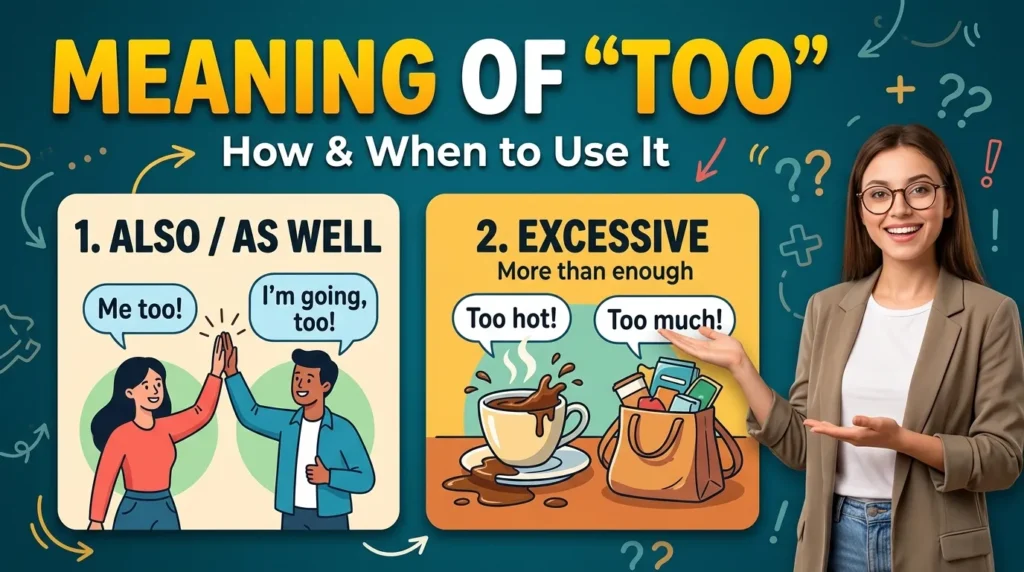
The word too has two main meanings in everyday English.
First, it means also or as well. It adds another person, thing, or action to an existing idea.
- I want to come too.
- My brother likes basketball too.
Second, too means more than is needed, wanted, or suitable.
- The room is too cold.
- This bag is too heavy.
In the first pair, too adds information. In the second pair, it describes an excessive degree or amount.
Definition of Too
Too is an adverb that means “in addition” or “to a degree greater than is desirable, necessary, or acceptable.”
When it means also, it adds information to a statement. When it indicates excess, it modifies an adjective, an adverb, or an expression of quantity.
For example, in “The test was too difficult,” the word too indicates that the difficulty exceeded a suitable level.
Main Difference
The main difference between to vs too is their meaning and grammatical function. Although they sound alike in standard pronunciation, you cannot normally substitute one for the other without changing the meaning or making the sentence incorrect.
| Feature | To | Too |
| Part of speech | Usually a preposition or infinitive marker | Adverb |
| Main meanings | Direction, relationship, or an action | Also or excessively |
| Before a verb | To study, to write, to speak | Not used to introduce an infinitive |
| Before an adjective | Not normally used this way to express degree | Too expensive, too difficult |
| Indicating addition | Not used for this meaning | I want to go too. |
| Indicating excess | Not used for this meaning | The box is too heavy. |
Consider these examples:
- I want to sleep. The word to introduces the verb sleep.
- I want to sleep too. The word to introduces sleep, and too means also.
- I am too tired to sleep. The first too indicates excess, while the second to introduces the verb sleep.
These examples show why context matters. A single sentence can correctly contain both words.
Which One Is Correct?
Both “to” and “too” are correct. Neither spelling is inherently wrong. You must choose the word that matches the meaning and structure of your sentence.
Use to when you want to indicate a destination, connect a recipient to an action, or introduce an infinitive.
- Correct: I need to call my teacher.
- Incorrect: I need too call my teacher.
Use too when you mean “also” or “more than necessary.”
- Correct: She wants to join us too.
- Incorrect: She wants to join us to. (If you mean that she wants to join as well.)
Compare these sentences:
- I went to the library. (The library is the destination.)
- I went too. (I went as well.)
- It is too late to leave. (It is later than is suitable.)
The correct spelling depends on what you mean, not which word sounds right when spoken.
Grammar and Usage
Understanding the grammatical role of each word makes the distinction easier to remember.
How To Functions in a Sentence
The word to commonly serves two main functions.
1. To as a preposition
A preposition connects a noun or pronoun to another part of a sentence. It can express direction, destination, a recipient, or a relationship.
Examples:
- We drove to the airport.
- She gave the keys to her sister.
- I look forward to the weekend.
2. To as an infinitive marker
An infinitive is the base form of a verb. The word to commonly appears before it.
Examples:
- I want to learn.
- He decided to wait.
- They hope to win.
The pattern is usually to + base verb, such as to write, to read, and to understand. However, some English constructions use the infinitive without to, as in “She can swim.”
Make your stories more expressive by practicing figurative language about dogs in creative sentences and descriptions.
How Too Functions in a Sentence
Too is an adverb with two principal uses.
1. Too meaning “also”
It adds a person, action, or idea to something already mentioned.
- I will attend the meeting too.
- She speaks Spanish, and she speaks French too.
- “I love this song.” “Me too!”
In this meaning, too often appears at the end of a sentence or clause, although its position can vary.
2. Too meaning “excessively”
It indicates that something exceeds a desirable or acceptable degree.
- The instructions are too complicated.
- You are walking too slowly.
- The box is too heavy to lift.
Here are some useful quantity expressions:
| Expression | When to use it | Example |
| Too much | An excessive amount of an uncountable noun | There is too much noise. |
| Too many | An excessive number of countable items | We have too many assignments. |
| Too little | Less than the required or desirable amount | We have too little time. |
| Too few | Fewer items than needed | There are too few chairs. |
Notice that too does not always mean something is extremely large or positive. It often signals a problem because an amount or quality has gone beyond an appropriate limit.
Cambridge Dictionary
+1
How to Use To and Too Correctly
The easiest way to choose between these words is to identify the meaning you want to express.
Use To Before a Verb
When you want to describe an intended or planned action, use to before the base verb.
Examples:
- I plan to study tonight.
- We agreed to help.
- She wants to become a doctor.
- He learned to drive last year.
Remember that the verb after to generally stays in its base form. Write “to go,” not “to goes,” and “to write,” not “to wrote.”
Use To for Direction or Destination
Use to when describing movement toward a place or person.
Examples:
- We traveled to New York.
- Please walk to the front desk.
- She sent the documents to her supervisor.
- The children ran to their parents.
The word can also connect a noun to a related idea, as in “the answer to the question” or “the key to success.”
Use Too When You Mean Also
If you can replace the word with also or as well without changing the intended meaning, too is usually the correct choice.
Examples:
- I want to participate too.
- You can invite your friends too.
- My parents enjoyed the movie too.
Compare:
“I want to participate” means that participation is what you want to do.
“I want to participate too” means that you want to participate in addition to someone else.
Use Too to Describe Excess
Place too before an adjective or adverb when the quality exceeds an acceptable level.
Examples:
- The shirt is too expensive.
- He drives too quickly.
- The water is too cold.
- The instructions were too difficult to follow.
You can often test this meaning by replacing too with excessively or overly.
For example, “The shirt is too expensive” means that its price is higher than the speaker considers acceptable.
Be careful not to confuse too with very. “The shirt is very expensive” describes a high price, while “The shirt is too expensive” suggests that the price exceeds a suitable limit.
Examples
These examples show how to use both words in everyday conversation, professional writing, and academic contexts.
Examples of To
- I need to finish this report before Friday.
- She walked to the nearest bus stop.
- Please send your questions to the support team.
- We decided to postpone the meeting.
- He wants to improve his English.
- The students went to the library after class.
- I gave the package to the delivery driver.
- They hope to visit their grandparents soon.
- The road to the village is narrow.
- She explained the problem to her manager.
- We have from Monday to Friday to complete the task.
- I called him to ask about the schedule.
Examples of Too
- I would like to join the discussion too.
- The coffee is too hot to drink.
- She is too busy to attend the event.
- We arrived too late to see the opening act.
- This suitcase is too heavy for me.
- He speaks too quickly for beginners to understand.
- My sister enjoys reading too.
- There is too much traffic this morning.
- We have too many tasks to finish today.
- The room is too small for the entire team.
- I hope you can come too.
- The instructions are too complicated to follow without help.
Examples Using Both To and Too
These sentences are especially helpful because they demonstrate the different functions of the words in the same context.
- I want to go too.
- She was too tired to continue.
- He needs to arrive early too.
- The bag is too heavy to carry upstairs.
- We went to the restaurant too late to get a table.
- I asked my colleague to attend the meeting too.
In each sentence, to and too serve separate grammatical purposes. One cannot replace the other.
Common Mistakes
Even experienced English writers sometimes confuse to and too. The most reliable solution is to check the meaning of the word in context.
Mistake 1: Writing Too Before a Verb Instead of To
Incorrect: I want too learn English.
Correct: I want to learn English.
Why it happens: Both words sound alike, so writers sometimes choose the spelling that looks familiar without checking the sentence structure.
Rule: Use to before the base form of a verb when the sentence requires a to-infinitive.
Mistake 2: Using To Instead of Too for Addition
Incorrect: I want to come to, just like you.
Correct: I want to come too, just like you.
Why it happens: The writer intends to say “also” but uses the shorter spelling.
Rule: If you mean also or as well, use too.
Mistake 3: Writing To Much Instead of Too Much
Incorrect: There is to much work to do.
Correct: There is too much work to do.
Why it happens: Writers may confuse the two spellings because they sound alike.
Rule: Use too much to describe an excessive amount of something uncountable, such as work, time, or water.
Mistake 4: Writing To Late Instead of Too Late
Incorrect: We arrived to late for the presentation.
Correct: We arrived too late for the presentation.
Why it happens: The writer may recognize to as a common word but overlook the meaning of excess.
Rule: Use too late when someone arrives or something happens later than is suitable or possible.
Mistake 5: Confusing Too With Two
Incorrect: I bought too notebooks.
Correct: I bought two notebooks.
Why it happens: To, too, and two are pronounced alike in many varieties of English.
Rule: Use two when referring to the number 2. Use too for addition or excess, and use to for its grammatical functions.
Mistake 6: Using Too Instead of To in Formal Writing
Incorrect: The application was sent too the department.
Correct: The application was sent to the department.
Why it happens: The writer may focus on pronunciation instead of the relationship between the words.
Rule: When identifying the recipient of an action, use to. Here, the department receives the application.
Linguistic Insight
The confusion between to and too is a useful example of how English spelling communicates meaning that pronunciation alone cannot convey.
Why To and Too Sound the Same
In many English accents, to and too share the same pronunciation, commonly represented as /tuː/ when stressed. However, the pronunciation of to often becomes shorter and weaker in ordinary speech, sometimes sounding like /tə/.
This weakening happens because to is a very common grammatical word. Speakers frequently pronounce it without strong emphasis.
By contrast, too often receives more emphasis when someone wants to stress addition or excess. Nevertheless, the words can sound identical, so listening alone may not reveal which spelling is correct.
definition in the Cambridge English Dictionary
+1
The Historical Relationship Between To and Too
The words have a shared historical background in Old English. Over time, spelling conventions helped distinguish their different uses in written English. The spelling too became established for meanings such as “also” and “excessively,” while to retained its familiar prepositional and infinitive functions.
This history helps explain why the spellings are so similar. They did not develop as completely unrelated words, even though modern English assigns them different grammatical roles and meanings.
Why Writers Confuse Them
Three factors contribute to the mistake:
- Identical pronunciation: Sound does not reliably distinguish the spellings.
- Frequent use: Both words appear in many everyday sentences.
- Different grammatical functions: Choosing the right word requires understanding the intended meaning and sentence structure.
The solution is to focus on meaning and grammar rather than pronunciation.
Usage Tips
Use these practical reminders to choose the correct spelling.
- Think direction or destination? Use to. Example: We drove to the airport.
- Think of an action? Use to before a required infinitive. Example: I want to read.
- Think also or as well? Use too. Example: I want to read too.
- Think more than necessary? Use too. Example: The book is too expensive.
- Think of the number 2? Use two. Example: I ordered two books.
Another helpful strategy is to substitute a similar word.
If you can replace too with also, the spelling is usually correct for the meaning you intend. If you can replace it with excessively, too is appropriate for the excessive-degree meaning.
For to, look at what follows it. If it introduces a destination, recipient, or infinitive verb, the single-o spelling is generally the one you need.
Expert Suggestion
As a grammar teacher, I recommend checking what each word contributes to the sentence rather than memorizing isolated examples.
When editing an essay, email, or website article, ask yourself three questions:
- Does the word indicate a destination, recipient, or action? Choose to when that function fits.
- Does it mean “also” or “more than necessary”? Choose too.
- Does it represent the number 2? Choose two.
For example, consider this sentence:
“I need to send two documents to my supervisor too.”
Each word has a distinct role. To introduces the action send and identifies the recipient, two gives the number of documents, and too means that the speaker is doing this in addition to something else.
Reading your writing once specifically to check these words can help you catch errors that ordinary proofreading may miss.
Summary
To and too are both correct English words, but they serve different purposes. Use to as a preposition to indicate direction, a recipient, or a relationship, and before a verb when forming a to-infinitive. Use too when you mean “also” or “more than necessary.”
The number word two adds a third spelling to remember. It represents the number 2.
Because these words often sound identical, pronunciation alone cannot tell you which spelling to use. Instead, identify the meaning you want to communicate and check the word’s grammatical role. With this simple approach, you can use to, too, and two correctly in everyday conversations, academic assignments, professional emails, and formal writing.
Frequently Asked Questions
What is the difference between to and too?
To indicates direction, a recipient, or an action introduced by an infinitive marker. Too means “also” or “more than necessary.” For example, “I want to leave” uses to before a verb, while “I want to leave too” means the speaker wants to leave as well.
Is too grammatically correct?
Yes. Too is a standard English adverb. It can mean “also,” as in “I want to come too,” or “excessively,” as in “The room is too hot.” Its correctness depends on whether it expresses the intended meaning.
When should I use to?
Use to when expressing direction, a destination, a recipient, or a relationship. It also appears before the base form of a verb in constructions such as “to read,” “to write,” and “to understand.” For example, “She went to work to finish her project.”
When should I use too?
Use too when you mean “also” or “more than necessary.” For example, “My friend is coming too” means your friend is coming as well. “The bag is too heavy” means its weight exceeds a suitable or manageable level.
Is it too or to much?
The correct expression is too much when describing an excessive amount. For example, “There is too much sugar in this tea.” Use to in a different grammatical construction, such as “I want to drink some tea.”
Is it too or to late?
The correct expression is too late when something happens after the appropriate or possible time. For example, “We arrived too late to catch the train.” Use to in a sentence such as “We went to the station late.”
Is it to or too in “I want to go too”?
Both words are correct in this sentence, and each has a different function. The first to introduces the verb go. The final too means “also.” The sentence indicates that the speaker wants to go in addition to someone else.
Is it to or too in “me too”?
The correct expression is “Me too.” It means “I do too,” “I am too,” or “the same applies to me,” depending on the conversation. For example, if someone says, “I love reading,” you can reply, “Me too.”
Is too the same as very?
No. Too often indicates that something exceeds a suitable or desirable degree, while very simply emphasizes a high degree.
For example, “The room is very cold” describes the temperature. “The room is too cold” suggests that the temperature is uncomfortably or undesirably low.
What is the difference between to, too, and two?
To indicates direction, a recipient, or an infinitive. Too means “also” or “excessively.” Two is the number 2. For example, “I went to the store, bought two apples, and bought oranges too.”
Can I use too at the end of a sentence?
Yes. Too frequently appears at the end of a sentence when it means “also.” For example, “I enjoyed the movie too.” It can also appear in other positions, such as “The movie was too long.”
Is “too much” always correct?
No. The expression too much is appropriate for an excessive amount of an uncountable noun or for describing an action, as in “You talk too much.” With plural countable nouns, use too many, as in “There are too many people here.”
Why do to and too sound the same?
In many English accents, both words have the same pronunciation. Their different spellings reflect their distinct meanings and grammatical functions, not a reliable difference in sound. That is why you need to consider the sentence’s meaning when choosing between them.
How can I remember the difference between to and too?
Remember that too has an extra o for an extra meaning. It can mean “also,” adding something, or “excessively,” meaning more than necessary. Use to for direction, recipients, and infinitive verbs. Use two when you mean the number 2.
Which word should I use in formal writing, to or too?
Both words are appropriate in formal writing when used correctly. Use to for its grammatical functions and too for addition or excess. Neither is inherently more formal than the other. The correct choice depends on the sentence’s meaning.

