
You may have seen sentences such as “There are to many people here” and wondered whether to many or too many is correct. The confusion is easy to understand because to and too sound alike in normal speech. However, they have different meanings and grammatical functions. This guide explains when to use too many, when to many can be correct, and how to avoid this common writing mistake.
Quick Answer
Too many is correct when you mean more people or things than are needed, wanted, suitable, or reasonable. Cambridge defines too many as more of something than is needed, wanted, or suitable.
To many can also be grammatically correct, but only when to has its normal function as a preposition and many refers to people or things. It does not mean “an excessive number.”
| Form | Correct? | Meaning | Example |
| Too many | Yes | More than needed or wanted | There are too many cars here. |
| To many | Yes, in specific structures | To or toward many people or things | The announcement was important to many people. |
| To many meaning “too many” | No | Incorrect use of to | There are to many cars here. |
The key distinction is simple: too many expresses excess, while to many usually shows a relationship, recipient, or direction.
Meaning and Definition
Meaning of Too Many
Too many means an excessive number of people or things. It suggests that the number is greater than what is needed, desired, expected, or appropriate.
For example:
- There are too many students in this classroom.
- I received too many emails this morning.
- We bought too many snacks for the party.
The phrase normally comes before a plural countable noun, such as books, people, questions, mistakes, or cars.
Learn whether simpler or more simple is correct to choose the natural comparative form when describing something easier.
Definition of Too Many
Too many means more than is needed, wanted, suitable, or acceptable.
Here, too functions as an adverb expressing excess, while many indicates a large number of countable things or people. Together, they form a quantity expression that indicates an excessive number.
Meaning of To Many
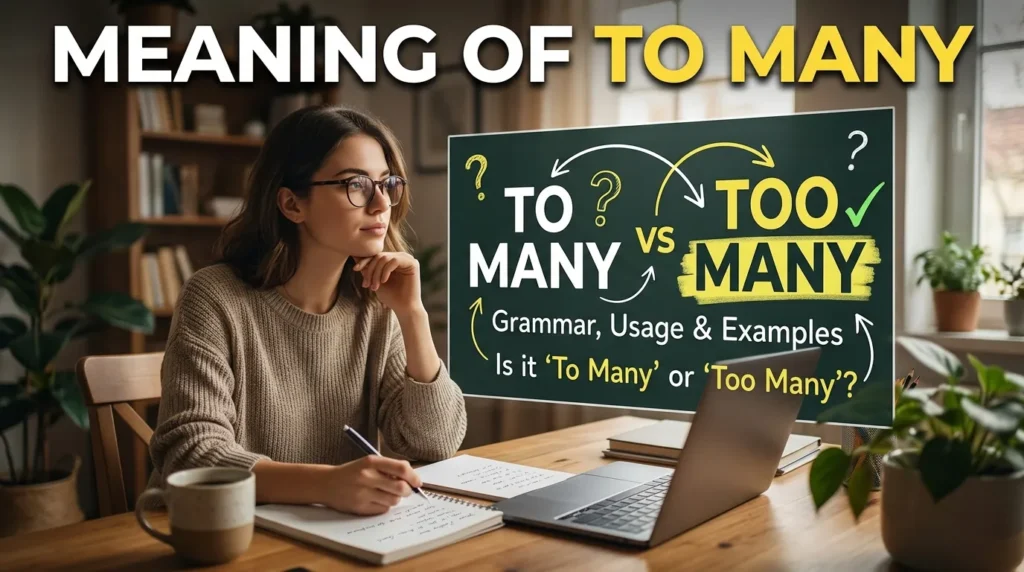
To many does not have one independent meaning as a fixed phrase. Its meaning depends on the larger sentence.
In sentences such as “The decision was surprising to many,” to is a preposition and many refers to many people.
For example:
- The news came as a surprise to many.
- She spoke to many students.
- The change was helpful to many families.
Definition of To Many
To many is a combination of the preposition to and the quantifying word many. It is grammatical when to has its normal function and many refers to an understood group.
It is not a standard alternative spelling of too many. Therefore, you cannot replace too many with to many when you want to express excessive quantity.
Main Difference
The main difference is the grammatical function and meaning of too and to.
| Feature | Too many | To many |
| Main function | Expresses excess | Usually shows a relationship, recipient, or direction |
| Meaning | More than needed or wanted | To or toward many people or things |
| Grammar | too + many | to + many |
| Used for excess? | Yes | No |
| Example | There are too many errors. | The advice was useful to many readers. |
Consider these two sentences:
There are too many people in the room.
This means the number of people is excessive.
The speaker talked to many people after the event.
This means the speaker communicated with a large number of people. It does not say that the number was excessive.
That difference is the heart of the issue.
Which One Is Correct?
If you are trying to say “more than necessary” or “more than wanted,” use too many.
Correct:
There are too many mistakes in this report.
Incorrect:
There are to many mistakes in this report.
However, it would be inaccurate to say that the sequence to many is always grammatically wrong. It is correct when to serves another grammatical purpose.
For example:
I sent the invitation to many colleagues.
Here, to identifies the recipients.
Similarly:
The new policy matters to many employees.
Here, to introduces the people affected or concerned.
So the rule is not simply “too many is correct and to many is always wrong.” The better rule is:
Use “too many” for excessive quantity. Use “to many” when “to” is functioning normally as a preposition.
Grammar and Usage
Too Many as a Quantity Expression
The structure is generally:
too + many + plural countable noun
Examples include:
- too many books
- too many questions
- too many students
- too many emails
- too many problems
- too many appointments
Cambridge’s grammar guidance confirms that too many is used with countable nouns when talking about quantities that are more than enough.
You can also use too many without directly stating the noun when the meaning is already clear:
We ordered ten pizzas, but that was too many.
The omitted noun is understood from the context.
To Many as a Prepositional Structure
The structure to many usually appears as part of a larger phrase:
verb/adjective/noun + to many + people/things
Examples:
- I spoke to many customers.
- She wrote to many readers.
- The change was confusing to many users.
- The decision was important to many families.
In these sentences, to does not express excess. It performs its ordinary grammatical role.
Too Many vs. Too Much
Do not confuse too many with too much.
Use too many with plural countable nouns:
There are too many books on the table.
Use too much with uncountable nouns:
There is too much water in the bottle.
Cambridge specifically distinguishes too many for countable nouns from too much for uncountable nouns.
How to Use Too Many
Use too many when the quantity has gone beyond an appropriate or desired limit.
For People
There are too many people in this small room.
Too many students missed the deadline.
For Objects
I have too many books on my desk.
We packed too many clothes for a three-day trip.
For Tasks or Activities
I have too many assignments to finish tonight.
She has too many meetings this week.
For Problems or Mistakes
The report contains too many errors.
We have faced too many delays already.
With “Of”
You can also use too many of when referring to a specific group:
Too many of the students arrived late.
Too many of these files are outdated.
Too many of us waited for an answer.
This structure is useful when you are talking about a particular group rather than people or things in general.
Examples
Examples of Too Many
- There are too many cars on this road during rush hour.
- I made too many mistakes in my first draft.
- We received too many applications for the available positions.
- She has too many responsibilities at work.
- There are too many choices on the menu.
- The teacher noticed too many spelling errors in the assignment.
- We have invited too many guests for such a small venue.
- He spends too many hours checking his phone.
- The meeting included too many unnecessary discussions.
- I bought too many apples, so I shared some with my neighbors.
Examples of To Many
- I sent the updated schedule to many employees.
- The announcement was confusing to many people.
- She spoke to many customers during the event.
- The new service is useful to many small businesses.
- The message came as a surprise to many readers.
- He wrote to many clients before the deadline.
- The decision was disappointing to many fans.
- The program provides assistance to many families.
- The change may be unfamiliar to many students.
- Her advice has been helpful to many learners.
Notice that to many is perfectly grammatical in these examples because to has a function within the sentence.
Common Mistakes
Mistake 1: Writing “To Many” for Excess
Incorrect:
There are to many people in the office.
Correct:
There are too many people in the office.
The mistake happens because to and too have the same pronunciation in many varieties of English. Their spelling and grammatical functions, however, are different.
Mistake 2: Assuming “To Many” Is Always Wrong
It is incorrect to say that to many can never be used.
Correct:
I gave the information to many people.
Here, to introduces the recipients.
The problem occurs only when someone uses to many to express excessive quantity.
Mistake 3: Using “Too Many” With an Uncountable Noun
Incorrect:
There is too many water in the glass.
Correct:
There is too much water in the glass.
Water is normally uncountable, so too much is required.
Mistake 4: Confusing Meaning in Similar Sentences
Compare:
She spoke too many words during the presentation.
This means she used an excessive number of words.
She spoke to many people after the presentation.
This means she communicated with many people.
The extra o in too is not a minor spelling detail. It changes the grammatical function and meaning.
Linguistic Insight
To and too are pronounced alike in standard English, making them homophones. Homophones are words that have the same pronunciation but different meanings or spellings.
This is one reason the mistake is especially common in writing. When you hear a sentence such as “There are too many people,” pronunciation alone does not tell you whether the writer should choose to or too.
The two words developed differently in English. To has long served grammatical functions related to direction, relationships, and infinitive constructions. Too developed as an adverb expressing ideas such as “also” and “excessively.”
In too many, too modifies the quantity expressed by many. Cambridge describes too as an adverb and identifies too many as the form used for quantities that are more than enough.
The confusion therefore comes mainly from sound, not from the words having similar grammatical functions.
Usage Tips
Use these simple tests when you are unsure.
Use “Too Many” for Excess
If you can replace the phrase with “more than necessary” or “more than wanted,” use too many.
There are too many emails.
You could say:
There are more emails than I need.
So too many is correct.
Use “To Many” for a Recipient or Relationship
If to connects someone or something with a recipient, audience, or affected group, to many may be correct.
The announcement was important to many people.
She sent the document to many clients.
Remember the Extra “O”
A useful memory trick is:
Too = extra
The extra o in too can remind you of an extra amount.
Too many = an excessive number
This is only a memory aid, but it can be useful when proofreading.
Expert Suggestion
When you see to many or too many, do not decide based only on how the phrase sounds. Look at what the sentence means.
Ask yourself:
Am I talking about an excessive number?
If yes, use too many.
Am I showing who receives something, who is affected, or who someone communicates with?
If yes, to many may be correct.
For professional, academic, and everyday writing, this quick meaning check is more reliable than trying to remember the spelling in isolation.
Summary
Too many is the correct form when you mean more than needed, wanted, suitable, or reasonable. It is normally used with plural countable nouns, such as people, books, questions, and mistakes.
To many is not an alternative spelling of too many, but the two words can appear together correctly when to functions as a preposition. For example, “The decision was important to many people” is correct.
The easiest rule is simple: too many expresses excess, while to many serves another grammatical function. Because the two forms sound alike, always check the meaning before choosing the spelling.
Frequently Asked Questions
Is “too many” correct?
Yes. Too many is the standard expression for an excessive number of people or things. For example, “There are too many cars on this road” means that the number of cars is greater than what is considered appropriate or desirable.
Is “to many” correct?
To many can be correct when to is functioning as a preposition. For example, “The decision was surprising to many people” is grammatical. However, to many is incorrect when you intend to express an excessive number.
What is the difference between “too many” and “to many”?
Too many means an excessive number. To many usually contains the preposition to followed by many, as in “I spoke to many students.” The phrases may sound alike, but they perform different grammatical functions.
Why do people confuse “to” and “too”?
They are commonly confused because they sound the same in speech. Since pronunciation does not reveal the spelling, writers must use the sentence’s meaning and grammatical structure to choose between them.
Does “too many” mean a lot?
Not exactly. Too many means a number that is excessive in a particular context. A lot of simply indicates a large quantity and does not necessarily suggest that the quantity is undesirable.
Can I say “too many people”?
Yes. Too many people is completely correct because people is a plural countable noun. It means there are more people than are considered appropriate or desirable in that situation.
Can I say “too many water”?
No. In standard English, use too much water because water is normally an uncountable noun. Too many is generally used with plural countable nouns.
Is “too many” used in formal writing?
Yes. Too many is standard English and is appropriate in academic, professional, and formal writing when the meaning requires it. For example, “The report contains too many errors” is perfectly acceptable.
Can “to many” come before a noun?
Yes, when to has its normal grammatical function. For example, “She sent invitations to many guests” is correct. Here, to many guests identifies the recipients rather than expressing excessive quantity.
Is “too many of us” correct?
Yes. Too many of us is grammatically correct when you mean that an excessive number of people in a particular group are involved.
For example:
Too many of us arrived without checking the schedule.
What is the difference between “too many” and “too much”?
Use too many with plural countable nouns: “too many books.” Use too much with uncountable nouns: “too much information.” Both expressions indicate an excessive quantity.
Is “there are to many” correct?
No, not if you mean that there is an excessive number. The correct sentence is “There are too many.” For example, “There are too many people in the room.”
How can I remember “too many”?
Remember too = extra. The additional o in too can remind you that the quantity is extra or excessive. Therefore, too many means more than needed or wanted.
Which form should I use in formal writing?
Use too many whenever you mean an excessive number. Use to many only when the sentence genuinely requires the preposition to, as in “The information was useful to many readers.”

