
If you are writing a sentence such as “She is taller ___ her brother” or “Finish your work, ___ go home,” it can be easy to hesitate between then and than. The words look and sound similar, but they perform different jobs in English. This confusion is especially common in quick writing because the two words differ by only one letter and can sound similar in unstressed speech.
The basic rule is simple: then usually relates to time, sequence, or consequence, while than is used for comparison. Once you understand what each word does, choosing the correct form becomes much easier.
Quick Answer
Then and than are both correct English words, but they have different meanings and uses.
| Word | Main Use | Meaning | Example |
| Then | Time, sequence, or result | At that time, next, afterward, or in that case | We had dinner and then watched a movie. |
| Than | Comparison | Used to compare people, things, amounts, or actions | Sarah is taller than Emma. |
A quick way to remember the difference is:
- Then = time or what happens next
- Than = comparison
For example:
- I finished my homework and then went outside.
- My new laptop is faster than my old one.
If you are comparing two things, use than. If you are talking about when something happened, what happens next, or the result of a condition, use then.
Learn the correct spelling of Time Slot vs. Timeslot so you can write clearly in professional emails, schedules, and everyday communication.
Meaning and Definition
Meaning of Then
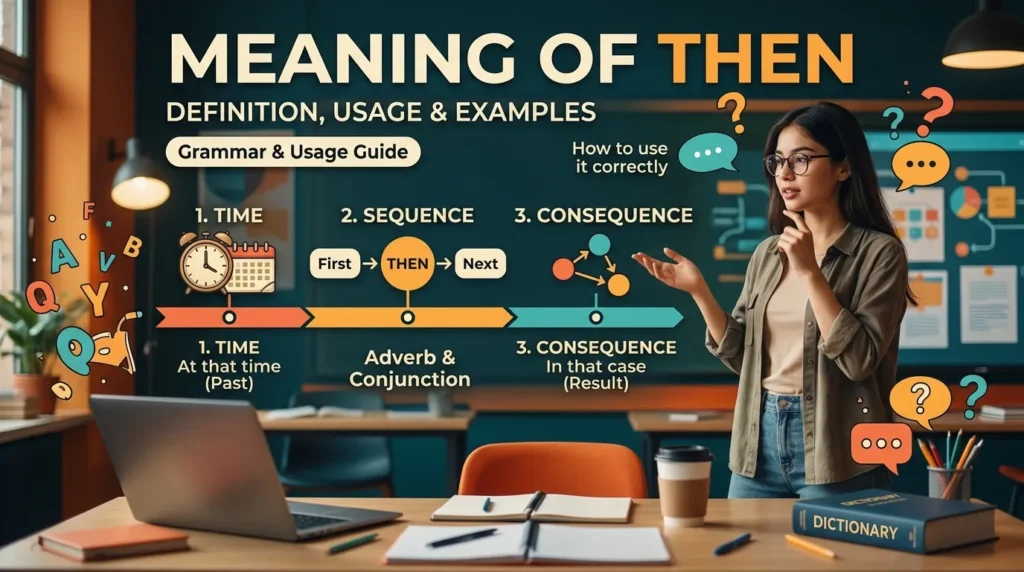
Then usually refers to time, sequence, or consequence.
It can mean:
- at that time
- next
- afterward
- in that case
- as a result of a condition
For example:
I lived in Chicago then.
Here, then refers to a particular time in the past.
In this sentence:
We finished dinner and then went for a walk.
Then means “after that.”
It can also appear in conditional sentences:
If you finish your work, then you can leave.
Here, then introduces the result of the condition.
Definition of Then
Then is primarily an adverb that refers to a particular time, sequence, or consequence. It can also function as a noun in expressions such as since then and as an adjective when describing a former position or status, as in the then president.
In practical English, you will most often see then used to show when something happened or what happens next.
Meaning of Than
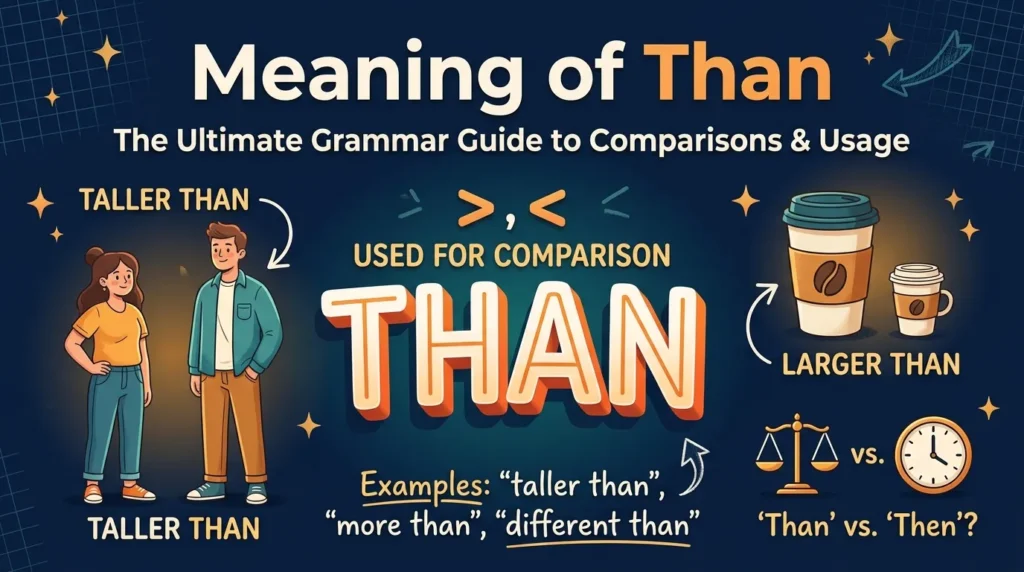
Than is used to introduce a comparison.
It connects two people, things, actions, qualities, amounts, or ideas being compared.
For example:
My car is faster than yours.
The sentence compares the speed of two cars.
You can also use than when comparing amounts:
The project took less than a week.
Or preferences:
I would rather walk than take the bus.
Definition of Than
Than is a grammatical word used primarily to introduce the second element of a comparison. It commonly appears after comparative words such as more, less, better, worse, taller, smaller, faster, and easier. It can function as a conjunction or, in some constructions, as a preposition.
For example:
This book is more interesting than the other one.
The word than connects the two sides of the comparison.
Main Difference
The central difference is time versus comparison.
| Then | Than |
| Relates to time or sequence | Relates to comparison |
| Can mean “at that time” | Introduces a comparison |
| Can mean “next” or “after that” | Often follows a comparative word |
| Can show a result in an if-then construction | Can express differences in degree or amount |
| Example: We ate, then we left. | Example: We left earlier than expected. |
Consider these two sentences:
She finished the report and then called her manager.
There is no comparison. The sentence describes the order of two events.
She finished the report faster than I did.
Here, two performances are being compared, so than is required.
This distinction remains consistent in standard modern English.
Improve your vocabulary by practicing Descriptive Expressions About Wealth for everyday conversations, creative writing, and academic assignments.
Which One Is Correct?
Both then and than are correct words. Neither is a misspelling of the other.
The correct choice depends on what you mean.
Use then when you mean:
- at that time
- next
- afterward
- in that case
- as the result of a condition
Use than when you are making a comparison.
For example:
- Correct: She is older than her sister.
- Correct: She finished dinner and then went to bed.
- Correct: If you’re ready, then we can begin.
- Correct: This test was easier than the previous one.
A common mistake is assuming that one of the two words is always correct and the other is always wrong. In reality, both are standard English words, but they cannot normally replace each other because their grammatical functions differ.
Grammar and Usage
How Then Functions
Then is most commonly an adverb.
It can modify a verb or describe the timing or sequence of an action.
We arrived at noon and then checked into the hotel.
It can also refer to a particular period:
I was working at a bank then.
Another important use appears in conditional structures:
If you need help, then call me.
In this construction, then signals the consequence of the condition.
You can also use then to describe a former position or status:
The then CEO announced the changes.
Here, then means the person who held the position at that time.
How Than Functions
Than is used when comparing two or more elements.
It commonly follows comparative adjectives and adverbs:
- taller than
- faster than
- cheaper than
- more useful than
- less expensive than
- more carefully than
Examples:
This route is shorter than the other one.
She speaks more clearly than I do.
Than also appears in common expressions involving preference:
I’d rather stay home than go out.
Another fixed expression is other than, which generally means “except for” or “besides”:
Everyone attended other than Mark.
These uses are not about time, so then would be incorrect.
If-Then Sentences
One especially useful pattern is if…then.
If it rains, then we will stay inside.
If you finish early, then you can leave.
In these sentences, then introduces the consequence.
Do not write:
If it rains, than we will stay inside.
That is incorrect because the sentence does not contain a comparison.
How to Use Then
Use then when you are describing time, order, or a consequence.
To Mean “At That Time”
I was living in Boston then.
Things were different then.
We didn’t have smartphones back then.
To Mean “Next” or “After That”
First, wash the vegetables, then cut them into small pieces.
She opened the email and then replied.
We went to the museum and then had lunch.
To Show a Result
If you don’t want the job, then don’t accept it.
If everyone agrees, then we can move forward.
In “Since Then”
Since then refers to a period beginning at a particular point in the past and continuing until another time.
I moved here in 2020 and have worked here ever since then.
In “Back Then”
Back then means “at that time in the past.”
Back then, people communicated differently.
This is a very common expression in everyday English.
How to Use Than
Use than when one thing is being compared with another.
With Comparative Adjectives
My new phone is better than my old one.
This box is heavier than that one.
Maria is taller than her brother.
With Comparative Adverbs
He runs faster than I do.
She completed the task more quickly than expected.
With Amounts
The meeting lasted less than an hour.
More than 100 students attended the event.
With Preferences
I would rather read than watch television.
She prefers walking than driving.
In standard usage, however, prefer X to Y is often more natural than prefer X than Y:
She prefers walking to driving.
With “Rather Than”
The expression rather than is standard.
I’d rather call than send an email.
He chose to walk rather than wait.
The word is than, not then, because the phrase expresses a comparison or preference.
Examples
Examples of Then
- We finished the meeting and then went to lunch.
- I lived in New York then.
- First, add the flour, then mix the ingredients.
- She called me and then sent an email.
- Back then, I didn’t know much about computers.
- If you agree, then we can start.
- He was the then manager of the company.
- I haven’t spoken to her since then.
- We can discuss the problem then.
- Finish this section first, and then check your answers.
Examples of Than
- This book is more useful than the other one.
- My car is older than yours.
- The second test was easier than the first.
- She arrived earlier than expected.
- This restaurant is less expensive than that one.
- He works faster than I do.
- More than 50 people attended the event.
- I’d rather stay home than go out tonight.
- The new system is more efficient than the old one.
- The journey took longer than we expected.
Common Mistakes
Mistake 1: Using “Then” After a Comparative
Incorrect:
My new phone is better then my old one.
Correct:
My new phone is better than my old one.
Why does the mistake happen? The words look and sound similar, especially when someone is writing quickly. But better establishes a comparison, so than is required.
Mistake 2: Using “Than” for Sequence
Incorrect:
We ate dinner, than we watched a movie.
Correct:
We ate dinner, then we watched a movie.
The sentence describes what happened next. There is no comparison, so then is correct.
Mistake 3: Writing “Rather Then”
Incorrect:
I’d rather walk then take the bus.
Correct:
I’d rather walk than take the bus.
The standard expression is rather than.
Mistake 4: Writing “If…Than”
Incorrect:
If you’re finished, than you can leave.
Correct:
If you’re finished, then you can leave.
This is an if-then construction. The sentence expresses a condition and its result, not a comparison.
Mistake 5: Writing “Back Than”
Incorrect:
Back than, we didn’t have smartphones.
Correct:
Back then, we didn’t have smartphones.
Back then refers to a past period, so it needs then.
Mistake 6: Writing “More Then”
Incorrect:
The company has more then 500 employees.
Correct:
The company has more than 500 employees.
The phrase more than expresses a comparison involving quantity.
Linguistic Insight
The confusion between then and than is understandable because the words have a close historical relationship. Their forms developed from related Old English words, and their functions became more clearly separated over the course of English language history. Modern English now uses the two spellings for different grammatical purposes.
Their pronunciation can also contribute to confusion. Then is commonly pronounced with a vowel similar to the one in pen, while than has a vowel closer to the one in man. In normal speech, however, unstressed vowels can become less distinct, which can make the words harder to distinguish by sound alone.
There is also an important grammatical difference. Then is primarily associated with adverbial meanings involving time, sequence, or consequence. Than, on the other hand, introduces the second part of a comparison.
That is why changing one word can change the entire relationship between ideas:
We finished the work and then left.
This tells us the order of events.
We finished the work faster than expected.
This compares the actual speed with an expectation.
Understanding the function of the word is therefore more reliable than trying to remember its spelling in isolation.
Usage Tips
The easiest memory trick is:
Then = time.
Than = comparison.
You can also use a substitution test.
If then could be replaced with next, after that, or at that time, you probably need then.
We ate dinner and then left.
Try:
We ate dinner and after that left.
The meaning still works.
For than, ask yourself whether the sentence compares two things.
This bag is heavier than that one.
You are comparing the weight of two bags, so than is correct.
Another useful memory aid is to associate the a in than with comparison. This is only a memory trick, not a grammatical rule, but it can help you recall the correct spelling.
Pay particular attention to these common combinations:
Then
- and then
- back then
- since then
- until then
- first…then
- if…then
Than
- more than
- less than
- better than
- worse than
- rather than
- taller than
- faster than
- other than
Expert Suggestion
When proofreading, don’t try to memorize every sentence containing then and than. Instead, identify what the word is doing.
Ask one question:
Am I talking about time or sequence, or am I making a comparison?
If you are talking about time, order, or a result, choose then. If you are comparing people, things, actions, qualities, or amounts, choose than.
For professional and academic writing, this simple check is especially useful in sentences containing more, less, better, worse, rather, faster, easier, taller, and similar comparative words.
Summary
Then and than are both correct English words, but they serve different purposes.
Then relates mainly to time, sequence, order, or consequence. It can mean “at that time,” “next,” or “after that,” and it commonly appears in if-then constructions.
Than is used for comparisons. It commonly follows words such as more, less, better, worse, faster, taller, and easier.
Remember the simplest rule: then = time or sequence; than = comparison.
For example, “We ate and then left” describes a sequence, while “She is taller than me” makes a comparison.
Frequently Asked Questions
Is “then” correct?
Yes. Then is a standard English word used mainly for time, sequence, order, and consequence. For example, “We finished the meeting and then went home.” It can also appear in expressions such as back then, since then, and if-then.
Is “than” correct?
Yes. Than is a standard English word used primarily to introduce comparisons. For example, “This car is faster than mine.” It also appears in expressions such as more than, less than, rather than, and other than.
What is the difference between then and than?
Then is mainly related to time, sequence, or consequence, while than is used for comparison. Use “then” in “We ate, then left.” Use “than” in “She is taller than her sister.”
Is it “better then” or “better than”?
The correct phrase is better than. The word better is comparative, so it requires than when introducing the thing being compared. For example, “This version is better than the previous one.”
Is it “rather then” or “rather than”?
The correct expression is rather than. For example, “I’d rather walk than drive.” Than is used because the sentence compares or contrasts two choices.
Is it “more then” or “more than”?
The correct phrase is more than when expressing a comparison or amount. For example, “More than 100 people attended the event.” Then would be incorrect in this context.
Is it “if then” or “if than”?
The correct conditional construction is if…then. For example, “If you finish your work, then you can leave.” Then introduces the result of the condition.
Is it “back then” or “back than”?
The correct expression is back then. It refers to a particular time in the past. For example, “Back then, we didn’t have smartphones.”
How can I remember then vs. than?
Remember then = time and than = comparison. You can also test then by replacing it with “after that” or “at that time.” If that substitution works, then is probably correct.
Is “different than” correct?
Different than is accepted in American English, although different from is widely used and often preferred in careful formal writing. Usage varies by region and style, so the choice can depend on the variety of English and context.
Can then mean “in that case”?
Yes. Then can introduce a consequence or result, especially in conditional reasoning. For example, “If you don’t need the ticket, then give it to someone else.” Here, then means roughly “in that case.”
Can than be used without a comparison word?
Yes. Although than frequently follows comparative words such as more or better, it can occur in other comparative constructions. For example, “I would rather stay home than go out.” It is also used in expressions such as other than.
Are then and than pronounced the same?
Not in careful standard pronunciation. Then generally has a vowel like the one in pen, while than has a vowel like the one in man. However, their pronunciation can sound similar in rapid or unstressed speech, which contributes to the confusion.
Which word should I use in formal writing?
Use then when you mean time, sequence, or consequence, and use than when making a comparison. In formal writing, the most important point is to match the word to its grammatical function rather than its sound.

