
Have you ever paused while writing an email, completing an assignment, or sending a text because you were unsure whether to use their or there? These two words sound alike, but they have different meanings and grammatical functions. Choosing the wrong one can change your sentence or create a spelling mistake. The confusion becomes even greater when you add they’re, which sounds the same but means something different. This guide explains the meanings, definitions, grammar rules, and practical uses of their vs there, with clear examples to help you choose the correct word confidently.
Quick Answer
Their shows possession or a relationship, while there refers to a place or introduces the existence of something. Both are correct English words, but you use them in different contexts.
| Word | Correct? | Meaning | Example |
| Their | Yes | Belonging to or associated with them | Their house is beautiful. |
| There | Yes | In or at a place, or used to show existence | The house is over there. |
| They’re | Yes | Short for “they are” | They’re waiting outside. |
The simplest way to remember the difference is:
- Their = possession: Their dog is friendly.
- There = place or existence: The dog is over there. There is a dog outside.
- They’re = they are: They’re walking the dog.
The keyword focuses on their and there, but understanding they’re is helpful because all three words are commonly confused.
Meaning and Definition
Meaning of Their
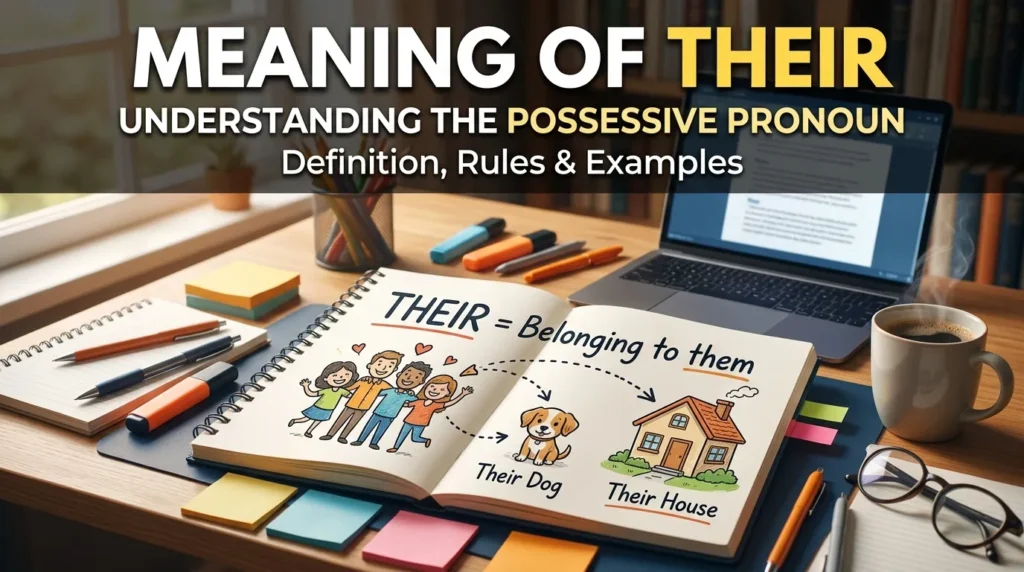
Their means belonging to, associated with, or connected to people or things referred to as they. It usually appears before a noun to show possession or a relationship.
For example, in the sentence “The students submitted their assignments,” the word their connects the assignments to the students.
You can use their when talking about:
- Something owned by a group of people.
- A quality, opinion, or decision associated with someone.
- Something connected to an organization, animal, or group.
- One person whose gender is unknown, unspecified, or expressed using they/them pronouns.
Examples:
- The children packed their lunches.
- The employees shared their ideas.
- Someone forgot their umbrella.
- Alex said their presentation was ready.
Notice that their does not always indicate legal ownership. It can also show a connection or association.
Definition of Their
Their is a possessive determiner used before a noun to indicate that something belongs or relates to the people or entities represented by they.
For example, in “Their decision surprised everyone,” the word their identifies whose decision is being discussed.
In traditional grammar, their is often called a possessive adjective. Modern grammar generally uses the term possessive determiner because the word determines which person or thing the following noun relates to.
Examples:
- Their office is on the second floor.
- We appreciated their support.
- The birds returned to their nests.
In each sentence, their helps identify a relationship between the noun and the people or things being discussed.
Meaning of There

There commonly refers to a place, position, or location. It can also introduce a sentence that tells readers something exists or happens.
When used to indicate a location, there often contrasts with here.
For example, “Please put the bag there” tells someone where to place the bag.
When used to introduce existence, there appears in sentences such as “There is a problem with the printer.” In this sentence, it does not point to a physical location. Instead, it introduces the fact that a problem exists.
Examples:
- We visited the museum and stayed there for hours.
- Your keys are over there.
- There is a meeting this afternoon.
- There are several ways to solve this problem.
These different uses make there more versatile than a simple location word.
Definition of There
There is an English word that functions as an adverb, an introductory pronoun, and in other grammatical roles, depending on the sentence.
As an adverb, it means in, at, or to a particular place or position.
Example: “She left her bag there.”
As an introductory pronoun, it introduces an existential construction, which states that something exists or occurs.
Example: “There are three messages in your inbox.”
In the second example, there introduces the existence of three messages. The noun phrase three messages identifies what exists.
The exact function of there depends on how the word is used in context.
Explore similes that describe devotion to express loyalty, commitment, and dedication more vividly in English.
Main Difference
The main difference between their and there is possession versus place or existence. Their spelling is similar, and they sound the same in ordinary English pronunciation, but they perform different jobs in a sentence. Cambridge Dictionary’s grammar guide explains these distinctions in its usage guidance.
| Feature | Their | There |
| Main meaning | Belonging to or associated with them | In a place or indicating existence |
| Part of speech | Possessive determiner | Adverb, introductory pronoun, and other uses |
| Typical pattern | Their + noun | There + verb, or verb + there |
| Location reference | No, not by itself | Yes, in its location sense |
| Example | Their teacher is helpful. | Their teacher is there. |
| Common question | Whose? | Where? or What exists? |
Consider these sentences:
- Their books are on the desk. The word their tells you whose books they are.
- The books are over there. The word there tells you where the books are.
- There are books on the desk. The word there introduces the existence of books.
The words may appear in the same sentence, but you cannot substitute one for the other without changing the meaning or making the sentence incorrect.
Which One Is Correct?
Both their and there are correct standard English words. The right choice depends on what you want to communicate.
Use their when you need a possessive determiner.
- Correct: Their manager approved the request.
- Incorrect: There manager approved the request.
Use there when referring to a place or introducing something that exists.
- Correct: Your manager is waiting there.
- Incorrect: Your manager is waiting their.
Remember that they’re is also correct, but it is a contraction of they are.
- Correct: They’re waiting for the manager.
- Incorrect: Their waiting for the manager.
The second sentence would require a different construction if you intended to describe possession. These words are not alternative spellings of one another, and neither American nor British English changes the basic distinction.
Grammar and Usage
Understanding how each word functions makes the difference easier to remember.
How Their Works in a Sentence
Their usually comes directly before a noun or a noun phrase.
Common patterns include:
- Their + noun: Their house is spacious.
- Their + adjective + noun: Their new project looks promising.
- Their + gerund phrase: Their arriving early surprised us.
The word can refer to more than one person or thing.
Example: The players celebrated their victory.
It can also refer to a single person when that person’s gender is unknown or irrelevant, or when the person uses they/them pronouns.
Example: Every applicant should bring their identification.
This singular use of their is established in modern English and is accepted by major dictionaries and contemporary style guides. The MLA Style Center discusses both plural and singular uses of the word.
How There Works in a Sentence
There has several grammatical uses, but two are especially important.
1. There as an adverb of place
Use it to identify a location or destination.
Examples:
- Leave the package there.
- We traveled there last summer.
- The restaurant is right there.
2. There in sentences about existence
Use introductory there with a form of the verb be to say that something exists, is available, or occurs.
Examples:
- There is a letter for you.
- There are two seats available.
- There was a power outage last night.
- There will be another opportunity.
The verb usually agrees with the noun phrase that follows it in standard writing. For example, use there is a book but there are several books.
Clarify confusing age descriptions by studying how to write ages correctly in English across different sentence structures.
How to Use Their and There
Choose the word based on the role it plays in your sentence, rather than how it sounds.
Use Their to Show Possession or Association
Use their when you want to connect a person, group, or entity with a noun.
For example:
- The students completed their homework.
- The company announced their new policy.
- The neighbors painted their front door.
- The team discussed their strategy.
In the company example, their refers to the company. Singular organizations are often referred to as it in formal American English, so “The company announced its new policy” may be preferable when treating the company as a single entity. The appropriate choice can depend on the intended meaning and style.
Use There to Refer to a Place
Use there when you are pointing to or describing a location.
For example:
- Put your shoes there.
- We waited there until the store opened.
- The nearest bus stop is over there.
- I left my notebook there yesterday.
A helpful test is to replace there with here. If the sentence still makes sense with the location changed, there may be the word you need.
For example, “Leave the box there” becomes “Leave the box here.” Both sentences are grammatical, although they describe different locations.
Use There to Introduce Something That Exists
You can also use there to introduce people, objects, events, or situations.
Examples:
- There is a mistake in this report.
- There are many opportunities to learn.
- There was a delay at the airport.
- There seems to be a misunderstanding.
In these sentences, there does not indicate where something is. It introduces the existence of the situation being described.
Examples
Examples of Their
Here are natural examples of their in different contexts.
- The students submitted their assignments before the deadline.
- My friends invited me to their wedding.
- The employees discussed their concerns with the manager.
- The children forgot their jackets at school.
- The writers revised their articles before publication.
- Each customer received their confirmation email.
- The neighbors planted flowers in their garden.
- The researchers published their findings in a journal.
- The athletes celebrated their team’s victory.
- Jordan said their appointment had been rescheduled.
In each example, their identifies a relationship between the noun and the person or group being discussed.
Examples of There
These examples show the different uses of there.
- Your phone is over there on the table.
- We went there to meet our friends.
- There is a new restaurant near my office.
- There are five questions on the test.
- There was a loud noise outside.
- Is there enough time to finish the assignment?
- There will be a meeting on Friday.
- The children played there until sunset.
- There seems to be a problem with the website.
- There are several reasons to review the document.
Notice that some sentences use there for location, while others use it to introduce existence.
Examples Using Their, There, and They’re Together
Because these three words sound alike, comparing them in one sentence can help you recognize their functions.
- They’re leaving their bags over there.
- Their teacher said they’re ready to go there.
- They’re taking their seats over there.
- Their parents know they’re waiting there.
- They’re bringing their books there tomorrow.
In the first sentence, they’re means they are, their shows possession, and there identifies a place.
Common Mistakes
Mistake 1: Using There Instead of Their
Incorrect: There children are playing outside.
Correct: Their children are playing outside.
Why it happens: Both words sound alike, so a writer may choose the wrong spelling when typing quickly.
How to avoid it: Ask yourself, “Whose children?” If the answer is a particular person or group, use their.
Mistake 2: Using Their Instead of There
Incorrect: Please put the files over their.
Correct: Please put the files over there.
Why it happens: The writer knows the word refers to a location but chooses the wrong homophone.
How to avoid it: If the sentence tells someone where to put something, there is generally the correct choice.
Mistake 3: Writing Their Is Instead of There Is
Incorrect: Their is a problem with my computer.
Correct: There is a problem with my computer.
Why it happens: Writers may mistakenly treat their as a general introductory word.
How to avoid it: Use the standard existence construction there is for a singular noun phrase and there are for a plural noun phrase.
Mistake 4: Confusing Their With They’re
Incorrect: Their going to arrive soon.
Correct: They’re going to arrive soon.
Why it happens: The writer intends to say they are but chooses the possessive form.
How to avoid it: Expand they’re to they are. If the expanded sentence makes sense, they’re is the correct choice.
Mistake 5: Using They’re to Show Possession
Incorrect: They’re house is near the park.
Correct: Their house is near the park.
Why it happens: The writer confuses the contraction with the possessive determiner.
How to avoid it: Remember that they’re always means they are. It never means “belonging to them.”
Mistake 6: Assuming Their Can Only Refer to Multiple People
Incorrect: Everyone must submit his or her application, because singular their is always wrong.
Better: Everyone must submit their application.
Why it happens: Some older grammar guidance discouraged singular their.
How to avoid it: Recognize that singular their is accepted in contemporary English when referring to an individual of unknown or unspecified gender, or someone who uses they/them pronouns.
Linguistic Insight
Why Their and There Sound the Same
Their and there are homophones, meaning they have the same pronunciation but different spellings and meanings. In most standard English accents, they’re shares this pronunciation as well.
Because speech does not distinguish these spellings, listeners generally understand the intended meaning through context. In writing, however, readers depend on spelling and sentence structure to understand the message.
This is why a sentence such as “Their waiting outside” can create confusion. The writer might intend “They’re waiting outside,” but the spelling changes the grammatical function.
The Historical Development of Their
The word their developed from forms associated with Old Norse, which influenced English during the Viking Age. It gradually replaced earlier English possessive forms in many contexts.
The modern word expresses possession and association, and its use has expanded to include singular antecedents such as someone, everyone, and each person.
This historical development helps explain why English has a possessive form that works with both plural references and certain singular references.
Why There Has More Than One Function
The word there has developed several related uses in English. Its location meaning appears in sentences such as “Put it there,” while its introductory function appears in “There is a solution.”
Linguists describe the second use as existential there, because it introduces a statement about the existence of something.
The two uses have different grammatical roles, even though they share the same spelling. Understanding this distinction helps explain why there is not always a location word.
Why Singular Their Is Accepted
English speakers often need a way to refer to one person without specifying gender. Singular their provides a natural option.
For example:
“Someone left their notebook in the classroom.”
The word someone refers to one person, while their refers back to that person. This construction is widely accepted in contemporary English and avoids unnecessary assumptions about gender.
Usage Tips
Use these practical memory aids whenever you are unsure which word to write.
- Their contains “heir.” An heir is someone who may inherit something, so this spelling can remind you of possession.
- There contains “here.” Both words can refer to a place, making this a useful location clue.
- They’re contains an apostrophe. The apostrophe marks the contraction of they are.
- Ask “whose?” If the sentence answers this question, their may be correct.
- Ask “where?” If the sentence identifies a location, there may be correct.
- Try expanding the contraction. If they are fits the sentence, use they’re.
For example, consider “They’re leaving their coats there.”
You can check each word separately. “They are leaving” confirms they’re. “Whose coats?” identifies their. “Where are they leaving them?” points to there.
Expert Suggestion
As a grammar teacher, I recommend checking the meaning and grammatical function of each word instead of relying on pronunciation.
When editing an email, essay, article, or professional document, search for their, there, and they’re and review each occurrence in context. Spellcheckers may not catch these mistakes because all three spellings are legitimate English words.
If you write frequently, practice using all three words in one sentence. This simple exercise helps you distinguish possession, location or existence, and the contraction of they are.
Most importantly, do not assume that a word is wrong simply because it looks unfamiliar in a particular sentence. Check its function and meaning before making a correction.
Summary
Their and there are both correct English words, but they serve different purposes. Use their to show possession or association, as in “Their car is new.” Use there to refer to a location or introduce existence, as in “The car is over there” or “There is a car outside.”
Remember that they’re means they are. Although these three words sound the same, their meanings and grammatical roles are different. You can avoid most mistakes by asking whether the sentence describes possession, identifies a place, introduces something that exists, or uses the contraction they are.
With practice, you will be able to choose the correct word naturally in everyday conversation, academic writing, emails, and professional communication.
Frequently Asked Questions
What is the difference between their and there?
Their shows possession or association, while there refers to a place or introduces the existence of something. For example, “Their house is large” identifies whose house it is, while “The house is over there” identifies its location.
Is their or there correct?
Both are correct standard English words. Use their when referring to something that belongs or relates to someone, and use there when referring to a place or stating that something exists. The correct choice depends on the sentence’s meaning.
How do you remember their vs there?
Remember that their contains the word heir, which can remind you of ownership. There contains here, which can remind you of location. You can also ask “Whose?” for their and “Where?” for the location meaning of there.
Is it their house or there house?
The correct phrase is their house when you mean a house belonging to or associated with someone. Their appears before the noun house to show the relationship. “There house” is incorrect in standard English when possession is intended.
Is it their is or there is?
The correct expression is there is when introducing the existence of a singular noun phrase. For example, “There is a message for you.” Their is a possessive determiner and cannot replace there in this construction.
What does their mean in a sentence?
Their identifies something belonging or relating to the people or entities represented by they. In “The students brought their books,” the word indicates that the books belong to or are associated with the students.
What does there mean in a sentence?
There can indicate a location, as in “Wait there,” or introduce existence, as in “There are two tickets left.” Its precise grammatical function depends on the sentence in which it appears.
Can their refer to one person?
Yes. Singular their is widely accepted in contemporary English when referring to someone whose gender is unknown or unspecified, or a person who uses they/them pronouns. For example, “Someone left their phone on the table” is correct.
What is the difference between their and they’re?
Their shows possession or association, while they’re is the contraction of they are. For example, “Their friends are here” shows association, while “They’re here” means “They are here.” The apostrophe in they’re marks the contraction.
Are their and there pronounced the same way?
Yes. In most standard English accents, their and there are homophones, meaning they have the same pronunciation but different spellings and meanings. Context usually helps listeners understand the intended meaning in spoken English.
Is their or there used in American and British English?
Both American and British English use their for possession and there for location or existence. The basic distinction is the same in both varieties, so you do not need to change the spelling based on your audience’s location.
Can you use their and there in the same sentence?
Yes. For example, “Their bags are over there.” In this sentence, their shows whose bags they are, while there identifies where the bags are. Each word has a different grammatical function.
Why do people confuse their and there?
People confuse these words because they sound alike but have different meanings and spellings. When writing quickly, someone may select the wrong word without noticing. Reviewing the sentence’s meaning and grammatical function helps prevent this mistake.


1 thought on “Their vs There: Meaning, Difference & Examples”