
You are writing a professional email and want to refer to a question, request, or business matter. Should you write “in regard to” or “in regards to”? Both expressions appear in everyday communication, which makes the choice confusing. Although the two forms are widely understood, traditional grammar and many professional style guides prefer “in regard to” without the final s. Understanding the difference will help you choose the most appropriate expression for emails, academic assignments, business documents, and formal writing.
Quick Answer
“In regard to” is the traditional standard form preferred in formal and professional writing. “In regards to” is also widely used, particularly in conversational English, but it is often considered nonstandard or less appropriate in edited writing.
| Phrase | Correct? | Meaning | Recommended Use |
| In regard to | Yes | Concerning or about | Formal and informal writing |
| In regards to | Commonly used, but often considered nonstandard | Concerning or about | Best avoided in formal writing |
| With regard to | Yes | Concerning or relating to | Professional and formal communication |
| With regards to | Commonly used, but often considered nonstandard | Concerning or relating to | Use “with regard to” instead |
| As regards | Yes | Concerning or about | Formal writing and speech |
| Regarding | Yes | About or concerning | Clear, concise writing |
For example:
- Preferred: In regard to your application, we need additional information.
- Less preferred: In regards to your application, we need additional information.
- Concise alternative: Regarding your application, we need additional information.
The main distinction is the grammatical form, not the meaning. In this expression, use the singular noun regard before “to.” However, “as regards” is a legitimate alternative that follows a different grammatical pattern.
If you are unsure which word conveys progress, explore the proper usage of “accel” in English and its connection to acceleration.
Meaning and Definition
Meaning of In Regard To
“In regard to” means about, concerning, with respect to, or in connection with. It introduces a subject that someone wants to discuss, explain, or address.
People commonly use it when referring to a specific matter, such as a job application, customer complaint, business proposal, academic question, or personal concern.
For example:
- In regard to your question, I have prepared a detailed explanation.
- We received your message in regard to the upcoming meeting.
- In regard to the new policy, all employees must follow the updated procedures.
In each sentence, the expression identifies the subject being discussed.
Definition of In Regard To
In regard to is a fixed prepositional expression that means concerning a particular subject or matter. It introduces a noun, pronoun, noun phrase, or noun clause that identifies the topic under consideration.
For example, in “In regard to the budget, we need more information,” the expression introduces “the budget” as the topic of discussion.
The phrase does not describe an action by itself. Instead, it establishes a relationship between the rest of the sentence and the subject being addressed.
Meaning of In Regards To
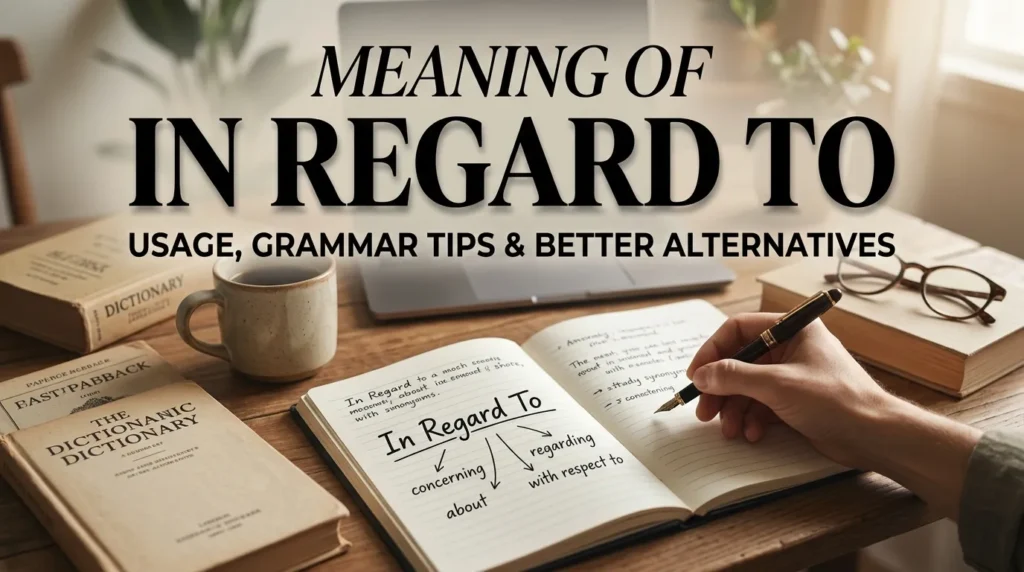
“In regards to” is a commonly used variant of “in regard to.” In everyday speech and informal writing, people frequently use it to mean about or concerning something.
For example:
- In regards to your question, I will respond tomorrow.
- She contacted the office in regards to her appointment.
These sentences are understandable, but many editors and grammar guides recommend removing the final s from “regards” in this construction. For formal writing, use “in regard to” or the simpler word “regarding.”
Definition of In Regards To
“In regards to” is a variant expression used to introduce a subject or matter under discussion. However, it is often classified as nonstandard in traditional edited English because the conventional expression uses the singular noun “regard.”
The plural form “regards” is correct in other constructions, including “send my regards” and “as regards the proposal.” Its acceptability in those expressions does not automatically make “in regards to” the preferred form in formal writing.
The important point is that a phrase can be common and understandable without being the best choice for every writing context.
Main Difference
The main difference between “in regard to” and “in regards to” is their acceptance in standard edited English. Both expressions are used to introduce a topic, but the singular form is the established choice in formal writing.
| Feature | In Regard To | In Regards To |
| Meaning | About or concerning | About or concerning |
| Grammatical pattern | Conventional standard expression | Nonstandard or disputed variant |
| Meaning difference | None in ordinary use | None in ordinary use |
| Formal writing | Recommended | Generally avoided |
| Informal conversation | Appropriate | Commonly heard |
| Professional emails | Recommended | Better replaced |
| Concise alternative | Regarding | Regarding |
The two phrases do not normally communicate different meanings. The issue is whether the plural noun “regards” fits the established expression.
Consider these examples:
- Preferred: The manager contacted us in regard to the revised schedule.
- Less preferred: The manager contacted us in regards to the revised schedule.
Both communicate the same message, but the first is the safer choice when writing for a professional audience.
It is also important to distinguish “in regard to” from “as regards.” The latter is a legitimate expression in which “regards” functions as a verb. This is why the final s is acceptable in “as regards the proposal,” but not traditionally accepted in “in regards to the proposal.”
Which One Is Correct?
Use “in regard to” when you want the safest standard form, especially in formal or edited writing. The expression “in regards to” is widespread in everyday English, but it remains nonstandard or disfavored in many style guides.
Here is how to choose:
- Academic writing: Prefer “in regard to,” “regarding,” or “concerning.”
- Business emails: Use “in regard to” or “regarding.”
- Formal letters: Use “in regard to” or “with regard to.”
- Casual conversation: You may hear “in regards to,” and listeners will generally understand it.
- Concise writing: Prefer “about” or “regarding” when either expresses your meaning accurately.
The distinction is a matter of usage and editorial convention rather than a difference in meaning. The fact that a phrase appears frequently in speech does not mean every editor will accept it in formal prose. At the same time, widespread use explains why “in regards to” remains familiar to many English speakers.
Grammar and Usage
Part of Speech
“In regard to” functions as a multiword preposition, also called a complex preposition. It consists of several words that work together to establish a relationship between the sentence and a topic.
For example:
- In regard to the contract, we need legal advice.
- She asked several questions with regard to the new policy.
The expressions “in regard to” and “with regard to” have the same general meaning and can often be used interchangeably.
Sentence Structure
These expressions are commonly followed by a noun, pronoun, noun phrase, or noun clause.
Common patterns include:
- In regard to + noun: In regard to the budget, we need further discussion.
- In regard to + noun phrase: In regard to your recent application, we have an update.
- In regard to + noun clause: In regard to what you mentioned yesterday, I agree with your suggestion.
The expression introduces the topic being discussed. The rest of the sentence provides information about that topic.
In Regard To vs. With Regard To
Both expressions are correct and usually mean the same thing.
- In regard to your question, I have a suggestion.
- With regard to your question, I have a suggestion.
The choice between “in” and “with” is generally stylistic. Neither phrase requires the plural “regards” in traditional standard usage.
In Regard To vs. Regarding
“Regarding” is a shorter and often more natural alternative to “in regard to.”
Compare the following:
- Wordier: In regard to your request, we will respond shortly.
- Concise: Regarding your request, we will respond shortly.
- More conversational: About your request, we will respond shortly.
All three can communicate the same basic idea, although “about” may sound more natural in everyday conversation.
American and British English
The preferred form “in regard to” is suitable in both American and British English. The variant “in regards to” is also encountered in different English-speaking communities, but it is often discouraged in formal writing regardless of the variety of English.
There is no reliable general rule that makes “in regards to” exclusively American or British. For consistent professional writing, use “in regard to,” “with regard to,” or “regarding.”
How to Use In Regard To
Use “in regard to” when you need to introduce the subject of a discussion, question, request, or statement.
Use It to Introduce a Topic
The phrase can identify the particular issue you want to address.
Examples:
- In regard to the new schedule, the team has agreed on a different start time.
- In regard to your concerns, we are reviewing the available options.
- In regard to the meeting, please confirm your availability.
Use It in Professional Communication
The expression is appropriate when referring to a specific matter in business correspondence.
Examples:
- I am writing in regard to your recent inquiry.
- We have received your comments in regard to the proposed changes.
- In regard to the outstanding invoice, payment is due next Friday.
Although these sentences are grammatically acceptable, you can often make them more direct by using “about” or “regarding.”
If you want your descriptions to sound more engaging, practice using beauty-related similes in sentences for different situations.
Use It to Clarify a Previous Point
You can use the phrase to return to a subject that someone has already mentioned.
Examples:
- In regard to your earlier suggestion, I believe it deserves further consideration.
- In regard to what we discussed yesterday, I have prepared a revised plan.
- In regard to the second issue, we need additional evidence.
Avoid Adding an Unnecessary Final S
When using “in regard to,” keep “regard” singular.
Correct: In regard to your feedback, we have made several changes.
Less preferred: In regards to your feedback, we have made several changes.
This small spelling difference can make your writing more consistent with formal editorial standards.
Examples
Examples of In Regard To
The following sentences demonstrate the preferred expression in different contexts.
- In regard to your application, we will contact you within three business days.
- The manager sent an email in regard to the upcoming staff meeting.
- In regard to your question, the answer depends on the circumstances.
- We have received several complaints in regard to the quality of the service.
- In regard to the proposed changes, the committee will make a decision next week.
- The professor provided additional guidance in regard to the research project.
- I would like to speak with you in regard to my recent performance review.
- In regard to the payment, please contact our accounts department.
- The report contains important information in regard to workplace safety.
- In regard to your feedback, we have revised the final draft.
Examples of In Regards To
These examples illustrate a commonly encountered variant. They are included to show the form that writers are often advised to replace in formal editing.
- In regards to your application, we will contact you soon.
- The manager emailed the team in regards to the new schedule.
- In regards to your question, I will provide more details tomorrow.
- She called the office in regards to her appointment.
- In regards to the proposal, the committee has not reached a decision.
For formal or carefully edited writing, revise these sentences by changing “in regards to” to “in regard to,” “regarding,” or “about,” depending on the context.
Examples of With Regard To
“With regard to” is another standard expression with essentially the same meaning.
- With regard to your request, we need additional documentation.
- The company issued a statement with regard to the recent changes.
- With regard to the exam, students should review all assigned chapters.
- I have a few questions with regard to the contract.
- With regard to your concerns, we will arrange another meeting.
Examples of As Regards
“As regards” is also correct, although it can sound formal or somewhat stiff in everyday conversation.
- As regards the budget, we have already approved the necessary funds.
- As regards your application, the final decision has not been made.
- As regards customer service, the company has introduced several improvements.
- As regards the proposed policy, we need more time to evaluate its effects.
- As regards the meeting, everyone has confirmed their attendance.
Notice that “as regards” does not take the additional word “to.”
Common Mistakes
1. Adding an Unnecessary S to Regard
Incorrect or disfavored: In regards to your request, we need more information.
Correct: In regard to your request, we need more information.
The error often occurs because people confuse “in regard to” with the legitimate expression “as regards.” Remember that the standard phrase uses the singular noun “regard.”
2. Writing With Regards To Instead of With Regard To
Incorrect or disfavored: With regards to the new policy, employees must attend training.
Correct: With regard to the new policy, employees must attend training.
The same principle applies to both “in regard to” and “with regard to.” In traditional standard usage, the noun remains singular in these expressions.
3. Confusing In Regard To With As Regards
Incorrect: As regards to your complaint, we will investigate the matter.
Correct: As regards your complaint, we will investigate the matter.
Another correct alternative is:
In regard to your complaint, we will investigate the matter.
The confusion occurs because the two expressions have similar meanings but different grammatical structures. “As regards” does not include “to,” whereas “in regard to” does.
4. Using Regarding To
Incorrect: Regarding to your email, I have a question.
Correct: Regarding your email, I have a question.
“Regarding” already introduces the topic, so it does not need the additional preposition “to” in this construction.
5. Using a Wordy Expression When a Simpler One Works
Wordy: I am contacting you in regard to the delivery of your order.
Clearer: I am contacting you about your order delivery.
The longer phrase is not grammatically wrong, but simpler wording can make communication easier to follow.
Linguistic Insight
The difference between “in regard to” and “in regards to” illustrates how English expressions develop through repeated use.
The Meaning of Regard
The noun “regard” can mean attention, consideration, respect, or a particular way of viewing something. In “in regard to,” it helps form a fixed expression that directs attention to a subject.
For example:
“In regard to the proposal, we need more information.”
Here, “regard” contributes to the meaning of considering or addressing the proposal.
Why People Add the S
One reason speakers use “in regards to” is that English contains several similar expressions with different grammatical patterns.
Compare:
- In regard to the issue
- With regard to the issue
- As regards the issue
- Send my regards to your family
The final two examples show legitimate uses of “regards.” In “as regards,” the word functions as a verb. In “send my regards,” it is a plural noun referring to expressions of goodwill.
Because these expressions look and sound similar, speakers may transfer the final s from one construction to another.
How Language Usage Changes
English usage is not completely static. Expressions that were once strongly criticized can become more widespread as speakers adopt them in conversation and writing.
“In regards to” is a good example of this tension between actual usage and traditional editorial standards. Many people use the phrase naturally, yet formal editors often change it to “in regard to.”
For learners, the practical lesson is to distinguish between what people commonly say and what is preferred in a particular writing context. Understanding both helps you communicate naturally while maintaining conventional grammar in professional documents.
Usage Tips
- Remember the singular form: Write “in regard to,” not “in regards to,” when following traditional formal usage.
- Use the correct expression: “In regard to” and “with regard to” are both standard.
- Remember the exception: “As regards” is correct without “to.”
- Choose simpler alternatives: “Regarding,” “concerning,” and “about” often make sentences more concise.
- Match your audience: Formal documents benefit from conventional usage, while casual speech may reflect more widespread variants.
- Check the complete phrase: Do not judge the correctness of “regards” in isolation. Its grammatical role depends on the expression in which it appears.
A useful memory aid is this: in regard to, with regard to, but as regards.
Expert Suggestion
If you write professional emails, academic assignments, business reports, or website content, choose “in regard to” whenever you need this particular expression. Better still, consider whether “regarding” or “about” communicates your point more directly.
For example, instead of writing:
“I am writing in regard to your recent inquiry about our services.”
You can write:
“I am writing regarding your recent inquiry about our services.”
Or, for a more direct tone:
“I am writing about your recent inquiry.”
The best option is not always the longest or most formal one. Prioritize clarity, grammatical consistency, and the expectations of your audience.
Summary
“In regard to” and “in regards to” are used to communicate the same basic meaning: about, concerning, or with respect to something.
- In regard to: The traditional standard form preferred in formal and professional writing.
- In regards to: A widespread variant that is often considered nonstandard or less appropriate in edited prose.
- With regard to: A correct alternative to “in regard to.”
- As regards: A correct expression that does not take “to.”
- Regarding: A concise alternative that often makes writing clearer.
When in doubt, use “in regard to” or simply write “regarding.” Both choices help you avoid unnecessary disagreement over the plural form.
Frequently Asked Questions
Is “in regard to” correct?
Yes. “In regard to” is a standard English expression meaning about, concerning, or with respect to a subject.
Is “in regards to” grammatically correct?
“In regards to” is widely used and generally understood, but it is considered nonstandard or disfavored by many traditional grammar guides and editors. Use “in regard to” in formal writing.
What is the difference between in regard to and in regards to?
Both expressions generally mean the same thing. The difference is that “in regard to” is the conventional standard form, while “in regards to” is a disputed variant.
Should I use in regard to or in regards to in an email?
Use “in regard to” in professional emails. You can also use “regarding” or “about” for a clearer, more concise message.
Is with regard to correct?
Yes. “With regard to” is a standard expression meaning concerning or relating to something. It is often interchangeable with “in regard to.”
Is with regards to correct?
“With regards to” is commonly used, but it is often considered nonstandard in formal writing. The preferred form is “with regard to.”
Is as regards grammatically correct?
Yes. “As regards” is a legitimate expression meaning concerning or about. Unlike “in regard to,” it does not take the additional word “to.”
Can I use regarding instead of in regard to?
Yes. “Regarding” often replaces “in regard to” without changing the essential meaning. For example, “In regard to your application” can become “Regarding your application.”
Is in regard to formal or informal?
“In regard to” is suitable for both formal and informal contexts, although it can sound more formal than “about.” In professional writing, it is an accepted choice.
Is in regards to used in American English?
Yes. Speakers and writers of American English use “in regards to,” but many American style guides and editors prefer “in regard to.” The variant is not exclusive to American English.
Is in regard to the same as regarding?
In many contexts, yes. Both expressions introduce a subject under discussion. “Regarding” is usually shorter, while “in regard to” may sound more formal or deliberate.
Why do people say in regards to?
People may use “in regards to” because they encounter it frequently in speech and informal writing. The form may also be influenced by expressions such as “as regards” and “send my regards.”
Is in regard to too formal for everyday conversation?
Not necessarily, but it can sound formal or wordy. In everyday conversation, “about” is often more natural.
Should I write in regard to or regarding in academic writing?
Both are acceptable in academic writing, but “regarding” is often more concise. Follow your institution’s style requirements and choose the wording that makes your sentence clearest.
What is the easiest way to remember the correct form?
Remember this pattern: in regard to, with regard to, as regards. The first two use singular “regard” and include “to,” while the last uses “regards” without “to.”

