
Have you ever looked at a Chinese restaurant menu and wondered whether to order chow fun or mei fun? Although both are popular Chinese rice-noodle dishes, they are quite different in appearance, texture, and preparation.
The confusion is understandable because both use rice noodles and can contain similar ingredients, including chicken, beef, shrimp, eggs, and vegetables. However, the biggest difference is the shape of the noodles. Chow fun features wide, flat rice noodles, while mei fun uses thin, delicate rice vermicelli.
Understanding these differences will help you choose the right dish, recognize the noodles, and know what to expect when ordering Chinese food.
Quick Answer
Chow fun uses wide, flat rice noodles, whereas mei fun uses thin, narrow rice vermicelli. Both are popular in Chinese cuisine, but their shapes create different textures and eating experiences.
| Feature | Chow Fun | Mei Fun |
| Noodle type | Wide, flat rice noodles | Thin rice vermicelli |
| Appearance | Broad, flat ribbons | Fine, round strands |
| Main ingredient | Rice flour and water | Rice flour and water |
| Texture | Soft, slippery, and chewy | Delicate, tender, and slightly springy |
| Common preparation | Stir-fried in a wok | Stir-fried, steamed, or used in soups |
| Popular dish | Beef chow fun | Singapore mei fun |
| Typical ingredients | Beef, bean sprouts, scallions, and sauce | Shrimp, chicken, pork, eggs, and vegetables |
| Seasoning | Often savory soy-based sauces | Varies, sometimes includes curry seasoning |
The easiest way to remember the difference: Chow fun means wide, flat rice noodles, while mei fun means thin rice vermicelli.
You can learn more about Sang vs Sung and their grammatical differences to understand how these two forms of the verb sing function in different tenses.
Meaning and Definition
Meaning of Chow Fun
Chow fun is a Chinese noodle dish made with wide, flat rice noodles. It is commonly prepared by stir-frying the noodles with meat, seafood, vegetables, and savory sauces.
The noodles have a broad, ribbon-like appearance and a soft, chewy texture. They are especially popular in Cantonese cuisine.
One of the best-known versions is beef chow fun, which combines flat rice noodles with beef, bean sprouts, scallions, and seasonings.
Definition of Chow Fun
Chow fun is a Chinese dish traditionally made with wide, flat rice noodles that are stir-fried with various ingredients.
The name comes from Cantonese food terminology. The word chow is associated with stir-frying, while fun refers to rice noodles.
Chow fun is particularly associated with Cantonese cooking, including dishes originating in Guangdong and Hong Kong.
Meaning of Mei Fun
Mei fun refers to thin rice vermicelli noodles commonly used in Chinese and other Asian cuisines.
These noodles are much thinner than chow fun noodles and usually appear as fine, white strands. They are often stir-fried with vegetables, meat, seafood, eggs, and different seasonings.
A popular example is Singapore mei fun, a colorful noodle dish typically prepared with curry seasoning, shrimp, pork, eggs, and vegetables.
Definition of Mei Fun
Mei fun is a type of thin rice vermicelli made primarily from rice flour and water.
Unlike the broad noodles used in chow fun, mei fun noodles have a narrow, thread-like shape. They are commonly sold dried and need to be softened or rehydrated before cooking.
They are suitable for stir-fries, soups, and other Asian noodle preparations.
Main Difference
The main difference between chow fun and mei fun is the shape and thickness of their rice noodles.
Chow fun uses wide, flat noodles that provide a substantial, chewy bite. Mei fun uses thin, delicate strands that mix easily with vegetables, meat, and seasonings.
Here are the most important differences.
1. Noodle Shape and Appearance
Chow fun
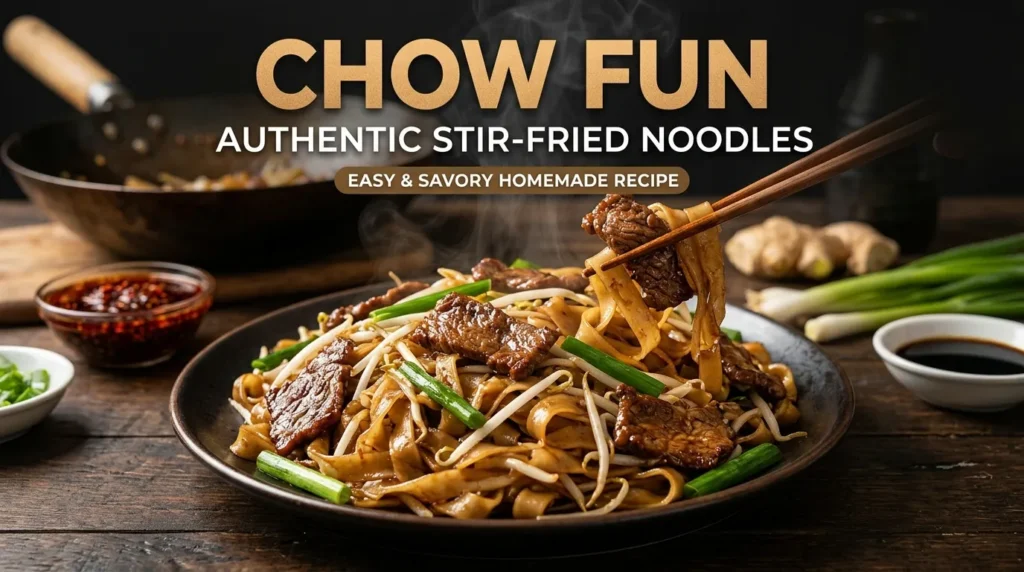
Chow fun noodles are wide, flat, and ribbon-shaped. Their broad surface makes them easy to recognize in Chinese noodle dishes.
Mei fun
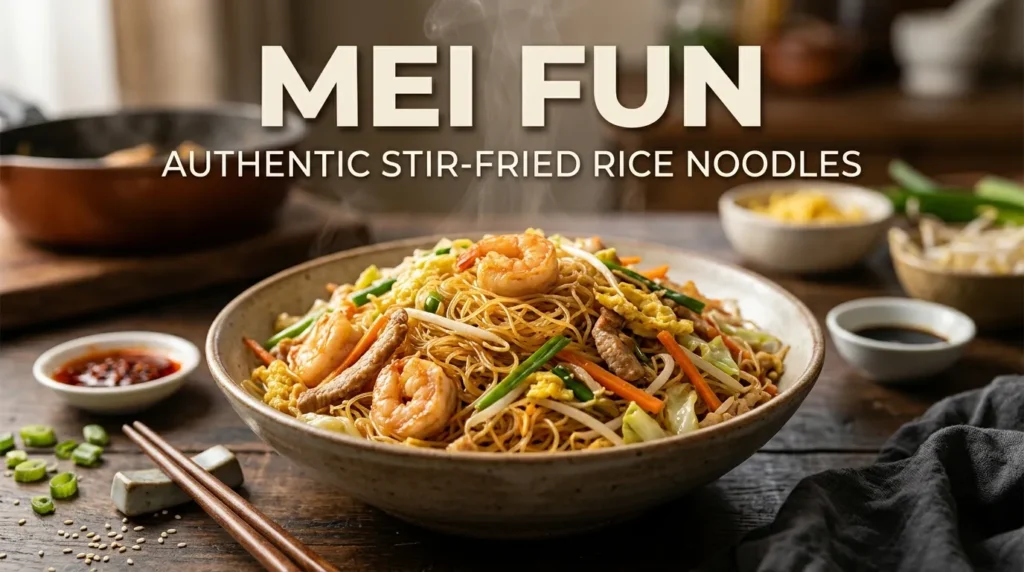
Mei fun noodles are thin, round, and thread-like. They usually resemble delicate white strands of vermicelli.
2. Texture
Chow fun noodles are generally soft, slippery, and chewy. Their thickness gives them a more substantial bite.
Mei fun noodles are thinner and more delicate. They can become tender and slightly springy when properly prepared.
3. Ingredients
Both dishes commonly use rice-based noodles, but their additional ingredients depend on the recipe.
Chow fun commonly includes:
- Beef or chicken
- Bean sprouts
- Chinese broccoli
- Scallions
- Soy sauce
- Oyster sauce
- Garlic
Mei fun commonly includes:
- Chicken, shrimp, or pork
- Eggs
- Carrots
- Cabbage
- Bean sprouts
- Scallions
- Soy sauce or curry seasoning
Neither dish has one mandatory combination of toppings.
4. Cooking Methods
Chow fun is particularly well known for high-heat wok stir-frying. Fresh noodles are often cooked quickly with meat, vegetables, and sauce.
Mei fun can also be stir-fried, but dried vermicelli usually needs soaking or rehydration before cooking.
Because mei fun noodles are thin, they require careful handling to prevent overcooking or breaking.
5. Flavor
Chow fun often has a savory flavor from ingredients such as soy sauce, oyster sauce, garlic, and meat.
Mei fun does not have one fixed flavor. Its taste depends on the seasoning and ingredients used. Some versions are mild and savory, while Singapore-style mei fun commonly has a distinctive curry flavor.
Importantly, the noodle shape does not determine the seasoning. Both dishes can be prepared with different sauces and spices.
Which One Is Correct?
Both chow fun and mei fun are correct food names. Neither is a misspelling of the other.
They refer to different types of rice-noodle preparations.
- Choose chow fun when you want wide, flat rice noodles.
- Choose mei fun when you want thin rice vermicelli.
These terms are commonly used on Chinese restaurant menus, especially in the United States.
The choice depends on the noodle texture and preparation you prefer, not on which name is more grammatically correct.
Grammar and Usage
Although chow fun and mei fun are food terms rather than ordinary English vocabulary, understanding their structure helps when using them in sentences.
Part of Speech
Both terms function primarily as compound food nouns in English.
Examples:
- We ordered beef chow fun for dinner.
- My family enjoys chicken mei fun.
- The restaurant serves several types of rice noodles.
Singular and Plural Usage
Chow fun and mei fun are generally treated as uncountable or dish names when referring to the food as a whole.
For example:
- I would like some chow fun.
- She ordered mei fun for lunch.
When referring to individual portions, you can use countable expressions:
- We ordered two plates of chow fun.
- They prepared three servings of mei fun.
Common Word Combinations
These terms frequently appear with other food-related words.
| Expression | Meaning |
| Beef chow fun | Wide rice noodles prepared with beef |
| Chicken chow fun | Wide rice noodles prepared with chicken |
| Shrimp chow fun | Wide rice noodles prepared with shrimp |
| Chicken mei fun | Thin rice vermicelli prepared with chicken |
| Shrimp mei fun | Thin rice vermicelli prepared with shrimp |
| Singapore mei fun | Thin rice vermicelli prepared in a Singapore-style curry-seasoned preparation |
How to Use Chow Fun and Mei Fun
Knowing how these food names are used in everyday situations makes it easier to order food and communicate your preferences.
How to Use Chow Fun
Use chow fun when referring to a dish featuring wide, flat rice noodles.
Common situations include:
- Ordering Chinese food at a restaurant.
- Discussing different Asian noodle dishes.
- Following a recipe for beef chow fun.
- Describing a meal containing wide rice noodles.
For example:
“I would like beef chow fun with extra bean sprouts.”
How to Use Mei Fun
Use mei fun when referring to dishes made with thin rice vermicelli.
Common situations include:
- Ordering Singapore-style noodles.
- Discussing thin rice-noodle recipes.
- Preparing a chicken vermicelli stir-fry.
- Describing a Chinese takeout dish.
For example:
“Can I have chicken mei fun with vegetables?”
Examples
The following examples demonstrate how chow fun and mei fun appear in everyday English.
Examples of Chow Fun
- I ordered beef chow fun from my favorite Chinese restaurant.
- Chow fun is made with wide, flat rice noodles.
- My brother prefers chow fun because he enjoys chewy noodles.
- We prepared chicken chow fun with fresh vegetables for dinner.
- The chef cooked the chow fun in a hot wok.
- Would you like shrimp chow fun or beef chow fun?
- The restaurant serves delicious Cantonese-style beef chow fun.
- Fresh rice noodles give chow fun its characteristic texture.
- I added extra bean sprouts to my chow fun.
- Chow fun is a popular choice for Chinese takeout.
Read more about how to make Charles possessive to learn how apostrophes help show ownership without creating unnecessary spelling confusion.
Examples of Mei Fun
- I ordered chicken mei fun for lunch.
- Mei fun is made with thin rice vermicelli.
- My mother enjoys preparing shrimp mei fun at home.
- Singapore mei fun often contains curry seasoning.
- The chef added vegetables and eggs to the mei fun.
- We bought dried mei fun noodles from an Asian grocery store.
- Mei fun is thinner than the noodles used in chow fun.
- She prefers mei fun because its strands are delicate.
- The restaurant offers chicken, shrimp, and vegetable mei fun.
- I soaked the dried mei fun before stir-frying it.
Common Mistakes
People sometimes confuse chow fun and mei fun because both dishes contain rice noodles and can have similar toppings.
Here are some common misunderstandings to avoid.
1. Thinking Both Dishes Use the Same Noodles
Incorrect assumption: Chow fun and mei fun are made with identical noodles.
Correct understanding: Chow fun uses wide, flat rice noodles, while mei fun uses thin rice vermicelli.
The confusion happens because both noodles are commonly made from rice.
2. Assuming Mei Fun Always Contains Curry
Incorrect assumption: Every mei fun dish must have curry powder.
Correct understanding: Curry seasoning is common in Singapore-style mei fun, but other mei fun preparations use different seasonings.
For example, chicken mei fun can be prepared with savory soy-based seasoning without curry.
3. Assuming Chow Fun Always Contains Beef
Incorrect assumption: Chow fun is exclusively a beef noodle dish.
Correct understanding: Beef chow fun is popular, but chow fun can also contain chicken, shrimp, pork, or vegetables.
The noodle name does not restrict the protein.
4. Confusing Chow Fun with Chow Mein
Incorrect assumption: Chow fun and chow mein are the same type of noodle dish.
Correct understanding: Chow fun generally uses wide rice noodles, whereas chow mein commonly uses wheat-based noodles.
The distinction involves the main noodle ingredient and shape, not simply the cooking method.
5. Assuming Both Dishes Have the Same Texture
Incorrect assumption: Both dishes feel identical because they contain rice noodles.
Correct understanding: Chow fun generally has a wider, chewier bite, while mei fun has a thinner, more delicate texture.
Their preparation methods and cooking times also influence the final texture.
Linguistic Insight
The names chow fun and mei fun come from Chinese language traditions, particularly Cantonese food terminology.
Understanding their linguistic background explains why the names refer to different noodle preparations.
Origin of Chow Fun
Chow fun is an English rendering of a Cantonese food name associated with stir-fried rice noodles.
The word chow comes from the Cantonese pronunciation of 炒, meaning to stir-fry.
The word fun represents 粉, referring to rice noodles or a rice-based noodle preparation in this context.
The wide, flat noodles used in traditional Cantonese chow fun are also known as ho fun or hor fun.
Origin of Mei Fun
Mei fun is another romanized Chinese food term associated with rice vermicelli.
It is connected with 米粉, a Chinese term for rice noodles. Romanized spellings vary because Chinese dialects and language systems represent pronunciation differently.
Mei fun, mai fun, and related spellings may appear on restaurant menus and food packaging.
Why Are People Confused?
There are several reasons people confuse these two dishes:
- Similar ingredients: Both use rice-based noodles and can contain similar vegetables and proteins.
- Similar restaurant menus: Many Chinese restaurants list both dishes in the same section.
- Unfamiliar names: Their Chinese-derived names may be unfamiliar to English-speaking customers.
- Regional variations: Different restaurants may use slightly different recipes and descriptions.
- Different transliterations: Alternative spellings can make the names more difficult to recognize.
The important linguistic distinction is that these are borrowed food terms, not interchangeable English words.
Usage Tips
Use these practical tips to remember the difference between chow fun and mei fun.
- Remember the shape: Chow fun uses wide, flat rice noodles.
- Think of fine strands: Mei fun uses thin rice vermicelli.
- Check the menu description: Restaurants may explain the noodle type underneath the dish name.
- Do not assume the seasoning: Mei fun is not always curry-flavored.
- Look at the ingredients: Both dishes can contain meat, seafood, vegetables, and eggs.
- Ask about preparation: If you prefer a particular flavor or texture, ask the restaurant how it prepares the dish.
A simple memory trick is to associate chow fun with broad ribbons and mei fun with fine strands.
Expert Suggestion
If you are ordering Chinese food for the first time, choose according to the noodle texture you enjoy.
Choose chow fun if you prefer broad, soft, chewy noodles that have a substantial bite.
Choose mei fun if you prefer thin, delicate rice vermicelli mixed with vegetables, meat, and seasonings.
If you have dietary restrictions, remember that rice noodles alone do not guarantee that the finished dish is gluten-free. Soy sauce, oyster sauce, marinades, and cross-contact during preparation may introduce gluten. Always check with the restaurant.
Summary
Chow fun and mei fun are two different Chinese rice-noodle preparations.
- Chow fun: Uses wide, flat rice noodles with a soft, slippery, and chewy texture.
- Mei fun: Uses thin rice vermicelli with a delicate, tender texture.
- Ingredients: Both can contain meat, seafood, eggs, vegetables, and sauces.
- Flavor: Chow fun is often savory, while mei fun can have different seasonings, including curry.
- Usage: Both names are correct and refer to different food preparations.
The main difference is the noodle shape. Choose chow fun for wide, flat noodles and mei fun for thin rice vermicelli.
Frequently Asked Questions
1. What is the main difference between chow fun and mei fun?
The main difference is their noodle shape. Chow fun uses wide, flat rice noodles, while mei fun uses thin rice vermicelli.
2. Is chow fun healthier than mei fun?
Neither is automatically healthier. Their nutritional value depends on portion size, cooking oil, sauces, vegetables, and protein. The noodles themselves are generally rice-based.
3. Is mei fun the same as rice vermicelli?
Yes. Mei fun commonly refers to thin rice vermicelli used in Chinese and other Asian dishes.
4. Is chow fun made from rice or wheat?
Traditional chow fun noodles are made primarily from rice flour and water. However, ingredients can vary between manufacturers and products.
5. Does mei fun always have curry?
No. Curry is common in Singapore-style mei fun, but many other mei fun dishes use soy sauce, oyster sauce, and other savory seasonings.
6. Which is thicker, chow fun or mei fun?
Chow fun is much thicker and wider. Mei fun consists of very thin, narrow rice-noodle strands.
7. Which tastes better, chow fun or mei fun?
Taste is subjective. Chow fun is a good choice if you enjoy chewy, wide noodles, while mei fun suits people who prefer delicate vermicelli.
8. Can I substitute mei fun for chow fun?
You can substitute them in some recipes, but they will not produce the same result. Their different shapes affect cooking time, texture, and sauce distribution.
9. Is chow fun the same as ho fun?
They are closely related terms but are not always interchangeable. Ho fun generally identifies the wide, flat rice noodle, while chow fun commonly refers to a stir-fried dish prepared with those noodles.
10. Is chow fun the same as chow mein?
No. Chow fun generally uses wide rice noodles, whereas chow mein commonly uses wheat-based noodles. Both are associated with stir-fried Chinese noodle dishes.
11. Is Singapore mei fun the same as regular mei fun?
No. Singapore mei fun is a particular preparation that commonly includes curry seasoning, vegetables, eggs, and meat or seafood. Regular mei fun can be prepared in many different ways.
12. Are chow fun and mei fun gluten-free?
Traditional rice noodles are naturally gluten-free, but the complete dishes may contain gluten through sauces, marinades, or cross-contact. Check the ingredients and preparation methods before ordering.
13. Which is better for stir-frying, chow fun or mei fun?
Both work well for stir-frying. Chow fun is popular for high-heat wok cooking, while mei fun is commonly used in lighter, finely textured noodle stir-fries.
14. Can chow fun and mei fun contain the same ingredients?
Yes. Both can contain beef, chicken, shrimp, pork, eggs, bean sprouts, cabbage, and other vegetables. The main difference is the type of rice noodle.
15. Which should I order, chow fun or mei fun?
Order chow fun if you enjoy wide, chewy rice noodles. Choose mei fun if you prefer thin, delicate rice vermicelli. Consider the sauce and toppings when making your final choice.

