
Have you ever wondered whether to write fair or fare when describing a situation, paying for transportation, or talking about how someone is doing? These two words often cause confusion because they sound exactly alike but have different meanings and uses.
Both fair and fare are correct English words, but you cannot use them interchangeably. Fair commonly describes something reasonable, just, or light in color. It can also refer to a public exhibition or event. Fare, on the other hand, usually refers to transportation costs, food, or how someone performs or manages in a particular situation.
Understanding the difference between fair and fare will help you choose the correct spelling in everyday conversations, professional writing, academic assignments, and other forms of communication.
Quick Answer
Fair and fare are both correct English words, but they have different meanings and grammatical functions.
| Word | Correct? | Meaning | Main Use |
| Fair | Yes | Just, reasonable, light in color, or an exhibition | Describing something or referring to an event |
| Fare | Yes | Transportation cost, food, or how someone manages | Talking about travel, meals, or performance |
Examples:
- Fair: Everyone deserves a fair opportunity to succeed.
- Fare: The bus fare has increased this month.
- Fair: We visited the local book fair yesterday.
- Fare: How did you fare in your final examination?
Remember: Use fair when talking about fairness, appearance, or an exhibition. Use fare when referring to transportation costs, food, or someone’s performance.
You can learn more about Sell or Sale to understand the difference between these commonly confused words and recognize when each form is correct.
Meaning and Definition
Although fair and fare have identical pronunciations in standard English, their meanings and grammatical functions are different.
Meaning of Fair
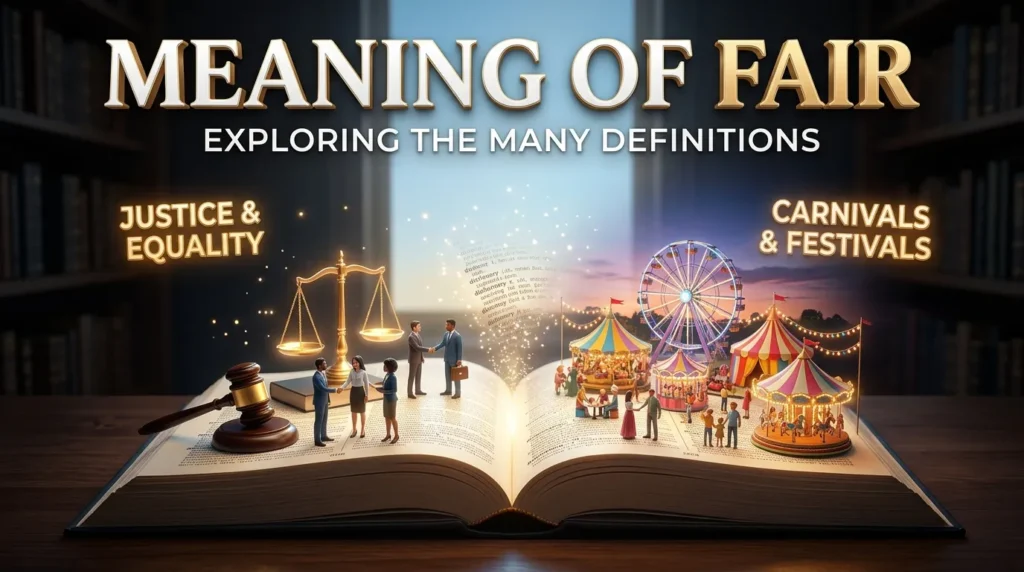
Fair generally means just, reasonable, equal, or appropriate. It describes situations in which people receive reasonable treatment or decisions are made without favoritism.
It can also describe someone or something with a light appearance, such as fair skin or fair hair.
As a noun, fair refers to an organized public event where people gather to enjoy entertainment, explore exhibitions, or purchase products.
For example:
- The teacher gave every student a fair chance.
- She has naturally fair hair.
- We attended the annual agricultural fair.
In everyday English, fair is commonly used when discussing justice, equal treatment, reasonable prices, physical appearance, and public events.
Definition of Fair
Fair is an adjective, noun, and adverb with several established meanings.
As an adjective, it means impartial, reasonable, acceptable, or light in color.
As a noun, it refers to a public gathering or exhibition, often featuring entertainment, businesses, products, or agricultural displays.
As an adverb, it can mean in an honest or proper manner, as in the expression play fair.
Examples:
- The company introduced a fair payment policy.
- The school organized a science fair.
- You should always play fair.
Meaning of Fare

Fare generally refers to the money paid for transportation, such as a bus, train, taxi, or airplane journey.
It also has other meanings. As a noun, fare can describe food or the type of entertainment and material offered to an audience.
As a verb, fare means to get along, perform, or experience a particular result in a situation.
For example:
- I paid the bus fare before boarding.
- The restaurant serves traditional Italian fare.
- She fared well in her interview.
In everyday communication, fare is particularly common when discussing transportation expenses, food choices, and someone’s progress or performance.
Definition of Fare

Fare is a noun and an intransitive verb.
As a noun, it means:
- The price paid for transportation.
- A passenger who pays for a journey.
- Food or a particular type of meal.
- Entertainment or material offered to an audience.
As a verb, it means to get along, experience a particular situation, or achieve a particular result.
Examples:
- The airline increased its ticket fares.
- The restaurant offers inexpensive vegetarian fare.
- He fared better than expected in the competition.
The verb fare is commonly used in expressions such as fare well, fare poorly, and fare better.
Main Difference
The main difference between fair and fare is their meaning and grammatical function.
Fair is primarily used to describe something reasonable, impartial, or light in appearance. It can also refer to an exhibition or event.
Fare is generally used as a noun to describe transportation costs, food, or a paying passenger. As a verb, it describes how someone manages or performs in a particular situation.
Here is a detailed comparison:
| Feature | Fair | Fare |
| Pronunciation | /fer/ in American English | /fer/ in American English |
| Main part of speech | Adjective | Noun and verb |
| Meaning | Just, reasonable, or light in color | Travel cost, food, or performance |
| Noun usage | An exhibition or public event | Transportation cost, food, or passenger |
| Verb usage | Has specialized, less common uses | To manage or get along |
| Adverb usage | Yes, as in play fair | No standard adverbial use |
| Example | That is a fair decision. | The taxi fare is expensive. |
1. Difference in Meaning
The most important distinction is what each word communicates.
- Fair describes fairness, reasonableness, appearance, or an exhibition.
- Fare describes transportation costs, food, or how someone performs or manages.
Examples:
- The manager made a fair decision. (Reasonable and impartial)
- The train fare is affordable. (Transportation cost)
2. Difference in Grammar
Fair and fare also function differently in sentences.
Fair can function as an adjective, noun, and adverb.
- Adjective: The price is fair.
- Noun: We attended a book fair.
- Adverb: You should play fair.
Fare functions as a noun and an intransitive verb.
- Noun: The bus fare is $3.
- Verb: I hope you fare well in your new position.
3. Difference in Context
The surrounding sentence helps determine which spelling is appropriate.
Use fair when discussing:
- Equal opportunities
- Honest decisions
- Reasonable prices
- Physical appearance
- Weather conditions
- Public exhibitions
Use fare when discussing:
- Bus and train tickets
- Transportation expenses
- Food and meals
- Paying passengers
- Personal performance
- Experiences and outcomes
Important: Both words are pronounced alike, so you must understand the intended meaning rather than rely on pronunciation.
Which One Is Correct?
Both fair and fare are correct standard English words. Neither spelling is inherently incorrect.
However, they have different meanings, so the correct choice depends on the context.
Use fair when you mean:
- Just or reasonable
- Equal or impartial
- Light in color
- An exhibition or public event
- Honest or according to the rules
Use fare when you mean:
- The cost of transportation
- A paying passenger
- Food or meals
- How someone manages or performs
- How a situation develops or turns out
Consider these examples:
- Correct: The teacher treated everyone fairly.
- Incorrect: The teacher treated everyone farely.
- Correct: I paid the bus fare.
- Incorrect: I paid the bus fair.
Similarly:
- Correct: How did you fare in the examination?
- Incorrect: How did you fair in the examination?
The important point is that fair and fare are both correct, but they cannot replace each other when their meanings differ.
Read more about when to use Versus or Verses to learn how context determines the correct word in comparisons, discussions, and references to poetry.
Grammar and Usage
Understanding the grammatical functions of fair and fare makes it easier to use them correctly.
1. Fair as an Adjective
Fair is most commonly used as an adjective.
It describes a person, decision, situation, price, or condition.
Common combinations include:
- Fair treatment
- Fair decision
- Fair price
- Fair opportunity
- Fair competition
- Fair weather
- Fair skin
- Fair judgment
Examples:
- Every employee deserves fair treatment.
- The shop offers fair prices.
- We enjoyed the fair weather during our vacation.
Fair also has comparative and superlative forms:
| Form | Word |
| Positive | Fair |
| Comparative | Fairer |
| Superlative | Fairest |
Examples:
- This is a fair solution.
- The new policy is fairer than the previous one.
- She made the fairest decision possible.
2. Fair as a Noun
Fair can also function as a countable noun.
It refers to an organized event or exhibition where people gather for entertainment, business, education, or public activities.
Common expressions include:
- Book fair
- Job fair
- Science fair
- Trade fair
- County fair
- Agricultural fair
Examples:
- My university organized a job fair.
- We bought several books at the book fair.
- Local farmers displayed their products at the agricultural fair.
The plural form is fairs.
3. Fair as an Adverb
Fair can also function as an adverb in certain established expressions.
For example:
- You should always play fair.
- The ball landed fair inside the boundary.
- The team won fair and square.
Although this adverbial use exists, fairly is more common in many ordinary sentences where an adverb is needed.
For example:
- She treated everyone fairly.
- The students were evaluated fairly.
4. Fare as a Noun
Fare is commonly used as a noun when discussing transportation costs.
Examples include:
- Bus fare
- Train fare
- Taxi fare
- Airfare
- Return fare
- One-way fare
Examples:
- The bus fare is five dollars.
- I checked the train fare online.
- The taxi driver asked for the correct fare.
Fare can also describe food or meals.
Examples:
- The restaurant serves traditional Indian fare.
- The hotel offers delicious vegetarian fare.
- We enjoyed the local seafood fare.
The plural form is fares.
5. Fare as a Verb
Fare is also used as an intransitive verb, meaning it does not normally take a direct object.
It describes how someone manages, performs, or experiences a particular situation.
Its main verb forms are:
| Verb Form | Usage |
| Base form | Fare |
| Third-person singular | Fares |
| Past tense | Fared |
| Past participle | Fared |
| Present participle | Faring |
Examples:
- I hope you fare well in your new job.
- She fares better under pressure.
- They fared poorly in the competition.
- How are you faring these days?
Common expressions include:
- Fare well
- Fare poorly
- Fare better
- Fare worse
- Fare badly
How to Use Fair and Fare
Choosing between fair and fare becomes easier when you identify the meaning you want to communicate.
How to Use Fair Correctly
Use fair when describing something that is reasonable, impartial, or acceptable.
For fairness and equal treatment:
- Everyone deserves a fair opportunity.
- The manager made a fair decision.
- We should treat all employees fairly.
For reasonable prices or conditions:
- The shop offers fair prices.
- They received a fair payment for their work.
- The agreement seems fair to both parties.
For physical appearance:
- She has fair skin and blonde hair.
- The child had fair hair and blue eyes.
For exhibitions and events:
- We visited the local book fair.
- The school organized a science fair.
- Many companies participated in the trade fair.
How to Use Fare Correctly
Use fare when referring to transportation expenses, food, or someone’s performance.
For transportation costs:
- The bus fare is affordable.
- I paid the taxi fare in cash.
- Airfares usually increase during busy travel periods.
For food and meals:
- The restaurant serves traditional Chinese fare.
- The hotel offers excellent breakfast fare.
- Local fare is available throughout the festival.
For performance and experiences:
- How did you fare in your interview?
- She fared well during the difficult situation.
- The team fared better than expected.
- I hope everything fares well for you.
Examples
The following examples demonstrate how fair and fare are used in different everyday situations.
Examples of Fair
- Everyone should receive a fair chance to succeed.
- The teacher made a fair decision about the examination results.
- We negotiated a fair price for the used car.
- She believes that equal pay is a matter of fair treatment.
- The weather remained fair throughout the weekend.
- He has fair skin and light brown hair.
- Our university organized a career fair for graduating students.
- I bought several interesting books at the annual book fair.
- The company follows a fair recruitment process.
- Children should learn to play fair during sports competitions.
- The judge promised to give both parties a fair hearing.
- The students displayed their projects at the science fair.
Examples of Fare
- The bus fare increased at the beginning of the month.
- I paid the taxi fare before leaving the vehicle.
- The train fare is cheaper when you book in advance.
- She checked the airfare before confirming her flight.
- The restaurant serves traditional Pakistani fare.
- The hotel offers delicious Italian fare.
- How did you fare in your final examination?
- The team fared better in the second half of the match.
- I hope you fare well in your new position.
- The company fared poorly during the economic downturn.
- The driver collected the fare from each passenger.
- The festival offers entertainment and traditional local fare.
Fair vs. Fare in the Same Sentence
Using both words together can help demonstrate their different meanings.
- We attended the book fair after paying the bus fare.
- The taxi fare was reasonable, and the driver treated us fairly.
- The food fair offered traditional fare at affordable prices.
- It is not fair to charge students an expensive transportation fare.
- She visited the job fair to learn how graduates fare in the employment market.
Common Mistakes
Although fair and fare sound identical, using the wrong spelling can change the meaning of a sentence.
Here are some common mistakes and their corrections.
1. Using Fair Instead of Fare for Transportation
Incorrect: I paid the bus fair this morning.
Correct: I paid the bus fare this morning.
Why it happens: Both words have the same pronunciation, so writers sometimes confuse their spellings.
Explanation: Fare refers to the money paid for transportation, while fair refers to something reasonable or just.
2. Using Fare Instead of Fair for Fairness
Incorrect: Everyone deserves a fare opportunity.
Correct: Everyone deserves a fair opportunity.
Why it happens: Writers may choose fare because it sounds identical to fair.
Explanation: Fair is the correct adjective when describing equal opportunities or impartial treatment.
3. Writing How Did You Fair?
Incorrect: How did you fair in your examination?
Correct: How did you fare in your examination?
Why it happens: Many people recognize fair as a familiar word but are less familiar with fare as a verb.
Explanation: Fare means to perform, manage, or experience a particular result.
4. Confusing Fair Food with Transportation Fare
Incorrect: The restaurant serves traditional fair.
Correct: The restaurant serves traditional fare.
Why it happens: Both spellings sound identical, but they have different meanings.
Explanation: Fare can describe food or a particular type of cuisine.
5. Using Fair in the Expression Fare Well
Incorrect: I hope you fair well in your new job.
Correct: I hope you fare well in your new job.
Why it happens: People sometimes associate the expression with the familiar adjective fair.
Explanation: Fare well means to manage or perform successfully.
6. Confusing Fair and Fairly
Incorrect: The manager treated all employees fair.
Better: The manager treated all employees fairly.
Why it happens: Fair and fairly are related, but they do not always perform the same grammatical function.
Explanation: Fair is primarily an adjective, while fairly is the usual adverb for describing how someone treats others.
Linguistic Insight
From a linguistic perspective, fair and fare are an interesting example of English homophones.
Although these words share the same pronunciation, their spellings, origins, meanings, and grammatical functions are different.
1. Fair and Fare Are Homophones
A homophone is a word that sounds the same as another word but has a different spelling or meaning.
Fair and fare are homophones because they are pronounced identically in standard American and British English.
In American English, both are generally pronounced /fer/.
In British English, both are generally pronounced /feə/.
Their pronunciation does not provide a reliable way to distinguish them. Readers and listeners must understand the surrounding context.
2. Origin of Fair
The word fair comes from Old English fæger, which meant beautiful, pleasant, or attractive.
Over time, its meaning developed to include concepts such as:
- Beauty and attractiveness
- Light-colored appearance
- Justice and impartiality
- Reasonableness and acceptability
These historical developments help explain why fair has several different meanings in modern English.
3. Origin of Fare
The word fare comes from Old English faran, meaning to travel or go.
It is related to other Germanic words associated with movement and journeys.
Its meanings developed around the idea of traveling and getting along.
For example:
- Transportation fare refers to the cost of a journey.
- Fare as a verb describes how someone gets along or experiences a situation.
- Fare as a food-related noun refers to the food available or served.
4. Why Do People Confuse Fair and Fare?
There are several linguistic reasons behind this confusion.
Identical pronunciation: Both words sound the same, making it impossible to identify their spelling from speech alone.
Different grammatical functions: Fair is commonly an adjective, while fare is frequently used as a noun or verb.
Multiple meanings: Both words have several meanings, which can make them confusing for English learners.
Spelling uncertainty: English contains many homophones with different spellings, and fair and fare follow this pattern.
Understanding their meanings and sentence functions is the most reliable way to distinguish them.
Usage Tips
Remembering the difference between fair and fare does not require complicated grammar rules. A few simple techniques can help.
1. Associate Fair with Fairness
The word fair contains the idea of fairness.
Think about expressions such as:
- Fair treatment
- Fair decision
- Fair opportunity
- Fair competition
If your sentence involves justice, equality, or reasonable treatment, fair is usually the correct choice.
2. Associate Fare with Travel
Remember that fare is commonly connected with transportation expenses.
Think about:
- Bus fare
- Train fare
- Taxi fare
- Airfare
If someone must pay for transportation, use fare.
3. Remember Fare Well
When discussing someone’s performance or experience, use fare.
For example:
- I hope you fare well.
- She fared better than expected.
- How did they fare in the competition?
4. Think About Food
Fare can also refer to food.
For example:
- Traditional fare
- Local fare
- Vegetarian fare
- Restaurant fare
Whenever you describe the type of food a restaurant serves, fare may be the appropriate word.
5. Check the Sentence Meaning
If you are unsure which spelling to choose, ask yourself what you are trying to express.
- Are you describing something reasonable? Use fair.
- Are you talking about transportation costs? Use fare.
- Are you describing someone’s performance? Use fare.
- Are you referring to an exhibition? Use fair.
These contextual clues will help you avoid most spelling mistakes.
Expert Suggestion
As a grammar teacher, I recommend learning fair and fare through their meanings rather than memorizing their spellings separately.
Pay particular attention to the expressions fair treatment, fair price, bus fare, and fare well.
These common combinations demonstrate how each word functions naturally in English.
If you are an ESL learner, student, or professional writer, practice identifying the intended meaning before selecting the spelling. This approach is more effective than relying on pronunciation because both words sound identical.
When proofreading your writing, pay special attention to sentences involving transportation, fairness, food, and performance. These are the situations in which confusion between fair and fare is most likely.
Summary
Fair and fare are both correct English words, but they have different meanings and grammatical functions.
- Fair means just, reasonable, impartial, or light in color. It can also refer to a public exhibition or event.
- Fare refers to transportation costs, paying passengers, food, or how someone manages or performs in a situation.
- Both words are homophones because they have the same pronunciation but different spellings and meanings.
- Fair functions primarily as an adjective, noun, and sometimes an adverb.
- Fare functions as a noun and an intransitive verb.
Remember to use fair for fairness, reasonable treatment, and exhibitions, and fare for transportation costs, food, and performance.
Frequently Asked Questions
1. What is the difference between fair and fare?
Fair means just, reasonable, or light in color, while fare refers to transportation costs, food, or how someone performs in a particular situation. Both words sound the same but have different meanings and spellings.
2. Is fair or fare correct?
Both fair and fare are correct English words. However, they are used in different contexts. Fair describes fairness or an exhibition, while fare refers to transportation costs, food, or performance.
3. Are fair and fare homophones?
Yes. Fair and fare are homophones because they have the same pronunciation but different spellings and meanings.
4. Is it bus fair or bus fare?
The correct expression is bus fare. Fare refers to the money passengers pay to travel by bus.
Example: The bus fare is five dollars.
5. Is it fair well or fare well?
The correct expression is fare well when you mean to manage or perform successfully.
Example: I hope you fare well in your new position.
The expression farewell is also a standard noun and interjection used when saying goodbye.
6. Is it how did you fair or how did you fare?
The correct expression is How did you fare?
Fare is a verb meaning to manage, perform, or experience a particular result.
Example: How did you fare in your final examination?
7. Can fair be used as a noun?
Yes. Fair can function as a noun referring to a public event or exhibition.
Examples include book fair, job fair, science fair, and agricultural fair.
8. Can fare be used as a verb?
Yes. Fare is an intransitive verb meaning to manage, perform, or experience a particular outcome.
Example: She fared well in the interview.
9. Does fare mean food?
Yes. Fare can refer to food, meals, or a particular type of cuisine.
Example: The restaurant serves traditional Italian fare.
10. Does fair mean beautiful?
Yes. Fair can describe someone or something that is beautiful or attractive. It can also refer to light-colored hair or skin.
Example: The painting depicted a fair and beautiful young woman.
11. What is the plural of fair and fare?
The plural forms are fairs and fares.
- Fairs refers to multiple exhibitions or public events.
- Fares refers to multiple transportation charges, passengers, or different types of food and other offerings.
Example: Several local fairs offer affordable travel fares.
12. Is fair an adjective or a noun?
Fair can function as both an adjective and a noun. It can also be used as an adverb in certain expressions.
As an adjective: Everyone deserves fair treatment.
As a noun: We attended a book fair.
As an adverb: Always play fair.
13. What does fare mean in a sentence?
Fare can refer to the price of transportation, food, or someone’s performance.
Examples:
- The taxi fare was expensive.
- The restaurant serves traditional fare.
- He fared well in his examination.
14. What is the easiest way to remember fair and fare?
Remember that fair is associated with fairness, equal treatment, and exhibitions, while fare is associated with travel costs, food, and performance.
For example, you pay a bus fare, attend a book fair, and hope to fare well in an examination.
15. Are fair and fare pronounced the same in American and British English?
Yes. Fair and fare have the same pronunciation in standard American and British English. Their exact vowel quality differs between the accents, but the two words remain homophones in both varieties.

