
Have you ever wondered whether to write apologize or apologise when saying sorry in an email, message, or formal letter? Both spellings are correct, but their usage depends on the variety of English you follow. American English generally uses apologize, while British English traditionally prefers apologise. This spelling difference often confuses English learners and writers, especially when communicating with international audiences. Understanding the distinction will help you choose the appropriate spelling, use its different verb forms correctly, and maintain consistency in your writing.
Quick Answer
Both apologize and apologise are correct English spellings. The difference is regional, not grammatical or semantic.
| Form | Correct? | Main Usage |
| Apologize | Yes | American English |
| Apologise | Yes | British English |
Both words have exactly the same meaning: to express regret or say that you are sorry for something you have done.
Examples:
- American English: I apologize for the inconvenience.
- British English: I apologise for the inconvenience.
Neither spelling is more correct than the other. Choose the spelling that matches your preferred variety of English and use it consistently.
You can learn more about Anyway or Any Way to understand the difference between these expressions and recognize when each form is grammatically appropriate.
Meaning and Definition
Meaning of Apologize
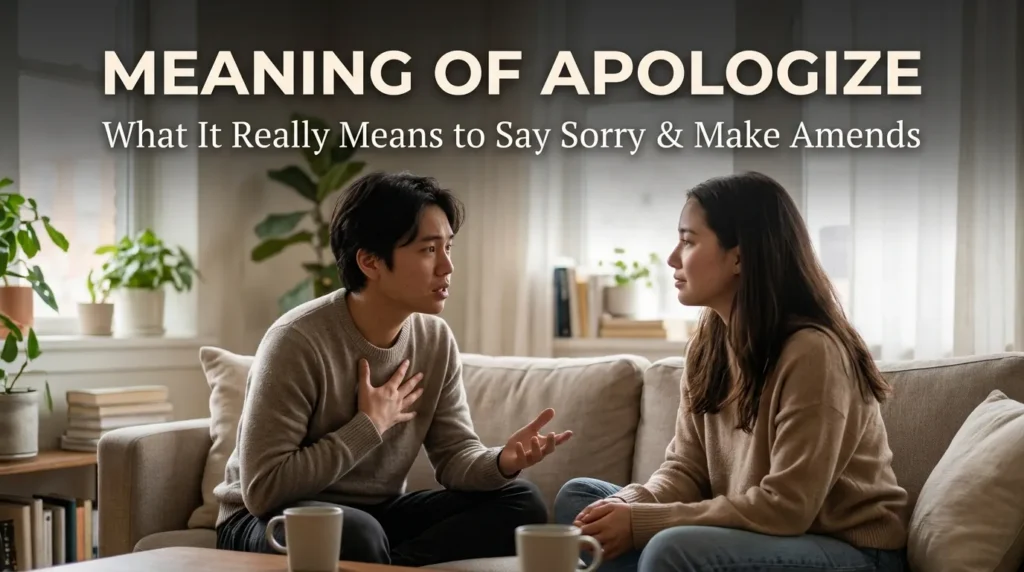
Apologize means to tell someone that you are sorry for something wrong you have done or for causing inconvenience, disappointment, or hurt.
People use this word when they want to acknowledge a mistake, express regret, or take responsibility for their actions.
For example:
- I apologize for arriving late to the meeting.
- You should apologize to your friend for your behavior.
- The company apologized for the delivery delay.
In everyday communication, apologize is commonly used in conversations, professional emails, public statements, and formal situations.
Definition of Apologize
Apologize (verb): To express regret or acknowledge responsibility for an action, mistake, offense, or situation that has caused someone inconvenience or unhappiness.
The verb describes the act of making an apology. It is generally intransitive, meaning it does not normally take a direct object.
For example:
- She apologized for her mistake.
- He apologized to his teacher.
- We apologize for the misunderstanding.
The word can also describe making a formal defense or explanation, although this meaning is less common in everyday modern English.
Meaning of Apologise

Apologise has exactly the same meaning as apologize. It means to express regret, acknowledge a mistake, or tell someone that you are sorry.
The only difference is its spelling. Apologise is traditionally preferred in British English and is also commonly used in several other varieties that follow British spelling conventions.
For example:
- I apologise for forgetting your birthday.
- She apologised to her colleague.
- We apologise for any inconvenience caused.
Whether someone writes apologize or apologise, the intended meaning remains unchanged.
Definition of Apologise
Apologise (verb): To express regret or acknowledge that you have done something wrong, caused an inconvenience, or hurt another person.
It functions as a verb and follows the same grammatical patterns as apologize.
For example:
- He apologised for his behavior.
- They apologised to the customers.
- I would like to apologise for the delay.
The spelling with an s does not indicate a different action, meaning, or level of politeness.
Main Difference
The main difference between apologize and apologise is their spelling and regional preference.
American English generally uses the -ize ending, whereas British English traditionally favors the -ise ending for this particular word.
| Comparison | Apologize | Apologise |
| Spelling | With z | With s |
| Meaning | To express regret | To express regret |
| Part of speech | Verb | Verb |
| American English | Standard spelling | Less commonly used |
| British English | Also accepted | Traditionally preferred |
| Pronunciation | Same | Same |
| Past tense | Apologized | Apologised |
| Present participle | Apologizing | Apologising |
| Third-person singular | Apologizes | Apologises |
American English Usage
In American English, apologize is the standard spelling.
American writers generally use this spelling in academic assignments, business correspondence, newspapers, professional documents, and everyday communication.
Examples:
- I apologize for the confusion.
- The manager apologized to the employees.
- We apologize for the inconvenience.
The related forms also retain the letter z:
- Apologizes
- Apologized
- Apologizing
British English Usage
In traditional British English, apologise is the preferred spelling.
It commonly appears in British newspapers, professional correspondence, educational materials, and everyday writing.
Examples:
- I apologise for the misunderstanding.
- She apologised to her parents.
- We apologise for the inconvenience.
The related forms use the letter s:
- Apologises
- Apologised
- Apologising
However, an important detail is that British English also accepts many words ending in -ize. Some British dictionaries and publishers use this spelling convention, so apologize is not incorrect in British English.
Which One Is Correct?
Both apologize and apologise are correct. Neither is a misspelling.
The appropriate choice depends on the English spelling convention you follow.
- Use apologize when writing in American English.
- Use apologise when following traditional British English spelling.
- If your organization, university, or publication has a preferred style guide, follow that convention.
There is also some variation within British English. The -ize ending is accepted in certain British writing styles, including conventions followed by some major British publishers.
Therefore, it is inaccurate to say that apologize is exclusively American or that British writers must always use apologise.
The most important rule is consistency. Avoid switching between American and British spelling within the same document.
Grammar and Usage
Both words function as verbs and follow the same grammatical rules.
Part of Speech
Apologize and apologise are verbs.
They describe the action of expressing regret or acknowledging a mistake.
Examples:
- I apologize for my behavior.
- She apologises whenever she makes a mistake.
- They apologized after the argument.
Verb Forms
Both spellings follow the regular verb pattern.
| Verb Form | American English | British English |
| Base form | Apologize | Apologise |
| Third-person singular | Apologizes | Apologises |
| Past tense | Apologized | Apologised |
| Past participle | Apologized | Apologised |
| Present participle | Apologizing | Apologising |
Present Tense
Use apologize or apologise when discussing an apology in the present.
Examples:
- I apologize for my mistake.
- She apologises when she hurts someone.
- We apologize for the delay.
Remember to add -s or -es to the third-person singular form, depending on the spelling convention.
Past Tense
Both spellings form their past tense by adding -d.
Examples:
- He apologized for being rude.
- She apologised to her friend.
- They apologized for the misunderstanding.
Use the appropriate spelling according to your chosen English variety.
Present Continuous Tense
Use the -ing form when describing an apology that is happening at the moment.
Examples:
- I am apologizing for my mistake.
- She is apologising to her teacher.
- They are apologizing to the customers.
Present Perfect Tense
Use the past participle with has or have to describe an apology that has occurred.
Examples:
- I have apologized for my actions.
- She has apologised to her parents.
- They have apologized for the inconvenience.
Common Prepositions
Two particularly important prepositions used with apologize and apologise are to and for.
Apologize to someone
Use to when identifying the person receiving the apology.
Examples:
- I apologized to my manager.
- She apologised to her brother.
- He needs to apologize to his customers.
Apologize for something
Use for when explaining the reason for the apology.
Examples:
- I apologize for my mistake.
- She apologised for arriving late.
- We apologize for the inconvenience.
You can also use both prepositions in one sentence:
- I apologize to my colleague for missing the meeting.
- She apologised to her parents for her behavior.
How to Use Apologize or Apologise
Using these words correctly is straightforward once you understand their common sentence patterns.
Apologize for Something
Use this pattern when explaining what you are sorry about.
Sentence structure: Subject + apologize/apologise + for + noun or gerund.
Examples:
- I apologize for the confusion.
- She apologised for forgetting the appointment.
- They apologized for making a mistake.
Apologize to Someone
Use this structure when identifying the person who receives the apology.
Sentence structure: Subject + apologize/apologise + to + person.
Examples:
- You should apologize to your teacher.
- He apologised to his wife.
- The company apologized to its customers.
Apologize to Someone for Something
Combine both patterns when you want to identify the recipient and the reason for an apology.
Examples:
- I apologize to my friend for being late.
- She apologised to her manager for the error.
- We apologize to our customers for the delay.
Use Apologize in Formal Writing
Both spellings are suitable for formal communication.
Examples:
- We sincerely apologize for the inconvenience.
- I would like to apologise for the misunderstanding.
- Please accept our apologies for the delayed response.
Choose the spelling that matches the style of your document.
Use Apologize in Everyday Conversation
You can also use these verbs in informal conversations.
Examples:
- I should apologize.
- You need to apologise to her.
- He finally apologized.
In casual situations, people also frequently say I’m sorry instead of using the verb apologize.
Examples
Examples of Apologize
The following sentences use the American English spelling.
- I apologize for arriving late to the meeting.
- She apologized to her friend after the argument.
- We apologize for any inconvenience caused.
- The teacher apologized for the misunderstanding.
- He apologized to his parents for his behavior.
- I would like to apologize for my mistake.
- The company apologized publicly after the incident.
- You should apologize if you have hurt someone.
- They apologized for submitting the report late.
- Please accept my sincere apology for the confusion.
You can learn more about powerful similes for fear to discover creative ways to describe frightening experiences and express intense emotions through vivid comparisons.
Examples of Apologise
The following sentences use the traditional British English spelling.
- I apologise for forgetting your birthday.
- She apologised to her colleague for the mistake.
- We apologise for the delay in processing your order.
- He apologised after realizing his behavior was inappropriate.
- They apologised to the customers for the inconvenience.
- I would like to apologise for my absence.
- The manager apologised for the misunderstanding.
- You should apologise when you make a mistake.
- She apologises whenever she unintentionally hurts someone.
- Please accept our sincere apologies for the error.
Examples in Professional Emails
Both forms are appropriate for professional communication.
American English:
- I apologize for the delayed response.
- We apologize for any inconvenience this may have caused.
- Please accept my sincere apology for the error.
British English:
- I apologise for the delayed response.
- We apologise for any inconvenience this may have caused.
- Please accept my sincere apology for the error.
Common Mistakes
Although both spellings are correct, English learners sometimes make mistakes when using their verb forms or combining them with other words.
1. Mixing American and British Spellings
Incorrect (inconsistent spelling):
– I apologize for the delay. We apologised for the inconvenience.
Correct (American English):
– I apologize for the delay. We apologized for the inconvenience.
Correct (British English):
– I apologise for the delay. We apologised for the inconvenience.
Why it happens: Writers sometimes mix spelling conventions without realizing that related verb forms should follow the same system.
2. Using Apologize Instead of Apology
Incorrect: I want to offer an apologize.
Correct: I want to offer an apology.
Why it happens: Apologize and apology are related words, but they have different grammatical functions.
- Apologize is a verb.
- Apology is a noun.
3. Using the Wrong Past Tense
Incorrect: Yesterday, I apologize for my mistake.
Correct: Yesterday, I apologized for my mistake.
British English: Yesterday, I apologised for my mistake.
Why it happens: Writers sometimes forget to change the verb into its past form when discussing completed actions.
4. Using an Incorrect Form After Did
Incorrect: She did apologized for being late.
Correct: She did apologize for being late.
British English: She did apologise for being late.
Why it happens: The auxiliary verb did already indicates past tense, so the main verb must remain in its base form.
5. Confusing Apologize With Apologizes
Incorrect: He apologize for his mistake.
Correct: He apologizes for his mistake.
British English: He apologises for his mistake.
Why it happens: In the simple present tense, third-person singular subjects such as he, she, and it require the appropriate verb ending.
6. Using the Wrong Preposition
Incorrect: I apologize you for my behavior.
Correct: I apologize to you for my behavior.
Why it happens: The preposition to identifies the person receiving the apology, while for introduces the reason.
Linguistic Insight
The difference between apologize and apologise is an example of regional spelling variation in English.
Although the two forms look different, they share the same linguistic meaning, grammatical function, and pronunciation.
Word Origin
The verb apologize developed from the word apology, which has roots in the Greek word apologia.
Originally, the Greek term referred to a speech or argument made in defense of someone or something.
Over time, the meaning developed to include expressing regret and acknowledging wrongdoing.
The verb apologize emerged in English around the late sixteenth century.
The Role of -ize and -ise
The endings -ize and -ise are associated with verb formation in English.
In this word, the two endings represent alternative spelling conventions rather than different grammatical forms.
American English generally favors -ize, while traditional British English commonly uses -ise for apologize.
However, British spelling is not entirely uniform. Some British dictionaries and publishing styles also accept or prefer -ize.
Why Do People Confuse These Spellings?
The confusion mainly comes from differences between English-speaking countries.
People encounter both forms through:
- International websites
- Books and educational materials
- Social media
- Professional emails
- Online dictionaries
- Academic publications
Because both spellings are accepted, learners may mistakenly assume that one must be incorrect.
Understanding regional spelling conventions makes the distinction much easier.
Pronunciation
Both words have the same pronunciation within a given English variety.
The main pronunciation difference is between American and British accents, not between the spellings themselves.
The word has four syllables, with the main stress on the second syllable.
A simplified pronunciation guide is:
Uh-POL-uh-jize
The American pronunciation typically uses a broader vowel sound in the stressed syllable, while British pronunciation commonly uses a shorter, rounded vowel.
Changing the final letter from z to s does not change the pronunciation.
Usage Tips
Here are some practical ways to remember the correct spelling.
- Remember the American convention: Use apologize when writing in American English.
- Remember the traditional British convention: Use apologise when following British -ise spelling.
- Keep verb forms consistent: If you write apologize, also write apologized and apologizing.
- Use the correct prepositions: Apologize to someone for something.
- Check your audience: Consider your readers when choosing between American and British spelling.
- Follow your style guide: Professional organizations and academic institutions may have specific spelling preferences.
- Remember that both are correct: Do not assume that the spelling with s is a mistake or that the spelling with z is exclusively American.
Expert Suggestion
As a grammar teacher, my recommendation is to choose one English spelling convention and follow it consistently.
If you write primarily for American readers, use apologize, apologizes, apologized, and apologizing.
If you write for readers who follow traditional British English, use apologise, apologises, apologised, and apologising.
For international websites and content creators, consistency across the entire article or website is especially important.
Also, remember that spelling is only one part of effective communication. A meaningful apology should clearly acknowledge the situation and express genuine regret.
Summary
Apologize and apologise are both correct English spellings. They have the same meaning, pronunciation, and grammatical function.
The main difference is regional spelling preference:
- Apologize: The standard American English spelling.
- Apologise: The traditionally preferred British English spelling.
Both words mean to express regret or acknowledge a mistake.
Their verb forms follow the same grammatical rules:
| American English | British English |
| Apologize | Apologise |
| Apologizes | Apologises |
| Apologized | Apologised |
| Apologizing | Apologising |
Choose the appropriate spelling for your audience and maintain consistency throughout your writing.
Frequently Asked Questions
Is apologize or apologise correct?
Both are correct. Apologize is the standard American English spelling, while apologise is traditionally preferred in British English.
Is apologize American or British English?
Apologize is primarily associated with American English. However, it is also accepted in some British English spelling conventions.
Is apologise British or American English?
Apologise is traditionally the preferred British English spelling. American English generally uses apologize instead.
Do apologize and apologise mean the same thing?
Yes. Both words mean to express regret, acknowledge a mistake, or tell someone that you are sorry. Their meanings are identical.
How do you spell apologize in British English?
The traditional British spelling is apologise, with an s instead of a z.
How do you spell apologise in American English?
The standard American spelling is apologize, with a z instead of an s.
Is apologize acceptable in British English?
Yes. Although apologise is traditionally preferred, apologize is also accepted in British English, particularly in spelling systems that favor -ize endings.
Is apologised or apologized correct?
Both are correct. Apologised is the traditional British spelling, while apologized is the standard American spelling.
Is apologising or apologizing correct?
Both forms are correct. Apologising follows traditional British spelling, while apologizing follows American spelling.
What is the difference between apologize and apology?
Apologize is a verb meaning to express regret or say sorry. Apology is a noun referring to the statement or act of expressing regret.
For example:
- I apologize for the mistake.
- Please accept my apology.
What preposition is used with apologize?
The most common prepositions are to and for.
Use to when identifying the person receiving the apology and for when explaining the reason.
Example: I apologize to my colleague for the misunderstanding.
Is apologize formal or informal?
Apologize is appropriate in both formal and informal communication. It is commonly used in professional emails, public statements, academic writing, and everyday conversations.
What is the past tense of apologize?
The past tense is apologized in American English and apologised in traditional British English.
Example: She apologized for arriving late.
How many syllables are in apologize?
Apologize has four syllables: a-pol-o-gize. The main stress falls on the second syllable.
Should I use apologize or apologise in international writing?
Choose the spelling that matches your publication’s preferred English convention. American-oriented publications generally use apologize, while publications following traditional British spelling generally use apologise. Consistency is more important than choosing one as universally correct.

