
Have you ever wondered whether to write eventhough or even though when expressing a contrast in a sentence? The confusion is understandable because the two forms sound exactly the same when spoken. However, English spelling rules distinguish between them. Whether you are writing an email, completing an assignment, or preparing professional content, choosing the correct form matters.
The correct standard English expression is even though, written as two separate words. Eventhough is a common spelling mistake, not an accepted standard alternative. This article explains its meaning, definition, grammar, usage, examples, and common mistakes so you can use it confidently.
Quick Answer
Even though is the correct spelling. Eventhough is incorrect in standard English.
| Form | Correct? | Meaning | Main Use |
| Even though | Yes | Despite the fact that | Introduces a contrast or unexpected result |
| Eventhough | No | Not a standard English expression | Incorrect spelling |
Example:
- Correct: Even though it was raining, we went outside.
- Incorrect: Eventhough it was raining, we went outside.
Use even though when you want to show that something happened despite a condition or situation that might have prevented it.
Make your writing more descriptive with powerful comparisons for expressing fear in different situations.
Meaning and Definition
Meaning of Even Though
Even though means despite the fact that or although. It introduces information that contrasts with another statement or makes the main idea seem unexpected.
People use this expression when one situation does not prevent another situation from happening.
For example:
- Even though she was tired, she continued working.
- He smiled even though he was disappointed.
- Even though the price was high, we bought the product.
In each sentence, the first clause describes a circumstance that might normally lead to a different outcome. However, the second clause shows what actually happened.
Definition of Even Though
Even though is a subordinating conjunction that introduces a dependent clause expressing contrast or concession.
In practical terms, it connects two related ideas and emphasizes that the main statement remains true despite the circumstance mentioned in the dependent clause.
For example:
Even though the road was crowded, we arrived on time.
Here, the crowded road could have caused a delay, but the people arrived on time.
Is Eventhough a Word?
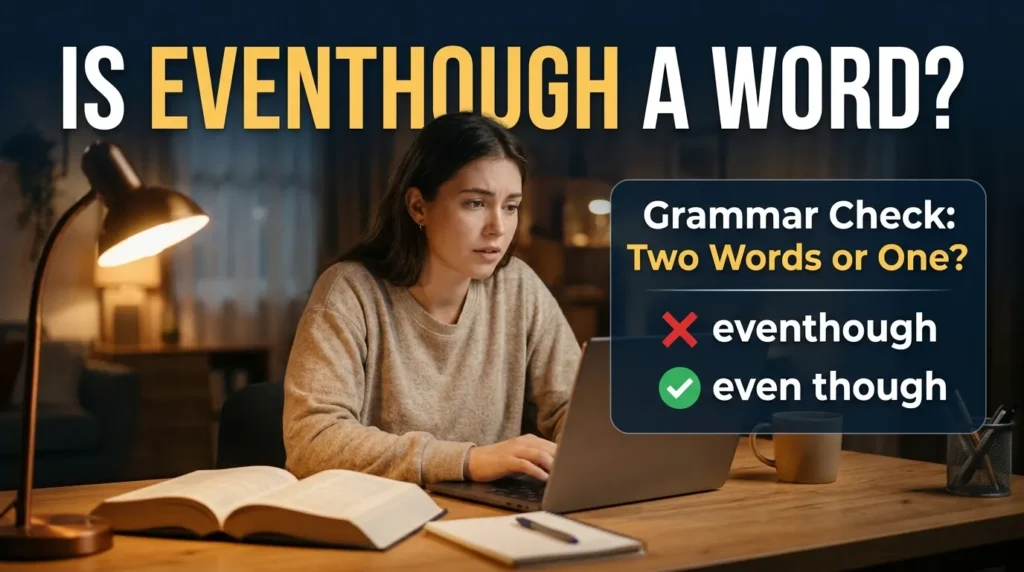
Eventhough is not a standard English word or accepted spelling of the expression even though.
It is a spelling error that occurs when writers combine two separate words into one. Although readers can usually understand the intended meaning, the combined spelling should be avoided in academic, professional, and everyday standard writing.
Do not use eventhough as an alternative to even though.
Main Difference
The main difference between even though and eventhough is spelling and correctness.
| Feature | Even Though | Eventhough |
| Spelling | Correct | Incorrect |
| Word structure | Two separate words | Incorrectly combined |
| Grammatical status | Standard conjunction | Not a standard form |
| Meaning | Despite the fact that | No separate standard meaning |
| Formal writing | Accepted | Should be avoided |
| Everyday writing | Correct | Incorrect |
Even though consists of two words:
- Even: An adverb that adds emphasis.
- Though: A conjunction that introduces a contrasting idea.
Together, they create an expression that emphasizes a contrast between two clauses.
For example:
Even though he had little experience, he performed well.
The expression highlights the unexpected relationship between his limited experience and his successful performance.
By contrast, eventhough has no recognized grammatical function in standard English.
Which One Is Correct?
Even though is the only correct standard English spelling.
You should always write it as two separate words, regardless of whether you are using American or British English.
Consider these examples:
- Correct: Even though I was busy, I answered your call.
- Incorrect: Eventhough I was busy, I answered your call.
- Correct: She attended the meeting even though she felt unwell.
- Incorrect: She attended the meeting eventhough she felt unwell.
The incorrect spelling does not become acceptable simply because it is frequently used online or understood by readers.
Remember that even though is the established expression in standard written and spoken English.
Grammar and Usage
Understanding how even though works grammatically makes it easier to use the expression correctly.
Part of Speech
Even though functions as a subordinating conjunction.
A subordinating conjunction introduces a dependent clause and connects it to an independent clause.
For example:
Even though the weather was cold, we enjoyed our walk.
The sentence contains two clauses:
- Dependent clause: Even though the weather was cold.
- Independent clause: We enjoyed our walk.
The dependent clause cannot normally stand alone as a complete sentence in this construction because it leaves the reader expecting additional information.
Sentence Structure
The expression generally follows two common sentence patterns.
Pattern 1: Even though + subject + verb + main clause
Example:
Even though Sarah studied hard, she did not pass the examination.
Pattern 2: Main clause + even though + subject + verb
Example:
Sarah did not pass the examination even though she studied hard.
Both structures are grammatically correct.
Comma Usage
Comma placement depends on where the dependent clause appears.
When even though begins the sentence:
Place a comma after the introductory dependent clause.
Example:
Even though it was getting late, we continued our discussion.
When even though appears in the middle:
A comma is generally unnecessary when the dependent clause follows the main clause naturally.
Example:
We continued our discussion even though it was getting late.
Tense Usage
Even though does not require a particular verb tense. You can use it with different tenses depending on the meaning of the sentence.
| Tense | Example |
| Present simple | Even though he works hard, he earns little. |
| Past simple | Even though she called me, I did not answer. |
| Present continuous | Even though it is raining, they are playing outside. |
| Present perfect | Even though I have apologized, he remains upset. |
| Future meaning | Even though it rains tomorrow, we will attend the event. |
Notice that the expression itself does not determine the tense. The context determines which tense is appropriate.
Formal and Informal Usage
Even though is appropriate in both formal and informal English.
You can use it in:
- Academic assignments
- Business emails
- Professional reports
- Everyday conversations
- Personal messages
- Articles and essays
It is slightly more emphatic than although in many contexts, making it useful when you want to highlight a surprising contrast.
American and British English
There is no spelling difference between American and British English.
Both varieties use even though as two separate words.
Examples:
- American English: Even though the store was closed, we waited outside.
- British English: Even though the shop was closed, we waited outside.
The vocabulary may differ, but the expression’s spelling and grammatical function remain the same.
How to Use Even Though
Use even though when you want to connect two ideas that contrast with each other.
The expression is particularly useful when the second situation happens despite an obstacle, difficulty, expectation, or opposing circumstance.
1. To Show an Unexpected Result
Use even though when something happens despite a situation that might normally prevent it.
Examples:
- Even though he was nervous, he delivered an excellent presentation.
- She completed the assignment even though she had very little time.
- Even though the restaurant was expensive, we enjoyed our dinner.
2. To Express Contrast Between Two Facts
Use the expression to connect two facts that seem contradictory.
Examples:
- Even though Mark is young, he has considerable professional experience.
- I enjoyed the movie even though its ending was disappointing.
- Even though the house is small, it has plenty of space.
3. To Describe Difficult Circumstances
You can use even though when explaining that someone continued an activity despite a challenge.
Examples:
- Even though she was exhausted, she finished her project.
- He attended the class even though he had a headache.
- Even though they faced several problems, they completed the journey.
4. To Make a Statement More Emphatic
The word even strengthens the contrast and draws attention to the unexpected relationship between the two ideas.
Examples:
- Even though everyone disagreed, she remained confident.
- He helped his friend even though they had argued earlier.
- Even though the task seemed impossible, the team completed it.
Examples
The following examples demonstrate how to use even though naturally in different situations.
Examples of Even Though
Everyday conversation
- Even though I am tired, I want to watch another movie.
- She went shopping even though she did not need anything.
- Even though it was cold, the children played outside.
- He enjoys swimming even though he is not a strong swimmer.
- Even though we live far apart, we talk every day.
Professional communication
- Even though the deadline was approaching, the team maintained its quality standards.
- We accepted the proposal even though some details needed clarification.
- Even though the client was dissatisfied, the manager handled the situation professionally.
- She received a promotion even though she had joined the company recently.
Academic writing
- Even though the study involved a small sample, its findings provided useful insights.
- The experiment produced reliable results even though several conditions changed.
- Even though the theory has limitations, it remains useful for explaining the phenomenon.
Social situations
- Even though he disagreed with my opinion, he listened respectfully.
- She invited everyone even though she had limited space.
- Even though they had never met before, they quickly became friends.
Formal writing
- Even though the proposal requires additional funding, it offers significant long-term benefits.
- The organization continued its operations even though economic conditions were challenging.
- Even though the evidence was incomplete, the committee proceeded with its investigation.
Find fresh ways to describe landscapes by learning how to compare sand to familiar objects.
Examples of Incorrect Eventhough
The following examples demonstrate the spelling mistake and its correction.
| Incorrect | Correct |
| Eventhough I was tired, I studied. | Even though I was tired, I studied. |
| She smiled eventhough she was sad. | She smiled even though she was sad. |
| Eventhough it was raining, we left. | Even though it was raining, we left. |
| He succeeded eventhough it was difficult. | He succeeded even though it was difficult. |
Remember that the correction involves separating the two words, not changing their meaning.
Common Mistakes
Writers often make spelling and grammatical mistakes when using even though. Understanding these errors can help you avoid them.
1. Writing Eventhough as One Word
Incorrect: Eventhough she was tired, she continued working.
Correct: Even though she was tired, she continued working.
Why it happens: Both words are pronounced together in natural speech, which can make them seem like a single word.
Correction: Always write even though as two separate words.
2. Using Although and But Together
Incorrect: Although he was sick, but he attended the meeting.
Correct: Although he was sick, he attended the meeting.
Also correct: He was sick, but he attended the meeting.
Why it happens: Learners sometimes combine two different ways of expressing contrast.
Correction: Use either although or but to connect the contrasting ideas in these sentence structures, rather than unnecessarily using both.
3. Confusing Even Though with Even If
Incorrect for an established fact: Even if she was tired yesterday, she finished her work.
Correct: Even though she was tired yesterday, she finished her work.
Why it happens: Both expressions introduce subordinate clauses, but their meanings are different.
Correction: Use even though for an actual or accepted circumstance. Use even if for a condition that may or may not happen.
4. Using Even Though Without a Complete Main Clause
Incorrect: Even though I studied all night.
Correct: Even though I studied all night, I could not finish the assignment.
Why it happens: Writers sometimes mistake a dependent clause for a complete sentence.
Correction: Add an independent clause that completes the thought.
5. Confusing Even Though with Despite
Incorrect: Despite it was raining, we went outside.
Correct: Even though it was raining, we went outside.
Also correct: Despite the rain, we went outside.
Why it happens: Both expressions communicate contrast, but their grammatical structures differ.
Correction: Use even though before a subject and verb. Use despite before a noun, pronoun, or gerund.
Linguistic Insight
From a linguistic perspective, even though is an interesting example of how separate words work together to create a stronger grammatical meaning.
Word Formation
The expression contains two independent words:
- Even: An adverb that adds emphasis.
- Though: A conjunction that introduces contrast or concession.
When combined, they form a multiword conjunction.
This means the expression performs a single grammatical function even though it consists of two separate written words.
Syntax: How the Expression Works
Syntax refers to the way words are arranged to form meaningful sentences.
In even though constructions, the expression introduces a subordinate clause that provides contrasting information.
Consider this example:
Even though the journey was difficult, they reached their destination.
The subordinate clause establishes the difficulty of the journey, while the main clause communicates the unexpected outcome.
The expression helps readers understand the relationship between these two pieces of information.
Semantics: The Meaning of Contrast
Semantics is the study of meaning in language.
The phrase even though expresses concession. In other words, it acknowledges a fact that might normally suggest one outcome while presenting a different outcome as true.
For example:
Even though the exam was difficult, she passed.
The difficult examination might suggest that passing would be unlikely. However, the main clause presents a contrasting result.
Why People Confuse the Spelling
There are several reasons people write eventhough instead of even though:
- Connected pronunciation: In natural speech, the words flow together.
- Writing habits: People sometimes combine familiar expressions when typing quickly.
- Spelling assumptions: Some learners assume that frequently used expressions eventually become single words.
- Visual familiarity: Repeated exposure to an incorrect spelling online can make it appear familiar.
However, pronunciation does not determine whether an expression should be written as one word or two.
Historical Development
The word though has Old English roots, while even developed from an older English word associated with equality or being level.
In the modern expression even though, the word even functions as an intensifier, strengthening the concessive meaning of though.
The expression is therefore understood as a combination of separate words rather than a single compound word.
Usage Tips
Remember these practical tips to use even though correctly.
- Always use two words: Write even though, never eventhough in standard English.
- Remember its meaning: Think of even though as meaning despite the fact that.
- Look for contrasting ideas: Use it when one fact does not prevent another situation from happening.
- Check the clause structure: Follow even though with a subject and a verb.
- Use commas correctly: Place a comma after an introductory dependent clause.
- Do not confuse it with even if: The former expresses concession, while the latter introduces a condition.
- Read your sentence aloud: Check whether the two clauses communicate a logical contrast.
Easy memory trick:
Remember that even though contains the complete word though. Keep even and though separate whenever you write the expression.
Expert Suggestion
As a grammar teacher, I recommend learning even though as a complete two-word expression instead of trying to remember its spelling every time you use it.
A simple way to improve your writing is to practice replacing it with despite the fact that.
For example:
Even though he was inexperienced, he performed well.
You can express the same idea as:
Despite the fact that he was inexperienced, he performed well.
If the replacement preserves the intended meaning, you are probably using the expression correctly.
For students, ESL learners, professional writers, and content creators, the most important rule is simple: Always write even though as two separate words.
Summary
The correct expression is even though, not eventhough.
Here are the most important points to remember:
- Even though is a standard English expression written as two words.
- Eventhough is an incorrect spelling in standard English.
- Even though means despite the fact that or although.
- It functions as a subordinating conjunction.
- It introduces a dependent clause expressing contrast or concession.
- It is appropriate in both formal and informal writing.
- Its spelling is the same in American and British English.
Final rule: Whenever you want to express contrast using this phrase, write even though as two separate words.
Frequently Asked Questions
1. Is Eventhough one word or two?
Even though is two words. The spelling eventhough is incorrect in standard English. Always keep the words separate when writing the expression.
2. Is Even Though grammatically correct?
Yes. Even though is a grammatically correct subordinating conjunction used to introduce a clause that expresses contrast or concession.
3. What does Even Though mean?
Even though means despite the fact that. It introduces a circumstance that contrasts with the main statement.
Example: Even though it was late, we continued working.
4. Why is Eventhough incorrect?
Eventhough is incorrect because standard English recognizes the expression as two separate words. Combining them creates a nonstandard spelling.
5. Can I use Even Though at the beginning of a sentence?
Yes. You can begin a sentence with even though when introducing a dependent clause.
Example: Even though she was nervous, she spoke confidently.
Place a comma after the introductory clause.
6. Can Even Though be used in the middle of a sentence?
Yes. It can introduce a dependent clause after the main clause.
Example: He continued playing even though he was injured.
7. Is Even Though formal or informal?
It is appropriate in both formal and informal English. You can use it in academic essays, business communication, professional documents, and everyday conversations.
8. What is the difference between Even Though and Although?
Both expressions introduce contrasting ideas. However, even though generally places stronger emphasis on the contrast, while although is a more neutral alternative.
Example:
- Even though he was tired, he continued working.
- Although he was tired, he continued working.
Both sentences are correct.
9. What is the difference between Even Though and Even If?
Even though introduces an actual or accepted circumstance, whereas even if introduces a possible or hypothetical condition.
Examples:
- Even though it is raining, we are going outside.
- Even if it rains, we will go outside.
10. Is Even Though the same in American and British English?
Yes. Both American and British English use even though with the same spelling, meaning, and grammatical function.
11. Can Even Though be used in academic writing?
Yes. It is suitable for academic writing when you need to establish a contrast between two ideas, findings, or circumstances.
Example: Even though the sample size was limited, the results revealed an interesting pattern.
12. Should I use a comma before or after Even Though?
When the dependent clause begins the sentence, place a comma after it.
Example: Even though he was busy, he answered the email.
When the expression introduces a clause at the end of a sentence, a comma is generally unnecessary.
Example: He answered the email even though he was busy.
13. What can I use instead of Even Though?
Depending on the sentence, you can use:
- Although
- Though
- Despite the fact that
- In spite of the fact that
These expressions can communicate similar meanings, but their grammatical structures may differ.
14. Is Even Though a conjunction?
Yes. Even though functions as a subordinating conjunction. It introduces a dependent clause and connects it to a main clause.
15. How can I remember the correct spelling of Even Though?
Remember that even and though are separate words. A useful memory trick is to practice writing the expression in a complete sentence, such as: “Even though I was tired, I finished my work.”


1 thought on “Eventhough or Even Though: Which Is Correct?”