
Imagine you are leading a meeting and still have three questions left to answer. You might say, “If time permits, we’ll take a few more questions,” or “If time allows, we’ll take a few more questions.” Both sound natural, but which one is correct?
The confusion comes from the fact that permit and allow can both mean “make possible” or “let something happen.” Search results show that people commonly want to know whether these phrases are interchangeable, which sounds more natural, and whether one is more formal.
The short answer is that both “if time permits” and “if time allows” are correct. They normally express the same condition: something will happen only if enough time is available.
Quick Answer
“If time permits” and “if time allows” are both grammatically correct. They usually mean “if there is enough time” or “if the available time makes it possible.”
| Phrase | Correct? | Meaning | Typical tone |
| If time permits | Yes | If there is enough time | Slightly formal |
| If time allows | Yes | If there is enough time | Neutral, natural |
| If we have time | Yes | If enough time is available | Conversational |
The main difference is style rather than meaning. “If time permits” tends to sound somewhat more formal or traditional, while “if time allows” often sounds more neutral and conversational. The distinction is not absolute, and both phrases work in professional and everyday contexts.
For example:
If time permits, we’ll discuss the final question.
If time allows, we’ll discuss the final question.
Both sentences tell the reader that discussing the question depends on having enough time.
Meaning and Definition
Meaning of If Time Permits
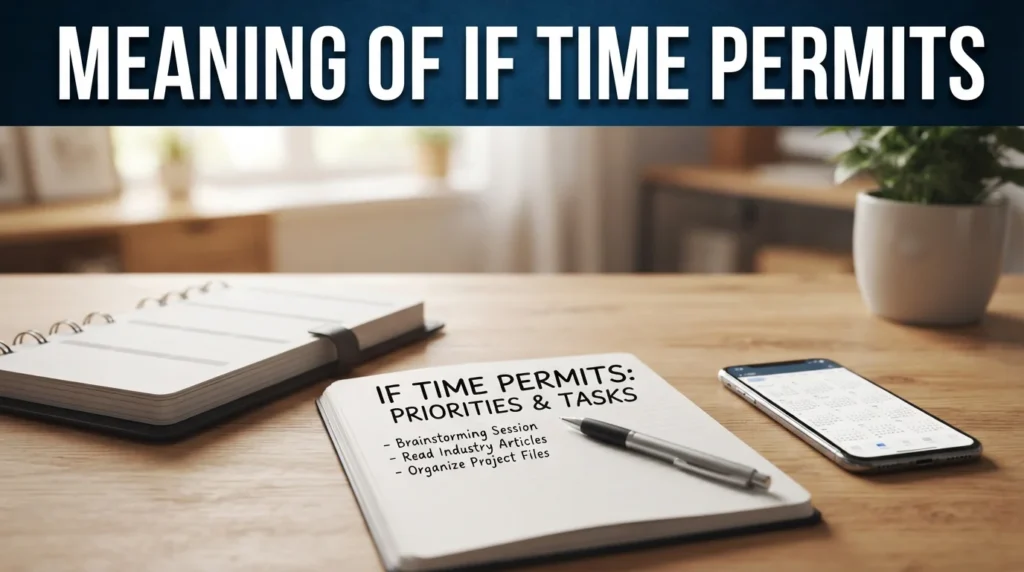
“If time permits” means “if there is enough time available to do something.”
It introduces a condition. The speaker is saying that an activity is possible, but it will happen only if the available time is sufficient.
For example:
If time permits, I’ll review the final section.
This means:
If there is enough time, I’ll review the final section.
The phrase is especially common when someone has a limited schedule and wants to leave room for an additional activity. Oxford specifically gives “We hope to visit the cathedral, if time permits” as an example of permit meaning “to make something possible.”
Definition of If Time Permits
If time permits is a conditional phrase meaning if the available time makes an action possible.
Here, permits does not mean that time is literally giving permission. Instead, permit is being used in the sense of “make possible” or “allow.” Oxford lists both “allow somebody to do something” and “make something possible” among the meanings of permit.
So:
If time permits, we’ll stay for another hour.
means:
If the available time makes it possible, we’ll stay for another hour.
Meaning of If Time Allows
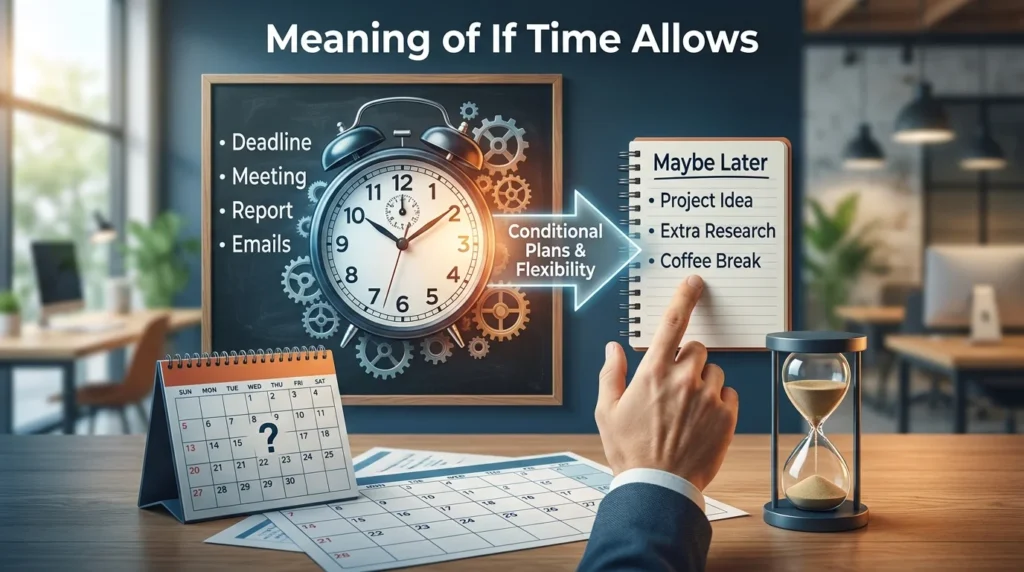
“If time allows” also means “if there is enough time available.”
It is used when an activity depends on having sufficient time.
For example:
If time allows, we can discuss the second proposal.
The speaker wants to discuss the proposal, but that discussion depends on how much time remains.
The verb allow commonly expresses the idea of letting something happen or making something possible. That is why it works naturally with time.
Definition of If Time Allows
If time allows is a conditional phrase meaning if the available time makes it possible to do something.
For example:
If time allows, we’ll stop for coffee.
The sentence means that the coffee stop will happen only if the schedule provides enough time.
In practical usage, “if time allows” and “if time permits” overlap almost completely in meaning.
Main Difference
There is no major difference in meaning between “if time permits” and “if time allows.”
Both describe a situation in which an activity depends on the availability of enough time.
The main distinction is tone and style.
| Feature | If Time Permits | If Time Allows |
| Meaning | If there is enough time | If there is enough time |
| Grammar | Correct | Correct |
| Part of speech | Conditional phrase | Conditional phrase |
| Tone | Slightly formal | Neutral |
| Everyday speech | Less common than simpler alternatives | Natural |
| Professional writing | Very suitable | Very suitable |
| Academic contexts | Suitable | Suitable |
| Meaning difference | Minimal | Minimal |
“If Time Permits” Sounds More Formal
“If time permits” can have a slightly formal or polished tone.
For example:
If time permits, we will address the remaining questions.
This sounds perfectly natural in a presentation, meeting, academic discussion, or formal announcement.
The formality comes partly from the verb permit, which is itself marked as formal in Oxford’s dictionary.
“If Time Allows” Sounds More Neutral
“If time allows” generally feels a little more direct and conversational.
For example:
If time allows, we can review the final section.
This sentence works well in a meeting, email, conversation, or planning discussion.
However, the difference should not be exaggerated. “If time allows” is not informal, and “if time permits” is not restricted to formal writing.
Both Can Usually Be Substituted
In many sentences, you can replace one with the other without changing the intended meaning.
If time permits, we’ll visit the museum.
If time allows, we’ll visit the museum.
Both communicate the same basic idea.
The choice is mainly about how you want the sentence to sound.
Which One Is Correct?
Both “if time permits” and “if time allows” are correct.
Neither should be treated as a mistake simply because the other may be more common in a particular context.
Use “if time permits” when you prefer a slightly more formal or traditional expression.
Use “if time allows” when you want a natural, neutral expression.
For casual conversation, you may prefer an even simpler alternative:
If we have time, we can stop for coffee.
So there are three perfectly useful choices:
- If time permits, slightly formal
- If time allows, neutral
- If we have time, conversational
The best choice depends on your audience and context, not on grammatical correctness.
Grammar and Usage
The Structure of “If Time Permits”
The basic structure is:
if + subject + present-tense verb
In:
If time permits, we’ll continue.
the parts are:
- if = conjunction introducing the condition
- time = singular noun and subject
- permits = present-tense verb
- we’ll continue = main clause
Because time is singular, the verb must be permits, not permit.
Correct:
If time permits, we’ll continue.
Incorrect:
If time permit, we’ll continue.
Oxford’s verb forms confirm that permit takes permits with he, she, or it, which includes a singular noun such as time.
The Structure of “If Time Allows”
The same grammatical pattern applies to allows:
If time allows, we’ll continue.
Here:
- if introduces the condition
- time is the subject
- allows is the singular present-tense verb
- we’ll continue is the result
Correct:
If time allows, we’ll continue.
Incorrect:
If time allow, we’ll continue.
The important point is that time is singular, so the verb takes the third-person singular form.
Why Do We Use the Present Tense?
When an if-clause describes a possible future condition, standard English commonly uses the present tense in the condition clause.
For example:
If time permits, we’ll finish the discussion.
Not:
If time will permit, we’ll finish the discussion.
The first sentence is the normal construction.
The future idea appears in the main clause:
If time permits, we will finish.
The same pattern works with allow:
If time allows, we will finish.
Position in a Sentence
Both phrases can appear at the beginning or end of a sentence.
At the beginning:
If time permits, we’ll answer two more questions.
At the end:
We’ll answer two more questions if time permits.
Likewise:
If time allows, we’ll review the report.
We’ll review the report if time allows.
When the conditional clause comes first, a comma normally separates it from the main clause.
How to Use If Time Permits
“If time permits” works best when an activity is possible but not guaranteed because the schedule is limited.
In Meetings
If time permits, we’ll discuss the budget at the end of the meeting.
This tells participants that the budget discussion is dependent on the remaining time.
In Presentations
If time permits, I’ll take a few questions after the presentation.
This is useful when the speaker has a fixed amount of presentation time.
In Professional Communication
I’ll review the remaining documents if time permits.
This communicates that the task may be completed if the schedule allows.
In Academic Settings
If time permits, we’ll examine the final example.
The phrase works naturally when a teacher has several topics to cover in a limited class period.
When Making Plans
We can visit the old town if time permits.
The visit is possible, but it depends on the available time.
How to Use If Time Allows
“If time allows” is used in essentially the same situations.
In Conversation
If time allows, we can grab coffee after lunch.
The phrase sounds natural without being overly formal.
At Work
If time allows, I’d like to review the proposal with you.
This is appropriate for professional conversations and emails.
During a Meeting
If time allows, we can return to this issue before we finish.
It clearly signals that the topic is secondary to the main agenda.
During Travel
If time allows, we’ll visit the market before heading back.
The plan depends on how much time is available.
In Writing
If time allows, the researchers will examine the remaining data.
This construction can also work naturally in academic or professional writing.
Examples
Examples of If Time Permits
- If time permits, we’ll review the final chapter.
- I’ll answer your questions if time permits.
- If time permits, we can visit the museum tomorrow.
- The speaker will take questions if time permits.
- If time permits, I’ll check the figures again.
- We can discuss the second proposal if time permits.
- If time permits, the teacher will explain the final exercise.
- I’d like to call you later if time permits.
- If time permits, we’ll stop at the bookstore.
- The team will consider the remaining issues if time permits.
Examples of If Time Allows
- If time allows, we’ll review the final section.
- I can help you with the report if time allows.
- If time allows, we’ll visit the gallery after lunch.
- We can discuss the details if time allows.
- If time allows, I’ll call you this afternoon.
- The class can complete another exercise if time allows.
- If time allows, we’ll answer a few more questions.
- I’d like to read the full report if time allows.
- If time allows, we can meet again tomorrow.
- We’ll look at the final example if time allows.
Examples in Professional Communication
Both phrases work well in professional contexts.
If time permits, I’d like to discuss the revised schedule.
If time allows, I’d like to discuss the revised schedule.
The first sounds somewhat more formal. The second sounds slightly more conversational.
Examples in Everyday Conversation
For casual situations, simpler wording is often more natural.
If we have time, we can get something to eat.
You could also say:
If time allows, we can get something to eat.
The second sentence is correct, but the first is generally more conversational.
Common Mistakes
Mistake 1: Using “Permit” Instead of “Permits”
Incorrect:
If time permit, we’ll continue.
Correct:
If time permits, we’ll continue.
The mistake happens because some learners focus on time as an idea rather than as a singular grammatical subject.
Mistake 2: Using “Allow” Instead of “Allows”
Incorrect:
If time allow, we’ll continue.
Correct:
If time allows, we’ll continue.
The verb must agree with the singular subject time.
Mistake 3: Using “Will” After “If”
Incorrect:
If time will permit, we’ll continue.
Correct:
If time permits, we’ll continue.
For an ordinary future condition, the if-clause normally uses the present tense.
Mistake 4: Assuming One Phrase Is Incorrect
Some writers assume that “if time allows” is wrong because they are more familiar with “if time permits.”
That assumption is incorrect.
Both phrases are legitimate English expressions. The difference is primarily stylistic.
Mistake 5: Treating “If Time Permits” as a Promise
I’ll finish the report if time permits.
This does not promise that the report will definitely be finished. It says that finishing it depends on whether enough time is available.
If you need to make a firm commitment, use clearer wording:
I’ll finish the report by Friday.
Mistake 6: Using a Formal Phrase in a Very Casual Situation
There is nothing grammatically wrong with:
We can get ice cream if time permits.
But in a casual conversation, you might naturally say:
We can get ice cream if we have time.
The second version is simpler and more conversational.
Linguistic Insight
The interesting feature of both phrases is that time is treated as something capable of permitting or allowing an action.
Obviously, time does not literally grant permission. This is an ordinary figurative use of language. We describe the available circumstances as either making an action possible or preventing it.
In “if time permits,” the verb permit has the sense “make possible.” Oxford explicitly lists this meaning and provides “if time permits” as an example.
The verb permit ultimately comes from Latin permittere, built from elements meaning roughly “through” and “send” or “let go.” Its modern meanings developed beyond physical movement to include allowing something and making something possible.
The verb allow has a closely related function in the phrase “if time allows.” In both expressions, the subject time represents the available opportunity or scheduling conditions.
This is why the two phrases can normally substitute for one another without changing the central meaning.
Why Does “Permit” Sound More Formal?
One reason is lexical choice. Permit is explicitly marked as formal in Oxford’s learner dictionary.
Compare:
If time permits, we’ll continue.
with:
If we have time, we’ll continue.
The first is more impersonal and formal. The second uses ordinary everyday vocabulary.
That does not make permit better or allow worse. It simply gives the expressions slightly different stylistic flavors.
Usage Tips
Use “If Time Permits” for a More Formal Tone
If you are writing a formal report, giving a presentation, or speaking in an academic setting, “if time permits” is a polished choice.
If time permits, we will examine the remaining evidence.
Use “If Time Allows” for a Neutral Tone
For general communication, “if time allows” is clear and natural.
If time allows, we can review the proposal tomorrow.
Use “If We Have Time” for Casual Conversation
When speaking with friends or family, simpler language often sounds more natural.
If we have time, we’ll stop for coffee.
Remember the Verb Agreement
Think:
- time permits
- time allows
Not:
- time permit
- time allow
The singular noun time requires the singular verb form.
Do Not Confuse “If Time Allows” With “If You Allow”
The meaning changes when the subject changes.
If time allows, we’ll continue.
Here, time determines whether the activity is possible.
If you allow me, I’ll continue.
Here, you are the person giving permission.
The two constructions may use the same verb family, but their meanings are different because their subjects are different.
Expert Suggestion
If you are a student, ESL learner, professional writer, or content creator, remember one simple rule:
Both “if time permits” and “if time allows” are correct.
Choose based on tone:
- Formal: If time permits
- Neutral: If time allows
- Conversational: If we have time
Also remember that “if time permits” does not mean “when I want to.” It specifically indicates that the available time is a condition affecting whether something can happen.
If your real condition is something else, state that condition directly.
Instead of:
I’ll send the document if time permits.
when approval is actually the issue, write:
I’ll send the document once I receive approval.
Clear writing identifies the real condition.
Summary
“If time permits” and “if time allows” are both correct English phrases. Both mean that something will happen only if enough time is available.
The central difference is tone, not meaning. “If time permits” can sound slightly more formal or traditional, while “if time allows” generally has a neutral, natural tone.
Both phrases follow the same basic grammatical pattern:
if + time + singular verb
Therefore, the correct forms are “if time permits” and “if time allows.”
For casual conversation, “if we have time” is often simpler and more natural. In professional or formal writing, either of the two main phrases can work well.
Frequently Asked Questions
Is “if time permits” correct?
Yes. “If time permits” is grammatically correct. It means “if there is enough time” or “if the available time makes something possible.” Oxford lists permit with the meaning “to make something possible” and specifically gives “if time permits” as an example.
Is “if time allows” correct?
Yes. “If time allows” is also correct English. It means that an activity will happen only if enough time is available. It can be used in conversations, emails, meetings, presentations, and formal writing.
What is the difference between “if time permits” and “if time allows”?
The two phrases have essentially the same meaning. Both mean “if there is enough time.” The main distinction is stylistic. “If time permits” can sound slightly more formal, while “if time allows” often sounds more neutral and conversational.
Which is more formal, “if time permits” or “if time allows”?
“If time permits” is generally slightly more formal. The verb permit itself is marked as formal in Oxford’s dictionary. However, “if time allows” is also appropriate in professional and academic writing, so the difference should not be treated as a strict rule.
Can I use “if time permits” in an email?
Yes. “If time permits” works well in professional emails when you want to explain that an additional task or discussion depends on the available time.
For example:
If time permits, I’d like to discuss the final section during our meeting.
Can I use “if time allows” in formal writing?
Yes. “If time allows” is grammatically acceptable in formal writing. It is not an informal or incorrect expression. You may choose “if time permits” if you want a slightly more formal tone, but “if time allows” remains perfectly suitable.
Should I say “if time permit” or “if time permits”?
Say “if time permits.”
Because time is a singular subject, the present-tense verb needs the singular form permits.
Correct:
If time permits, we’ll continue.
Incorrect:
If time permit, we’ll continue.
Should I say “if time allow” or “if time allows”?
Say “if time allows.”
Again, time is singular, so the verb must be allows.
Correct:
If time allows, we’ll continue.
Incorrect:
If time allow, we’ll continue.
Is “if time permits” better than “if time allows”?
Neither is grammatically better. Both are correct. “If time permits” may be preferable when you want a slightly formal tone, while “if time allows” can sound more neutral. The choice depends on context and personal style.
Is “if we have time” the same as “if time permits”?
In most situations, yes. “If we have time” expresses essentially the same condition as “if time permits.” The difference is tone. “If we have time” is more conversational and direct, while “if time permits” sounds more formal and impersonal.
Can “if time permits” go at the end of a sentence?
Yes. It can appear at either the beginning or the end.
If time permits, we’ll discuss the final question.
We’ll discuss the final question if time permits.
Both are correct. When the conditional clause comes first, a comma normally separates it from the main clause.
Can I say “if time will permit”?
Usually, no. For an ordinary future condition, use the present tense after “if.”
Correct:
If time permits, we’ll finish the discussion.
Usually incorrect:
If time will permit, we’ll finish the discussion.
The future meaning is normally expressed in the main clause, not with will inside the if-clause.
What is another way to say “if time permits”?
Common alternatives include “if time allows,” “if we have time,” “if there is enough time,” and “if there’s time.” The best alternative depends on the tone you want. “If we have time” is especially natural in everyday conversation.


1 thought on “If Time Permits or If Time Allows: Meaning & Difference”