
When planning a wedding, arranging a classroom, or describing someone relaxing on a chair, you may wonder whether to write seating or sitting. Both words are correct English, but they serve different purposes. The confusion often arises in phrases such as seating arrangement and sitting arrangement, where choosing the wrong word can make a sentence sound unnatural. Understanding the difference will help you use both words confidently in everyday conversation, professional writing, and formal English.
Quick Answer
Seating usually refers to seats, their arrangement, or the act of providing people with places to sit. Sitting usually describes the action or state of being seated.
| Form | Meaning | Example |
| Seating | Seats, their arrangement, or the act of placing people in seats | The seating arrangement looks elegant. |
| Sitting | The action or state of being seated | She is sitting near the window. |
Both forms are correct, but they are not interchangeable in every sentence.
- Use seating arrangement when referring to how seats or people are organized.
- Use sitting when describing someone’s position or the act of sitting.
- Use sitting position to describe the way a person sits.
- Use seating capacity to describe how many people a venue can accommodate.
Improve your English grammar by learning how to use Farther or Further correctly in everyday conversations, academic writing, and professional communication.
Meaning and Definition
Meaning of Seating

Seating refers to the seats available in a place, the way those seats are arranged, or the process of assigning people to seats. It is commonly used when discussing restaurants, classrooms, theaters, weddings, offices, and other venues.
For example, a wedding planner might discuss the seating arrangement to decide where guests should sit. A theater manager might describe the seating capacity to explain how many people the venue can accommodate.
Common expressions include:
- Seating arrangement
- Seating plan
- Seating capacity
- Seating area
- Seating chart
- Seating options
- Outdoor seating
- Reserved seating
Definition of Seating
Seating is a noun that refers to the provision, availability, or arrangement of seats. It can also refer to the act of assigning or helping people find their seats.
In some contexts, seating functions as the present participle of the verb seat, meaning to place someone in a seat.
Examples:
- The restaurant offers outdoor seating.
- We finalized the seating plan for the conference.
- The host is seating the guests now.
In the first two examples, seating is a noun. In the third, it is part of the verb phrase is seating.
Meaning of Sitting
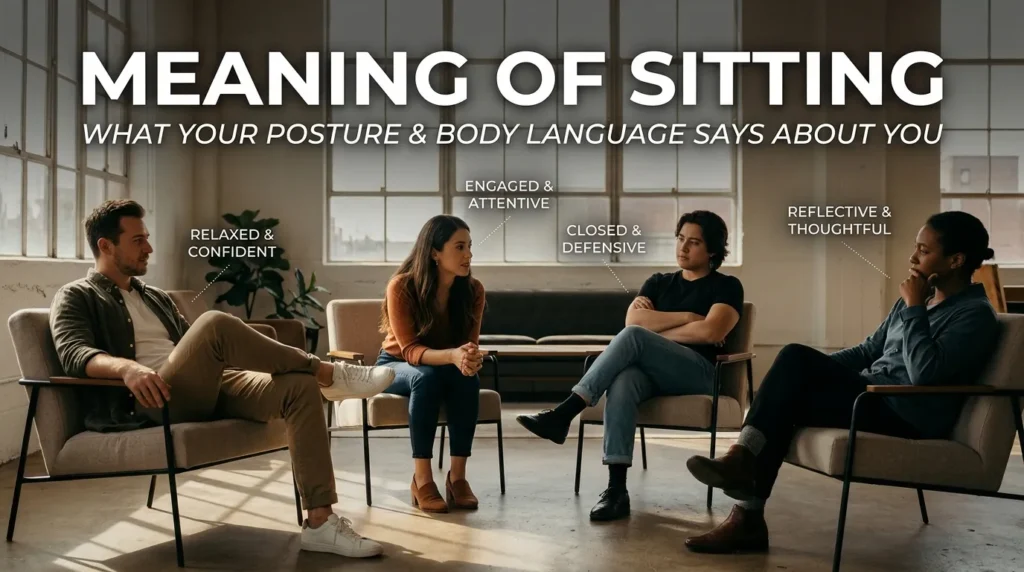
Sitting refers to the action or state of being seated, usually with your weight resting on a chair, bench, floor, or another surface.
It commonly appears when describing someone’s position, an ongoing activity, or the amount of time a person spends seated.
For example, if you say, “The student is sitting near the door,” you are describing the student’s current position.
Common expressions include:
- Sitting position
- Sitting posture
- Sitting still
- Sitting comfortably
- Sitting on a chair
- Sitting at a desk
- Sitting for long periods
- Sitting cross-legged
Definition of Sitting
Sitting is the -ing form of the verb sit. It can function as a present participle in continuous verb tenses or as a gerund, a verb form that functions as a noun.
Examples:
- She is sitting beside her friend. (Present participle)
- Sitting for hours can become uncomfortable. (Gerund)
- The children were sitting quietly. (Present participle)
The word sitting can also function as a noun meaning a period spent seated for a particular purpose, such as a photography session, a meal service, or a formal meeting.
For example, “The artist completed the portrait in two sittings.”
Main Difference
The main difference between seating and sitting is their grammatical function and meaning. Seating usually relates to seats or their arrangement, while sitting describes the act or state of being seated.
| Feature | Seating | Sitting |
| Main grammatical role | Noun, sometimes a verb form | Verb form, gerund, or noun |
| Basic meaning | Available seats or their arrangement | The action or state of being seated |
| Common expression | Seating arrangement | Sitting position |
| Common context | Events, venues, transportation | Personal position and physical activity |
| Example | The seating is limited. | He is sitting outside. |
| Related base verb | Seat | Sit |
| Simple past of the base verb | Seated | Sat |
Consider these examples:
- Correct: The seating arrangement was changed before the meeting.
- Correct: The employees were sitting around the conference table.
The first sentence describes how the seats or people are arranged. The second describes what the employees were doing.
Another important distinction appears in the phrases seating capacity and sitting capacity. In standard English, seating capacity is the natural and established expression for the maximum number of people a venue can accommodate.
Likewise, sitting arrangement may occur in some regional varieties of English, but seating arrangement is the preferred standard expression in professional and formal writing.
Which One Is Correct?
Both seating and sitting are correct English words. The correct choice depends on what you want to communicate.
Use seating when referring to available seats, their arrangement, or the act of assigning people to seats.
Examples:
- The restaurant has limited seating.
- Please check the seating chart before the ceremony.
- The usher is seating the guests.
Use sitting when describing someone being seated or spending time in a seated position.
Examples:
- She is sitting in the front row.
- The children were sitting on the floor.
- I enjoy sitting by the window while reading.
Is It Seating Arrangement or Sitting Arrangement?
Seating arrangement is the preferred standard expression in American and British English.
A seating arrangement describes how chairs are organized or where people are assigned to sit.
Example:
“The teacher changed the seating arrangement to encourage group discussion.”
Although sitting arrangement appears in some regional English usage, especially in parts of South Asia, it is generally less suitable for formal international English.
For academic assignments, professional emails, examinations, and published content, choose seating arrangement.
Make your emails and essays more accurate with practical guidance on using Looser and Loser correctly in sentences without confusing their meanings.
Is It Seating Position or Sitting Position?
Both expressions are possible, but they emphasize different things.
- Sitting position describes the posture or position of a person who is seated.
- Seating position can describe a designated seat or a person’s position within a seating layout, depending on context.
Examples:
- The physiotherapist corrected my sitting position.
- Each participant was assigned a seating position at the conference table.
For ordinary descriptions of body posture, sitting position is usually the more natural choice.
Grammar and Usage
Understanding how each word functions in a sentence makes the difference easier to remember.
How Seating Is Used in English
Seating commonly functions as an uncountable noun when referring to seats collectively, the provision of seats, or the capacity of a venue.
Examples:
- There is plenty of seating in the waiting area.
- The hotel offers comfortable seating.
- Seating is available near the entrance.
It also appears in compound nouns and established expressions.
| Expression | Meaning |
| Seating arrangement | The organization of seats or people’s places |
| Seating plan | A plan showing where people will sit |
| Seating chart | A visual guide to assigned seats |
| Seating capacity | The number of people a venue can accommodate |
| Seating area | A place intended for people to sit |
| Seating policy | Rules governing where or how people may sit |
Seating can also be part of a continuous verb tense when the base verb is seat.
For example, “The receptionist is seating the visitors.”
Here, the receptionist is actively directing or placing visitors in seats.
How Sitting Is Used in English
Sitting commonly appears in continuous verb tenses.
Examples:
- I am sitting near the entrance.
- She was sitting beside her manager.
- They have been sitting here for an hour.
It can also function as a gerund.
Examples:
- Sitting too long can be uncomfortable.
- Sitting near the front helps me see the screen.
- He prefers sitting outside in the evening.
As a noun, sitting may describe a session or period of time.
Examples:
- The photographer completed the shoot in one sitting.
- The court began its morning sitting.
- We finished the book in a single sitting.
The Difference Between Seat and Sit
The words seat and sit are closely related, but their grammar differs.
Seat can be a noun referring to a place to sit or a verb meaning to place someone in a seat. Sit is primarily a verb describing being or moving into a seated position.
| Base form | Present participle | Simple past | Past participle |
| Seat | Seating | Seated | Seated |
| Sit | Sitting | Sat | Sat |
Examples:
- The host seats the guests.
- The host is seating the guests.
- The guests sit near the stage.
- The guests are sitting near the stage.
- The guests sat near the stage yesterday.
- The guests have sat there before.
Notice that the past forms are different. The past tense of sit is sat, not seated, when describing the ordinary act of sitting.
How to Use Seating or Sitting
The easiest way to choose the correct word is to identify whether you are discussing seats and their organization or the act of being seated.
Use Seating for Arrangements and Available Seats
Choose seating when describing the layout, number, availability, or assignment of seats.
Examples:
- We need to finalize the seating arrangement.
- The hall has seating for 300 guests.
- The restaurant offers indoor and outdoor seating.
- The event coordinator prepared a seating chart.
- The airline confirmed our seating preferences.
These sentences focus on the seats or the organization of people within a venue.
Use Sitting for Positions and Activities
Choose sitting when describing someone’s physical position or an activity involving being seated.
Examples:
- My brother is sitting on the sofa.
- The students were sitting in small groups.
- I spend several hours sitting at my desk.
- She enjoys sitting beside the fireplace.
- The child was sitting cross-legged on the floor.
These sentences describe a person or people in a seated position.
Use the Verb Seating When Someone Assigns Seats
Remember that seating is not always a noun. It can also describe an action performed by someone who gives people places to sit.
Examples:
- The staff are seating the guests now.
- The usher is seating visitors in the front row.
- We will begin seating passengers shortly.
In these examples, seating is part of the verb phrase. It describes the process of placing or directing people to seats.
Choose Natural Expressions
Some word combinations are more established than others. Learning them as complete phrases can help you avoid mistakes.
| Natural expression | Example |
| Seating arrangement | The seating arrangement was changed. |
| Seating capacity | The venue has a seating capacity of 500. |
| Seating plan | Please review the seating plan. |
| Sitting position | Adjust your sitting position. |
| Sitting posture | Good sitting posture can improve comfort. |
| Sitting room | We relaxed in the sitting room. |
| Sitting still | The child had difficulty sitting still. |
Examples
The following examples show how seating and sitting work in everyday and professional English.
Examples of Seating
- The hotel provides comfortable seating for its guests.
- We changed the seating arrangement for the wedding reception.
- The stadium has a seating capacity of 25,000 people.
- Please check the seating chart before entering the conference hall.
- Outdoor seating is available at the restaurant.
- The event organizer is responsible for seating the guests.
- The airline offers several seating options for passengers.
- The theater has limited seating for late arrivals.
- The teacher created a new seating plan for the classroom.
- The receptionist is seating visitors in the waiting area.
Examples of Sitting
- My sister is sitting on the sofa.
- The students were sitting quietly during the examination.
- He enjoys sitting near the window while reading.
- I have been sitting at my desk for two hours.
- The children are sitting around the dining table.
- She sat beside her colleague during the meeting.
- Sitting in the same position for too long can be uncomfortable.
- The photographer completed the portrait in one sitting.
- The committee held an additional sitting to discuss the proposal.
- Please stop sitting on the edge of the table.
Examples of Seating and Sitting in Similar Contexts
These paired examples highlight the difference more clearly.
| Seating | Sitting |
| The seating arrangement needs to change. | The students are sitting in different groups. |
| The restaurant has limited seating. | The customers are sitting outside. |
| The seating plan is ready. | Everyone is sitting in the assigned place. |
| The staff are seating the guests. | The guests are sitting comfortably. |
| The hall has seating for 200 people. | Two hundred people are sitting in the hall. |
Notice that seating can describe an arrangement, available places, or an action performed by staff. Sitting describes the position or activity of the people themselves.
Common Mistakes
1. Writing Sitting Arrangement Instead of Seating Arrangement
Incorrect in standard professional usage: We prepared the sitting arrangement for the conference.
Correct: We prepared the seating arrangement for the conference.
Why it happens: Both words relate to sitting, so writers sometimes confuse the activity with the organization of seats.
Use seating arrangement when referring to a planned layout of seats or assigned places.
2. Using Seating Instead of Sitting in a Continuous Tense
Incorrect: She is seating beside her mother.
Correct: She is sitting beside her mother.
Why it happens: Learners may assume that seating is the continuous form of sit. However, seating comes from the verb seat, which usually takes an object when it means placing someone in a seat.
Compare:
- She is sitting beside her mother.
- She is seating her daughter beside her mother.
The first describes someone’s position. The second describes someone arranging another person’s position.
3. Confusing Seating Capacity With Sitting Capacity
Incorrect in standard venue-related usage: The hall has a sitting capacity of 500 people.
Correct: The hall has a seating capacity of 500 people.
Why it happens: Writers may think sitting capacity means the number of people who can sit in a room.
Use seating capacity to describe the maximum number of people a venue can accommodate in its seats.
4. Writing Seating Position When Referring to Body Posture
Less natural for general posture: Maintain a comfortable seating position while working.
More natural: Maintain a comfortable sitting position while working.
Why it happens: Both phrases are understandable, but sitting position is the usual expression when discussing body posture.
Use seating position when referring to an assigned or designated place in a vehicle, room, or seating layout.
5. Using Seating Down Instead of Sitting Down
Incorrect: Please seating down before the presentation begins.
Correct: Please sit down before the presentation begins.
You can also say, “Please start sitting down,” when referring to the process of taking seats, although Please sit down is more direct and natural.
Why it happens: Learners may confuse seating with the verb form required after a command. The base verb sit is used for this instruction.
6. Confusing Seated With Sitting
Both words can describe someone in a seated position, but they work differently in sentences.
Examples:
- She is sitting near the entrance.
- She is seated near the entrance.
Both sentences are correct. Sitting emphasizes the action or ongoing position, while seated often presents the position more formally or descriptively.
Linguistic Insight
Word Formation and Origins
The words seating and sitting come from two closely related English verbs, seat and sit.
The noun seat has historical roots in Old Norse, while sit developed from the Old English verb sittan. Both belong to a broader family of Germanic words connected with the idea of occupying a place or resting in a seated position.
Over time, English developed different grammatical forms to express related but distinct ideas.
- Sit → sitting: Describes the action or state of being seated.
- Seat → seating: Often refers to providing seats, arranging them, or placing people in them.
The endings are not enough by themselves to determine meaning. The base word matters.
Morphology: Why the Endings Can Be Confusing
Morphology is the study of how words are formed and how their parts contribute to meaning.
Both sitting and seating end in -ing, but the ending attaches to different base verbs.
In sitting, the consonant t is doubled when the verb sit takes the -ing ending. In seating, the final e of seat is dropped before adding -ing.
This produces two correctly spelled words with different grammatical functions.
The same pattern appears in other English verbs:
- Run → running
- Make → making
- Set → setting
- Write → writing
Understanding these spelling patterns helps learners recognize word forms without assuming that words with the same ending have identical meanings.
Syntax: How Each Word Works in a Sentence
Syntax refers to how words combine to form grammatical sentences.
Consider these examples:
- The seating is comfortable. Here, seating is a noun.
- The staff are seating the guests. Here, seating is part of a verb phrase.
- The guests are sitting comfortably. Here, sitting is part of a verb phrase.
- Sitting for too long can be tiring. Here, sitting functions as a noun-like gerund.
The surrounding words help determine the role of each form. In the second sentence, the staff perform an action on the guests. In the third, the guests themselves occupy seated positions.
Regional Usage and Standard English
English varies across regions, and some expressions are more common in particular communities than others.
For example, sitting arrangement appears in some regional varieties of English, including some South Asian contexts. However, seating arrangement is the more widely established expression in international professional English.
This distinction does not mean that every regional expression is meaningless or that speakers cannot understand it. Rather, writers should choose expressions that fit their audience and purpose.
For formal international communication, academic writing, and professional publications, seating arrangement is the safer choice.
Pronunciation
In standard American English, the two words are pronounced differently:
- Seating: /ˈsiːtɪŋ/
- Sitting: /ˈsɪtɪŋ/
The first vowel in seating is the long vowel sound /iː/, as in see. The vowel in sitting is the short /ɪ/ sound, as in sit.
The ending sounds similar in both words, so the vowel provides an important distinction.
Practicing the pair aloud can help learners recognize the difference in conversation.
Usage Tips
1. Remember the Base Word
Connect seating with seat and sitting with sit.
- Seats are arranged, provided, or counted.
- People sit, remain seated, or spend time sitting.
This simple connection works for most everyday situations.
2. Learn Common Word Combinations
Memorize these established expressions rather than translating directly from your first language.
Use seating with:
- Arrangement
- Chart
- Plan
- Capacity
- Area
- Options
Use sitting with:
- Position
- Posture
- Still
- Comfortably
- Cross-legged
- In one sitting
These combinations are useful in conversations, examinations, emails, and formal writing.
3. Ask What the Sentence Describes
Before choosing a word, ask yourself one question:
Am I describing the seats or the act of sitting?
If you are discussing the seats or how they are organized, seating is usually appropriate.
If you are describing a person who is seated or an activity involving sitting, sitting is usually appropriate.
4. Check the Verb in Continuous Sentences
When describing someone who is already in a seated position, use is sitting, are sitting, or was sitting.
When describing someone who is placing other people in seats, use is seating, are seating, or was seating.
For example:
- The manager is sitting near the entrance.
- The manager is seating the visitors.
5. Choose Established Expressions in Formal Writing
For business emails, reports, event plans, and academic work, use standard expressions such as seating plan, seating chart, and seating capacity.
Natural word combinations make your writing clearer and more professional.
Expert Suggestion
As a grammar teacher, I recommend learning seating and sitting through complete phrases rather than memorizing their definitions alone.
Practice using these four sentences:
- The seating arrangement is ready.
- The guests are sitting in their assigned places.
- The hall has a seating capacity of 400 people.
- Sitting for long periods can be uncomfortable.
Notice that seating usually focuses on the places or their organization, while sitting focuses on the action, state, or duration.
For content writers and English learners, the most important rule is to check the meaning of the entire phrase. If you are writing about an event or venue, expressions such as seating arrangement and seating capacity will usually be appropriate. If you are describing a person, sitting is often the better choice.
Summary
- Seating refers to available seats, their arrangement, or the act of assigning people to seats.
- Sitting refers to the action or state of being seated and can also describe a session or period spent seated.
- Both words are correct, but they have different meanings and grammatical functions.
- Use seating arrangement, seating plan, and seating capacity in standard English.
- Use sitting position, sitting posture, and sitting down when describing the act or position of sitting.
- Remember that seating can be a noun or a verb form, while sitting can be a verb form, gerund, or noun.
The simplest rule is this: seating concerns seats and their organization, while sitting concerns the act or state of being seated.
Frequently Asked Questions
1. What is the difference between seating and sitting?
Seating usually refers to seats, their arrangement, or the process of placing people in seats. Sitting describes the act or state of being seated. For example, seating arrangement is correct, while sitting on a chair describes an action.
2. Is seating or sitting correct?
Both are correct English words. The appropriate choice depends on the context. Use seating for seat arrangements and capacity, and sitting for someone’s position or the act of being seated.
3. Is it seating arrangement or sitting arrangement?
Seating arrangement is the preferred standard expression in American and British English. It refers to how seats are organized or where people are assigned to sit. Sitting arrangement occurs in some regional usage but is less suitable for formal international writing.
4. Is it seating capacity or sitting capacity?
Seating capacity is the standard expression. It describes the number of people a venue can accommodate in its seats. For example, “The auditorium has a seating capacity of 1,000.”
5. Is it sitting position or seating position?
Both expressions can be correct. Sitting position usually describes a person’s body posture, while seating position may refer to a designated place in a room or vehicle. Choose according to the intended meaning.
6. Is sitting down or seating down correct?
Sitting down is the correct expression for the act of moving into or occupying a seated position. For an instruction, use sit down. Seating down is not standard for this meaning.
7. What is the difference between seating and seated?
Seating commonly refers to seats or the action of placing someone in a seat. Seated describes someone or something that is in a seated position. For example, “The staff are seating the guests” describes an action, while “The guests are seated” describes their position.
8. Can seating be used as a verb?
Yes. Seating is the -ing form of the verb seat. It can describe placing or directing people to seats. For example, “The usher is seating the audience.”
9. Can sitting be used as a noun?
Yes. Sitting can function as a gerund, as in “Sitting for long periods can be tiring.” It can also mean a session or period spent seated, as in “She finished the book in one sitting.”
10. Why do people confuse seating and sitting?
The words are related in meaning, have similar spellings, and both end in -ing. However, they come from different base verbs, seat and sit, and serve different grammatical purposes. Learning common phrases helps prevent confusion.
11. Is sitting arrangement grammatically wrong?
The phrase is understandable and appears in some regional varieties of English, but seating arrangement is the more established expression in standard professional English. Use seating arrangement in formal writing, academic assignments, and international communication.
12. What is the difference between seating and sitting in a sentence?
In “The seating is comfortable,” seating refers to the seats provided. In “The visitors are sitting comfortably,” sitting describes what the visitors are doing. The words differ in both meaning and grammatical function.
13. How do you remember when to use seating or sitting?
Remember that people sit, while seats make up the seating. Use sitting to describe the action or position of a person and seating to describe seats, their arrangement, or their availability.
14. Is seating or sitting used differently in American and British English?
The basic distinction is the same in both varieties. Both American and British English use expressions such as seating arrangement, seating capacity, and sitting position. Some regional expressions may vary, but the standard usage remains consistent.
15. Which word should I use in formal writing?
Use seating for expressions such as seating plan, seating arrangement, and seating capacity. Use sitting when describing a person’s position, posture, or activity. Always choose the word that accurately expresses your intended meaning.

