
When you use a website, arrive at an office, or access an account, you may wonder whether the correct form is sign in, signin, or sign-in. The confusion usually comes from seeing different versions in websites, apps, buttons, and technical documentation. However, these forms do not all serve the same grammatical function. In standard English, sign in is the normal verb form, while sign-in can function as a noun or adjective. Signin is generally not the standard form in edited English.
Quick Answer
Sign in is the standard form when you are using the phrase as a verb.
Sign-in is commonly used as a noun or adjective, especially in dictionaries and general English usage.
Signin is generally not recommended as a standard English spelling, although you may see it in software, URLs, product names, code, or other technical contexts.
| Form | Standard use | Example |
| sign in | Verb | Please sign in to your account. |
| sign-in | Noun or adjective | The sign-in process was quick. |
| signin | Generally not standard | Avoid this spelling in normal prose. |
Cambridge Dictionary defines sign in as a phrasal verb used for entering personal details on a website or recording your arrival at a place. Microsoft and Google style guidance also distinguish the verb sign in from the hyphenated noun or adjective sign-in.
If you want to express attractiveness vividly, learn similes for beauty that make descriptions more engaging.
Meaning and Definition
Meaning of Sign In

Sign in means to enter a place, system, website, application, or account by providing your name, details, username, password, or other required information.
The phrase has two especially common meanings.
First, it can mean recording your arrival at a physical location:
Visitors must sign in at the front desk.
Second, it can mean accessing a digital account or service:
Please sign in to your account before continuing.
Cambridge Dictionary recognizes both uses. It describes signing in at a building and entering personal information on a website or similar service.
Definition of Sign In
Sign in is a phrasal verb meaning to enter or access something by identifying yourself, or to record your arrival by entering your name or other required information.
In computing, it commonly refers to entering credentials to access a protected account, application, network, or website. In everyday situations, it can refer to writing your name in a register when you arrive somewhere.
For example:
Employees sign in when they arrive at the office.
I need to sign in before I can view my account.
Meaning of Sign-In
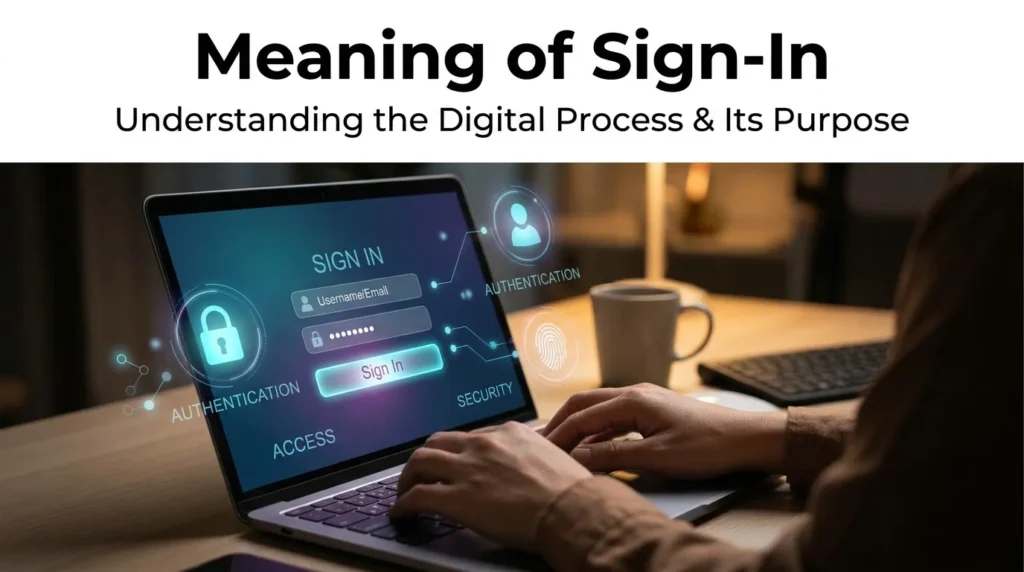
Sign-in refers to the act, process, event, or procedure of signing in. It can also describe something associated with signing in.
For example:
The sign-in took less than a minute.
Here, sign-in is a noun.
It can also appear before another noun as an adjective:
The sign-in page is easy to use.
In this sentence, sign-in modifies the noun page.
Definition of Sign-In
Sign-in is a hyphenated noun meaning an act or instance of signing in. It can also work as a compound modifier describing something related to the sign-in process.
Dictionary.com lists sign-in as a noun meaning an act, instance, or time of signing in.
The important point is that sign-in does not normally replace the verb sign in.
You would write:
Please sign in to your account.
Not:
Please sign-in to your account.
Meaning of Signin
Signin is generally not the preferred standard spelling in ordinary English prose.
You may encounter signin in technical environments, software interfaces, filenames, URLs, programming systems, or product-specific terminology. Its appearance in those contexts does not mean that it is the preferred spelling for general English writing.
Microsoft’s style guidance specifically advises against signin, while Google’s developer style guide recommends sign-in for the noun or adjective and sign in for the verb.
Definition of Signin
Signin is not normally treated as the standard form of the verb phrase in edited general English.
Therefore, it is better not to create a normal dictionary-style definition for signin as though it were interchangeable with sign in.
If you are writing an email, article, report, academic paper, or other standard English text, use sign in as the verb.
Improve your vocabulary with Halloween similes for spooky descriptions that add atmosphere to stories and creative writing.
Main Difference
The main difference is grammatical function.
Sign in consists of two words and normally functions as a verb phrase. Sign-in uses a hyphen and is commonly used as a noun or adjective. Signin, written as one word, is generally avoided in standard editorial style.
| Form | Function | Example |
| sign in | Verb | Sign in to continue. |
| sign-in | Noun | The sign-in was completed successfully. |
| sign-in | Adjective | Open the sign-in page. |
| signin | Generally avoided in standard prose | Use sign in instead. |
This distinction follows a common English pattern in which a multiword verb remains open while a related compound noun or modifier may become hyphenated.
Google’s developer documentation explicitly recommends sign-in as a noun or adjective and sign in as a verb.
Which One Is Correct?
All three spellings are not equally appropriate.
Is Sign In Correct?
Yes. Sign in is the correct standard form when it functions as a verb.
Examples include:
Please sign in to your account.
You must sign in before accessing the dashboard.
Remember to sign in when you arrive.
Cambridge Dictionary identifies sign in as a phrasal verb.
Is Sign-In Correct?
Yes, sign-in is correct when it functions as a noun or adjective.
As a noun:
The sign-in took only a few seconds.
As an adjective:
Click the sign-in button.
However, style preferences can vary. Microsoft, for example, recommends avoiding sign-in as a noun or adjective in its own documentation and instead suggests using more descriptive wording. This is a style preference, not evidence that the compound is universally ungrammatical.
Is Signin Correct?
Signin is generally not the preferred standard form in normal English writing.
You might see it in a website address, application interface, source code, file name, or proprietary terminology. Such technical usage does not make it the best choice for ordinary prose.
For general writing, use:
- sign in for the verb
- sign-in for a noun or adjective when the context calls for it
Grammar and Usage
Sign in is a phrasal verb. It combines the verb sign with the particle in.
Its forms change according to tense and subject:
| Form | Example |
| Base form | sign in |
| Third-person singular | signs in |
| Present participle | signing in |
| Past tense | signed in |
| Past participle | signed in |
Examples:
I sign in every morning.
She signs in before starting work.
They are signing in now.
He signed in at the reception desk.
We have signed in already.
The phrase can also be followed by to when you identify the destination or service:
Please sign in to your account.
She signed in to the company portal.
The construction sign in to contains two separate elements: the phrasal verb sign in and the preposition to.
Sign In to vs. Sign Into
In standard usage, especially in careful professional writing, sign in to is the safest choice when to introduces the destination.
Please sign in to the website.
I signed in to my email account.
Some speakers and organizations also use sign into, particularly in informal or technology-related writing. However, major style guides may prefer the two-word construction. Microsoft explicitly recommends sign in to rather than sign into, while Google gives the same guidance.
How to Use Sign In
Use sign in when the phrase describes an action.
Signing In to an Account
When you access an online account, use sign in as the verb.
I need to sign in to my banking account.
Please sign in to your profile.
Users must sign in before downloading the file.
Signing In at a Location
The phrase also applies to physical locations.
All visitors must sign in at reception.
Please sign in when you arrive.
Guests are required to sign in at the security desk.
Cambridge includes this physical meaning alongside the digital meaning.
Asking Someone to Sign In
Use the base form after please, to, or another structure that requires the base verb.
Please sign in.
You need to sign in first.
Remember to sign in when you arrive.
Talking About a Completed Action
Use signed in for a completed action.
I signed in at 9:00 a.m.
She signed in to the application earlier.
Talking About an Ongoing Action
Use signing in when the action is in progress.
The employees are signing in now.
I was signing in when the system stopped responding.
Examples
Examples of Sign In
Please sign in to your account before placing the order.
Students must sign in at the library entrance.
I forgot to sign in this morning.
You can sign in using your email address.
Visitors should sign in at the front desk.
She signed in to the company portal from her laptop.
We need to sign in before joining the online meeting.
Remember to sign in when you arrive at the conference.
These examples use sign in as a verb, so the two words remain separate.
Examples of Sign-In
Sign-in can function as a noun:
The sign-in took less than a minute.
We recorded the sign-in time for each visitor.
It can also function as an adjective:
The sign-in page is currently unavailable.
The sign-in process has been updated.
Check the sign-in screen for instructions.
Notice the difference:
Please sign in to your account.
The sign-in page is available now.
The first sentence uses a verb. The second uses a compound modifier.
Examples of Signin
Because signin is generally not the preferred standard form, avoid using it in ordinary sentences.
Instead of:
Please signin to your account.
Write:
Please sign in to your account.
Instead of:
The signin page is unavailable.
Write:
The sign-in page is unavailable.
If a particular software product officially uses Signin as a brand, interface label, variable, or technical identifier, preserve that official spelling when referring specifically to the product.
Common Mistakes
Writing Signin as the Verb
Incorrect: Please signin to your account.
Correct: Please sign in to your account.
The mistake happens because many compound words in English are written as one word, and users frequently see compressed forms in digital products.
Hyphenating the Verb
Incorrect: Please sign-in to your account.
Correct: Please sign in to your account.
The hyphen is unnecessary when sign in functions as a verb.
Using Sign-In as the Verb
Incorrect: You must sign-in before entering.
Correct: You must sign in before entering.
Use sign-in when it functions as a noun or modifier, not as the ordinary verb.
Using Signin in Formal Writing
Weak: Employees should signin when they arrive.
Better: Employees should sign in when they arrive.
Formal and professional writing should normally use the standard two-word verb.
Confusing Sign In With Sign Up
Sign in usually means accessing an existing account or recording your arrival.
Sign up usually means registering for something or creating a new account.
For example:
If you already have an account, sign in.
If you are a new user, sign up.
This distinction is especially important on websites and applications.
Confusing Sign In With Sign Out
Sign in means entering or accessing a system.
Sign out means ending your session or leaving a system.
Please sign in when you arrive.
Please sign out before leaving.
Linguistic Insight
The expression sign in is a phrasal verb. Phrasal verbs combine a verb with another short word, often called a particle, to create a meaning that works as a unit.
In sign in, the verb sign originally relates to writing or recording one’s name, while in contributes the idea of entering or being within a place or system.
The expression developed naturally from physical situations in which people recorded their arrival. Over time, its meaning expanded into computing and online services. Today, sign in is widely used for accessing websites, applications, devices, and other digital systems.
The noun sign-in developed from the verb phrase. This is not unusual in English. The language often turns verb phrases into compound nouns, sometimes using a hyphen to make the grammatical relationship clearer.
Dictionary.com dates the noun sign-in to the mid-20th century and describes it as a noun derived from the verb phrase sign in.
The reason people confuse sign in, sign-in, and signin is partly because digital interfaces frequently compress language. A website may use labels, buttons, URLs, filenames, and technical identifiers that follow product-specific conventions rather than general editorial rules.
For that reason, seeing signin in software does not automatically mean that signin is the preferred form in standard English.
Usage Tips
Remember these three rules:
- Use sign in as a verb: Please sign in to your account.
- Use sign-in as a noun or adjective when appropriate: The sign-in process was easy.
- Avoid signin in ordinary English prose: Use sign in instead.
A simple memory trick is to ask yourself whether sign in describes an action.
If it does, keep the words separate:
I need to sign in.
If you are naming the process or describing something related to it, sign-in may be appropriate:
The sign-in process is simple.
Also remember the common pattern sign in to:
Sign in to your account.
This is especially useful in professional and technical writing.
Expert Suggestion
If you’re writing an article, email, report, academic paper, or business document, use sign in whenever it functions as a verb.
When you need a noun or adjective, sign-in is widely recognized and grammatically established, although individual style guides may recommend alternative wording. Follow the style guide of your organization when one exists.
Most importantly, don’t assume that signin is correct simply because you see it in an app, URL, or technical interface. Digital products often use compact terminology that does not necessarily follow ordinary editorial style. Microsoft’s and Google’s style guidance both distinguish sign in from sign-in and advise against signin in standard documentation.
Summary
Sign in is the standard two-word verb used for entering a physical location or accessing an account, website, application, or system.
Sign-in is a legitimate hyphenated noun and adjective in general English. For example, you can write the sign-in process or the sign-in page.
Signin is generally not the preferred spelling in standard English prose. It may appear in technical systems, URLs, code, or product-specific terminology, but that does not make it the normal written form.
The easiest rule is simple: sign in for the action, sign-in for an appropriate noun or modifier, and generally avoid signin in ordinary writing.
Frequently Asked Questions
Is sign in one word or two words?
Sign in is two words when it functions as a verb. For example, write, “Please sign in to your account.” Do not normally combine the words into signin in standard English prose.
Is sign-in one word or two words?
Sign-in is written with a hyphen when it functions as a noun or adjective. For example, “The sign-in process was quick” uses it as an adjective, while “The sign-in took one minute” uses it as a noun.
Is signin correct English?
Signin is generally not the preferred standard spelling in ordinary English writing. You may encounter it in technical contexts, product interfaces, URLs, or code, but standard prose normally uses sign in as the verb.
Which is correct, sign in or sign-in?
Both can be correct, but they have different grammatical functions. Sign in is the standard verb, while sign-in can be a noun or adjective. For example, “Please sign in” and “the sign-in page” are both correct.
Should I write sign in to or sign into?
Sign in to is the safest choice in careful standard and professional writing when to introduces the destination. For example, “Please sign in to your account.” Some speakers and organizations use sign into, but major style guides recommend the separate construction.
Is sign-in a noun?
Yes. Sign-in can be a noun referring to the act, process, or instance of signing in. For example, “The sign-in took only a few seconds.” Dictionary.com lists sign-in as a noun with this meaning.
Is sign-in an adjective?
Yes. Sign-in can function as a compound modifier before a noun. For example, “sign-in page,” “sign-in process,” and “sign-in screen” are common constructions.
What does sign in mean?
Sign in means to record your arrival somewhere or enter information needed to access a website, application, account, or other system. Cambridge Dictionary recognizes both physical and digital uses of the phrase.
Is sign in formal English?
Yes. Sign in is standard English and is suitable for professional, academic, technical, and everyday writing. The phrase is widely recognized in both physical and digital contexts.
Is sign in the same as log in?
They can have essentially the same meaning when referring to accessing a digital account. Sign in is often preferred by particular organizations and style guides, while log in is also widely established in English. The choice may depend on the organization’s terminology.
Is sign in the opposite of sign out?
Yes, in many digital and workplace contexts. Sign in means entering or accessing a system, while sign out means ending your session or leaving the system. Both are normally written as two-word verbs.
Should I use sign-in in a sentence like “Please sign-in”?
No. When the phrase is the verb, write Please sign in. The hyphenated form is generally used when sign-in functions as a noun or modifier.
Why do websites use signin as one word?
Websites and software sometimes use signin because technical systems may favor compact labels, URLs, filenames, identifiers, or product-specific naming conventions. This does not mean that signin is the preferred spelling in standard English prose.
Which form should I use in formal writing?
Use sign in as the verb. Use sign-in when you need an established noun or compound modifier and your chosen style guide permits it. Avoid signin unless you are reproducing an official technical or product-specific name.

