
Have you ever paused while writing a message to decide whether to use maybe or may be? Both forms are correct in English, and they can express uncertainty, which is why they are easy to confuse. However, they serve different grammatical functions and cannot always replace each other.
You may encounter this distinction in everyday conversations, emails, academic assignments, and professional writing. Understanding the difference between maybe and may be will help you choose the correct form, avoid common spelling mistakes, and write more naturally.
Quick Answer
Maybe is an adverb that means perhaps or possibly. May be is a verb phrase that expresses possibility using the modal verb may and the verb be.
| Form | Correct? | Meaning | Main Use |
| Maybe | Yes | Perhaps or possibly | Expressing uncertainty about a statement |
| May be | Yes | Might be or could be | Expressing possibility about a condition, identity, or situation |
Examples:
- Maybe: Maybe we should leave early.
- May be: She may be late for the meeting.
A useful test is to replace maybe with perhaps. If the sentence still makes sense, maybe is probably the correct choice. If the sentence needs a verb phrase expressing possibility, may be is usually appropriate.
Clear up a common grammar confusion by learning the difference between its and it’s and when each form belongs in a sentence.
Meaning and Definition
Meaning of Maybe
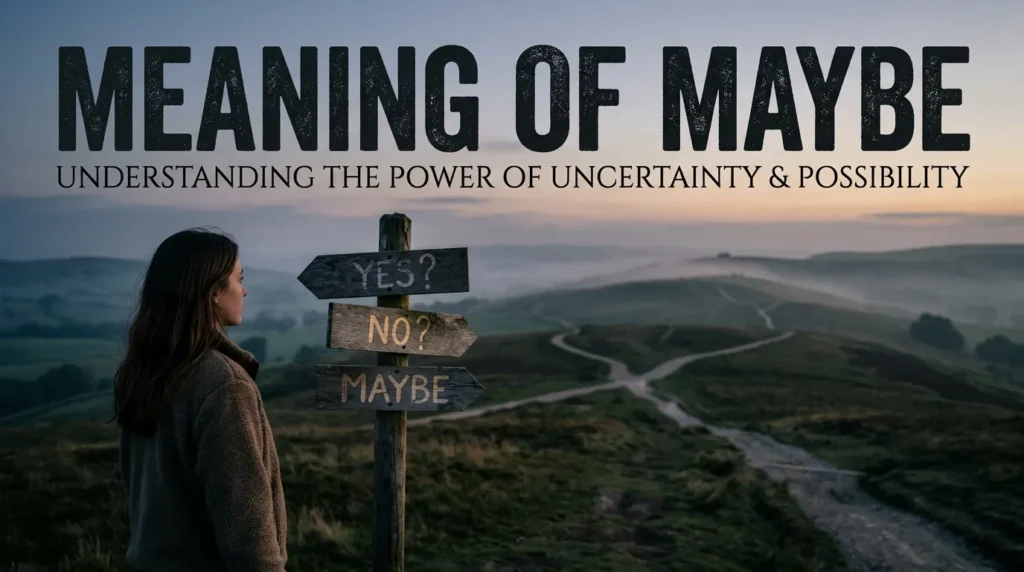
Maybe means perhaps, possibly, or it is possible that something is true or will happen. It expresses uncertainty without confirming or denying something.
People commonly use maybe when making suggestions, answering questions, discussing plans, or estimating quantities.
Examples:
- Maybe we can meet after work.
- Maybe he forgot to call me.
- The journey will take maybe two hours.
- “Are you coming to dinner?” “Maybe.”
In each example, maybe communicates possibility rather than certainty.
Definition of Maybe
Maybe is an adverb meaning perhaps or possibly. It modifies a sentence, clause, or statement to indicate that something is uncertain or could happen.
It can also function informally as a noun when referring to an uncertain answer or possibility.
Examples:
- Adverb: Maybe she will accept the invitation.
- Noun: His answer was a definite maybe.
As an adverb, maybe can appear at the beginning, middle, or end of a sentence, depending on the intended meaning and sentence structure.
Meaning of May Be

May be expresses the possibility that someone or something has a particular quality, identity, condition, or role. It can also describe a possible action or situation.
Examples:
- She may be tired after the journey.
- This may be the right address.
- They may be waiting outside.
- The answer may be different from what we expected.
In these sentences, may be indicates that something is possible but not certain.
Definition of May Be
May be is a verb phrase consisting of the modal auxiliary verb may and the verb be. The modal may expresses possibility, while be connects the subject to a description, identity, condition, or ongoing action.
Examples:
- He may be a good candidate for the position.
- The weather may be improving.
- There may be a problem with the connection.
Unlike the single-word adverb maybe, the phrase may be functions as part of the verb phrase in a sentence.
Main Difference
The main difference between maybe and may be is their grammatical function. Although both can express uncertainty, they work differently within a sentence.
| Feature | Maybe | May Be |
| Spelling | One word | Two words |
| Part of speech | Usually an adverb, sometimes a noun | Verb phrase |
| Meaning | Perhaps or possibly | Might be or could be |
| Sentence function | Modifies a statement or expresses uncertainty | Forms part of the predicate |
| Common position | Beginning, middle, or end of a sentence | Usually after the subject |
| Example | Maybe she is busy. | She may be busy. |
| Replacement test | Replace with perhaps | Replace with might be |
Consider these two sentences:
- Maybe she is at home. This means perhaps she is at home.
- She may be at home. This means she might be at home.
Both sentences communicate a similar idea, but the grammatical structures are different.
A useful distinction is that maybe introduces or modifies a possibility, while may be expresses that possibility through a verb phrase.
Which One Is Correct?
Both maybe and may be are correct standard English forms. Neither is inherently incorrect. The right choice depends on the sentence.
Use maybe when you mean perhaps.
- Maybe we should ask for directions.
- Maybe the package will arrive tomorrow.
- I will call her later, maybe.
Use may be when you need the modal verb may followed by be.
- She may be available tomorrow.
- The package may be delayed.
- This may be the answer we need.
Remember that the two forms are not always interchangeable without changing the sentence structure.
For example:
- Correct: Maybe he is right.
- Correct: He may be right.
- Incorrect for the intended meaning: He maybe right.
The last sentence needs may be because right describes the subject he, and the sentence requires a verb phrase.
Grammar and Usage
Understanding the grammatical structure of each form makes it easier to use the correct spelling consistently.
How Maybe Functions in a Sentence
Maybe is primarily an adverb. It expresses uncertainty about an entire statement, an action, or a possible situation.
It commonly appears in these patterns:
1. Maybe + subject + verb
- Maybe they know the answer.
- Maybe we will visit next weekend.
- Maybe the store is still open.
2. Subject + verb + maybe
- We can meet tomorrow, maybe.
- She will come later, maybe.
This position is often conversational and can make the statement sound tentative.
3. Maybe as a standalone response
- “Will you join us?” “Maybe.”
- “Could it be true?” “Maybe.”
4. Maybe before a number or quantity
- There were maybe 200 people at the event.
- The repair could cost maybe $100.
In these examples, maybe means approximately or perhaps, depending on the context.
Build confidence in formal writing by understanding common mistakes when spelling words ending in -e.
How May Be Functions in a Sentence
May be contains two separate words with distinct grammatical roles.
- May: A modal auxiliary verb expressing possibility.
- Be: A verb that can link a subject to a description or identity, or form part of a progressive or passive construction.
Common patterns include the following.
1. Subject + may be + adjective
- He may be nervous.
- The instructions may be confusing.
- The room may be too small.
2. Subject + may be + noun phrase
- She may be the new manager.
- That may be a mistake.
- He may be our best option.
3. Subject + may be + verb ending in -ing
- They may be working late.
- She may be preparing for the exam.
- The children may be playing outside.
4. There + may be + noun phrase
- There may be another solution.
- There may be delays because of the weather.
- There may be a mistake in the report.
5. Subject + may be + past participle
- The documents may be signed tomorrow.
- The building may be closed for repairs.
- The results may be announced next week.
Here, may be can form part of a passive construction.
Negative Forms
Both forms can appear in negative statements, but their structures differ.
With maybe, the negation usually belongs to the following statement.
- Maybe he is not ready.
- Maybe they will not attend.
- Maybe she does not understand.
With may be, the modal verb can be followed by not before be.
- He may not be ready.
- They may not be available.
- She may not be interested.
The placement of not matters. For example, “He may not be ready” means it is possible that he is not ready.
Questions
Maybe can appear in questions or serve as an answer.
- Maybe we should leave now?
- Could we maybe reschedule the meeting?
- “Are you sure?” “Maybe.”
The first example is a conversational suggestion, while the second is a polite request.
With may be, the phrase commonly appears in questions formed with another auxiliary or modal verb.
- Could she be waiting outside?
- Might he be the person we need?
- Do you think he may be late?
The structure depends on the type of question being asked.
How to Use Maybe or May Be
Choosing the correct form becomes easier when you examine the sentence’s meaning and grammatical structure.
Use Maybe to Mean Perhaps
If you can replace the word with perhaps without changing the essential meaning, use maybe.
Examples:
- Maybe I will take a day off.
- Perhaps I will take a day off.
Both sentences express uncertainty about a future decision.
Other examples:
- Maybe the restaurant is closed.
- Perhaps the restaurant is closed.
This substitution test is especially helpful when maybe appears at the beginning of a sentence.
Use May Be to Mean Might Be
If you can replace the phrase with might be, use may be.
Examples:
- She may be upset about the decision.
- She might be upset about the decision.
Both sentences describe a possible emotional state.
More examples:
- This may be the correct file.
- This might be the correct file.
The substitution test works particularly well when be introduces an adjective, noun phrase, or ongoing action.
Compare Both Forms in Similar Sentences
Sometimes the easiest way to learn the distinction is to compare two sentences with similar meanings.
| Maybe | May Be |
| Maybe he is sleeping. | He may be sleeping. |
| Maybe she is the winner. | She may be the winner. |
| Maybe they are busy. | They may be busy. |
| Maybe it is too expensive. | It may be too expensive. |
| Maybe there is a problem. | There may be a problem. |
Both columns contain correct English. The difference is how the possibility is expressed.
Use the Correct Form in Professional Writing
Both forms are acceptable in professional communication.
Use maybe for tentative suggestions, possibilities, or estimates.
- Maybe we should review the proposal again.
- The project may require maybe three additional days.
The second example is grammatically possible, but the repetition of possibility markers can sound awkward. A clearer alternative is “The project may require three additional days.”
Use may be when describing a possible condition or situation.
- The revised schedule may be more practical.
- The figures may be inaccurate.
- The client may be available next week.
For formal writing, perhaps can sometimes provide a more polished alternative to maybe, but maybe is not grammatically incorrect or universally inappropriate in formal contexts.
Examples
Examples of Maybe
The following sentences show how maybe is used in everyday, academic, and professional communication.
- Maybe we can finish the assignment before Friday.
- Maybe she left her phone in the car.
- Maybe the weather will improve this afternoon.
- Maybe we should discuss the budget before making a decision.
- I will visit my grandparents this weekend, maybe.
- Maybe the new employee needs more training.
- “Do you think he will accept the offer?” “Maybe.”
- Maybe we can find a better solution to the problem.
- The trip will take maybe four hours, depending on traffic.
- Maybe I misunderstood what you meant.
In each sentence, maybe expresses uncertainty, a tentative suggestion, or an approximate estimate.
Examples of May Be
These examples demonstrate the use of may be in different grammatical structures.
- She may be busy with her final exams.
- This may be the best opportunity we have.
- The meeting may be postponed until Monday.
- He may be waiting for us at the entrance.
- There may be a simpler way to solve the problem.
- The documents may be ready by tomorrow.
- The company may be hiring new employees next month.
- Your explanation may be correct.
- The package may be delivered this afternoon.
- This may be an important step toward completing the project.
In these examples, may be forms part of the verb phrase and indicates a possible state, identity, action, or event.
Common Mistakes
Mistake 1: Writing Maybe Instead of May Be
Incorrect: She maybe tired after work.
Correct: She may be tired after work.
Why it happens: Both forms express possibility, so writers sometimes combine them into one word without considering the grammar.
How to avoid it: If an adjective such as tired, happy, or ready follows the expression, check whether the sentence needs the verb phrase may be.
Mistake 2: Writing May Be Instead of Maybe
Incorrect: May be we should leave early.
Correct: Maybe we should leave early.
Why it happens: The writer wants to express perhaps but separates the word into two parts.
How to avoid it: Replace the opening word with perhaps. If the sentence remains natural, maybe is the appropriate choice.
Mistake 3: Using May Be Without a Subject or Appropriate Structure
Incorrect: I think may be difficult to finish today.
Correct: I think it may be difficult to finish today.
Why it happens: The writer recognizes the need for may be but leaves out the subject of the clause.
How to avoid it: Check that the clause has the necessary grammatical elements. In the corrected example, it serves as the subject of may be difficult.
Mistake 4: Confusing Maybe With May Have
Incorrect for the intended meaning: She maybe forgotten her keys.
Correct: She may have forgotten her keys.
Why it happens: The writer wants to describe a possible past event but confuses the structures.
How to avoid it: Use may have followed by a past participle when expressing a possible past action.
For example, “He may have missed the bus” means it is possible that he missed it.
Mistake 5: Assuming Both Forms Can Always Replace Each Other
Incorrect: There maybe a problem with the printer.
Correct: There may be a problem with the printer.
Why it happens: The writer assumes that the two forms are interchangeable because they express similar meanings.
How to avoid it: Identify the grammatical structure. In a sentence beginning with there, the phrase may be introduces the possible existence of something.
Mistake 6: Adding Unnecessary Words
Awkward: Maybe possibly we should postpone the meeting.
Better: Maybe we should postpone the meeting.
Also correct: Perhaps we should postpone the meeting.
Why it happens: Writers sometimes use several expressions of uncertainty together.
How to avoid it: Choose one clear expression unless you have a specific reason to emphasize uncertainty.
Linguistic Insight
The difference between maybe and may be illustrates how spelling, word formation, and grammar can affect meaning even when two expressions sound similar.
Word Formation and History
The word maybe developed historically from the combination of may and be. Over time, the two elements became established as a single word with its own grammatical function.
This process is an example of lexicalization, in which a combination of words develops into a recognized lexical unit with a distinct role in the language.
Today, maybe is a standard English adverb meaning perhaps or possibly. It can also function as a noun in informal expressions such as “It’s a maybe.”
By contrast, may be remains a grammatical combination of two separate words. The modal verb may expresses possibility, and be supplies the relevant verbal meaning.
Morphology and Syntax
Morphology concerns how words are formed, while syntax concerns how words are arranged in sentences.
In maybe, the two elements are written as one word and function together as an adverb.
In may be, the words retain separate grammatical roles. The modal verb may precedes the base form be, as modal verbs normally do.
Compare:
- Maybe the plan will work.
- The plan may be successful.
The first sentence uses an adverb to qualify the statement. The second uses a modal verb phrase to describe a possible condition.
Pronunciation
In ordinary speech, maybe and may be are often pronounced very similarly, with the same basic sequence of sounds.
Their spelling and grammatical function, rather than a reliable difference in pronunciation, usually determine which form is correct.
This explains why people sometimes make the mistake in writing even when they understand the intended meaning.
Meaning and Context
The two forms also demonstrate how meaning depends on grammar.
“Maybe she is right” and “She may be right” express essentially the same possibility. However, their structures differ because one uses an adverb and the other uses a modal verb phrase.
English contains many expressions in which separate words and combined forms have related meanings but different grammatical functions. Recognizing these patterns helps learners understand why spacing is sometimes grammatically significant.
Usage Tips
Use these practical strategies to remember when to write maybe and when to write may be.
- Try the perhaps test. If perhaps fits naturally, use maybe.
- Try the might be test. If might be fits naturally, use may be.
- Look at the following words. If the expression introduces a possible condition, identity, or ongoing action, may be is often appropriate.
- Check the sentence structure. A sentence such as “There may be a delay” requires the two-word phrase.
- Remember that both forms are correct. Do not assume that one spelling is always wrong.
- Read the sentence aloud. Although pronunciation may not distinguish the forms, reading can help you notice whether the sentence needs an adverb or a verb phrase.
- Avoid relying on word position alone. Maybe often begins a sentence, but it can also appear elsewhere.
The most reliable method is to check both meaning and grammar rather than relying only on the position of the expression.
Expert Suggestion
When proofreading, identify what role the expression plays in the sentence before checking its spelling.
If you are expressing uncertainty about a whole statement, maybe will often be the natural choice. If you are describing a possible condition, identity, or action with the modal verb may, use may be.
For example, compare “Maybe the report is incomplete” with “The report may be incomplete.” Both are correct, but the first begins with an adverb, while the second places the modal verb phrase after the subject.
For students and ESL learners, practicing these paired sentence patterns is more effective than memorizing isolated examples. For professional writers, a quick substitution test can catch most errors without changing the intended meaning.
Summary
Maybe and may be are both correct English forms, but they serve different grammatical purposes.
- Maybe is usually an adverb meaning perhaps or possibly. It can also function as a noun in informal usage.
- May be is a verb phrase consisting of the modal verb may and the verb be. It expresses a possible state, identity, action, or situation.
- Use maybe when it can naturally be replaced by perhaps.
- Use may be when it can naturally be replaced by might be.
- Both forms can express uncertainty, but their grammatical structures are different.
Remember the simple rule: maybe means perhaps, while may be means might be.
Frequently Asked Questions
1. What is the difference between maybe and may be?
Maybe is an adverb meaning perhaps, while may be is a verb phrase expressing possibility. For example, “Maybe she is busy” and “She may be busy” communicate a similar idea using different grammatical structures.
2. Is maybe one word or two words?
Maybe is one word. It is an adverb meaning perhaps or possibly. When written as two words, may be functions as a verb phrase.
3. Is may be correct English?
Yes. May be is correct standard English when the sentence requires the modal verb may followed by be. For example, “He may be late.”
4. Is maybe correct English?
Yes. Maybe is a standard English word used to express uncertainty or possibility. For example, “Maybe we can meet tomorrow.”
5. Can maybe and may be be used interchangeably?
Not in every sentence. They can express similar meanings in some contexts, but their grammatical functions differ. Use maybe for perhaps and may be when the sentence requires a verb phrase.
6. Should I write maybe she is or may be she is?
Write “Maybe she is …” when you mean perhaps she is. Alternatively, write “She may be …” when using the modal verb phrase. The construction “may be she is” is generally not the natural standard choice for this meaning.
7. Is it maybe or may be tired?
Use may be tired when describing a possible condition.
Correct: She may be tired after work.
You can also write “Maybe she is tired.” Both sentences express a possibility.
8. Is it maybe there is or may be there is?
Use “Maybe there is …” or “There may be …”.
For example, “Maybe there is another option” and “There may be another option” are both correct.
9. Is it maybe I should or may be I should?
Use “Maybe I should …” when making a tentative suggestion.
For example, “Maybe I should call her.”
You could also say “I may need to call her,” but the grammatical structure and wording are different.
10. Can maybe be used at the end of a sentence?
Yes. Maybe can appear at the end of a sentence, especially in informal conversation.
Example: “We could meet next week, maybe.”
It can express a tentative suggestion or an uncertain estimate.
11. Can maybe be used as a noun?
Yes. Maybe can function as an informal noun meaning an uncertain answer or possibility.
Example: “I asked whether he would attend, but he gave me a maybe.”
12. Is maybe more informal than may be?
The distinction is primarily grammatical, not a simple difference in formality. Maybe is common in conversation and writing, while may be is also widely used in formal and informal contexts. In formal writing, perhaps can sometimes be a suitable alternative to maybe.
13. What is the difference between maybe and might be?
Maybe is an adverb meaning perhaps. Might be is a verb phrase expressing possibility. For example, “Maybe he is at home” and “He might be at home” convey similar meanings through different structures.
14. Is maybe the same as perhaps?
Yes, when maybe functions as an adverb, it generally means the same as perhaps. Both express uncertainty, although their tone and preferred contexts can vary.
15. How can I remember when to use maybe or may be?
Use the perhaps test for maybe and the might be test for may be. If replacing the expression with perhaps works naturally, choose maybe. If replacing it with might be works, choose may be.


1 thought on “Maybe or May Be: Meaning, Difference & Usage”