
You are writing an email and want to say that a dog wagged its tail, but you are unsure whether to write “its tail” or “it’s tail.” Both forms are correct English, but they have different meanings and grammatical functions. Because they sound identical, even experienced writers sometimes confuse them. Understanding when to use its and it’s will help you write more clearly in emails, essays, professional documents, and everyday messages.
Quick Answer
Its shows possession or association, while it’s is a contraction of “it is” or “it has.”
| Form | Correct? | Meaning | Example |
| Its | Yes | Belonging to or associated with something | The cat licked its paw. |
| It’s | Yes | Short for “it is” or “it has” | It’s a beautiful day. |
| Its’ | No | Not a standard English spelling | Incorrect: The dog wagged its’ tail. |
Easy rule: If you can replace the word with “it is” or “it has” and the sentence still makes sense, use it’s. If you are showing possession, use its without an apostrophe.
Find fresh ways to express abundance or scarcity through memorable similes about wealth and spending in your writing.
Meaning and Definition
Meaning of Its
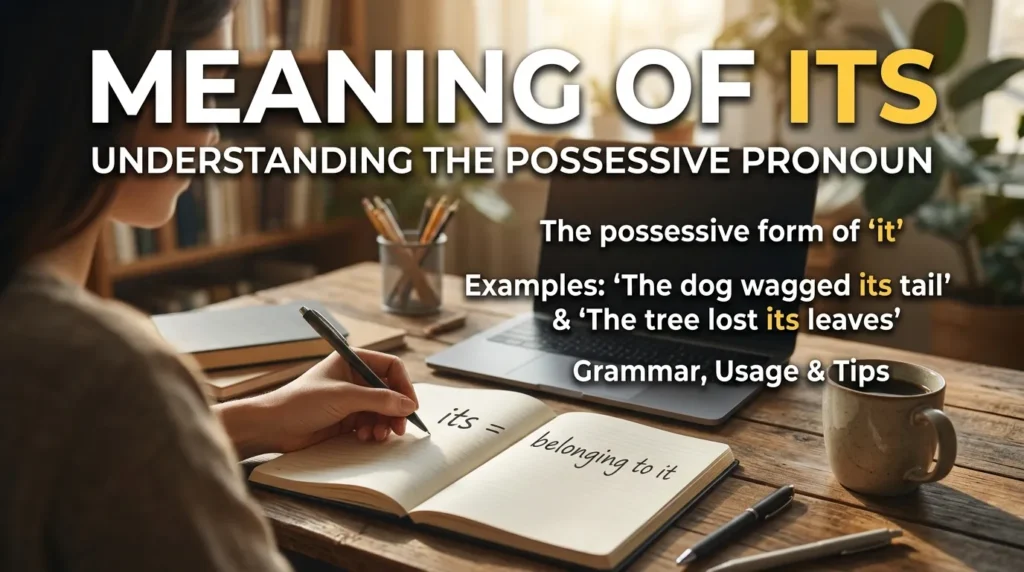
Its means belonging to, associated with, or connected to something previously mentioned or understood. It is commonly used when talking about animals, objects, organizations, places, and other things referred to as “it.”
For example, in “The bird spread its wings,” the word “its” indicates that the wings belong to the bird.
Definition of Its
Its is a possessive determiner used before a noun to indicate that something belongs to or is associated with the thing represented by the pronoun “it.”
Examples include:
- The company changed its name.
- The house lost its value.
- The computer needs its software updated.
- The country celebrated its independence.
In each sentence, “its” connects the noun that follows it to something mentioned earlier or understood from the context.
Meaning of It’s
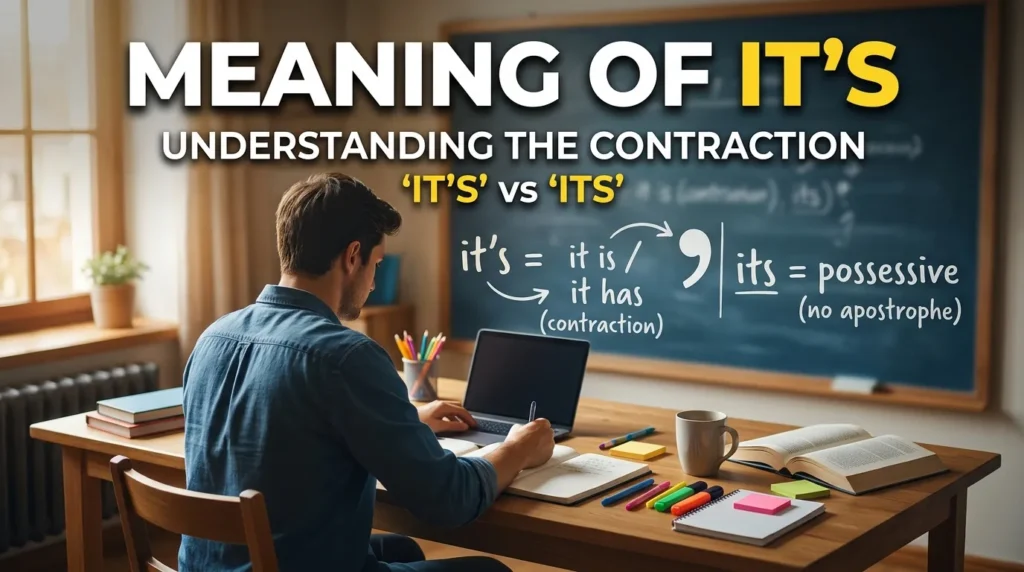
It’s is a shortened form of either “it is” or “it has.” It is used to make sentences more natural and concise in everyday communication.
For example, “It’s getting late” means “It is getting late,” while “It’s been a long day” means “It has been a long day.”
Definition of It’s
It’s is a contraction formed by combining the pronoun “it” with the verb “is” or “has.” The apostrophe indicates that letters have been omitted during the contraction.
Examples include:
- It’s cold outside. (It is cold outside.)
- It’s a good idea. (It is a good idea.)
- It’s been three hours. (It has been three hours.)
- It’s already started. (It has already started.)
The correct expansion depends on the grammatical structure and meaning of the sentence.
Main Difference
The main difference between its and it’s is their grammatical function. One indicates possession or association, while the other replaces two words with a contraction.
| Feature | Its | It’s |
| Grammatical function | Possessive determiner | Contraction |
| Meaning | Belonging to or associated with it | It is or it has |
| Apostrophe | No | Yes |
| Followed by a noun | Usually | Not as a possessive modifier |
| Example | The phone lost its signal. | It’s losing its signal. |
| Formal writing | Appropriate | Appropriate when contractions are permitted |
Consider these two sentences:
- The company updated its website. The website belongs to or is associated with the company.
- It’s updating its website. “It’s” means “it is,” and “its” indicates which website is being updated.
Both words can appear in the same sentence because they perform different grammatical jobs.
Which One Is Correct?
Both its and it’s are correct English words. Neither is universally better than the other. The correct choice depends on what you want to express.
Use its when indicating possession or association:
- The dog wagged its tail.
- The organization announced its decision.
- The tree has lost its leaves.
Use it’s when you mean “it is” or “it has”:
- It’s raining outside.
- It’s important to practice.
- It’s been a difficult week.
Remember that “its’” is not a standard English form. Do not add an apostrophe after the final s.
Grammar and Usage
Understanding the grammatical roles of these words makes the distinction easier to remember.
How Its Functions in a Sentence
Its is a possessive determiner. It normally appears before a noun or noun phrase to identify something associated with a particular object, animal, place, or organization.
Common patterns include:
- Its + noun: The machine lost its power.
- Its own + noun: The school has its own library.
- All of its + noun: The business invested all of its profits.
- Each of its + plural noun: Each of its employees received an invitation.
Although “its” expresses possession, the relationship does not always mean literal ownership. It can also indicate a characteristic, part, role, or connection.
For example, “The book is famous for its ending” describes a feature of the book rather than something it owns.
How It’s Functions in a Sentence
It’s has two principal grammatical uses.
1. It’s = It is
Use this contraction to describe a condition, identity, situation, or action expressed with “is.”
Examples:
- It’s sunny today.
- It’s my favorite restaurant.
- It’s difficult to explain.
- It’s becoming more popular.
2. It’s = It has
Use this contraction when “has” functions as an auxiliary verb, particularly in perfect-tense constructions.
Examples:
- It’s been a wonderful experience.
- It’s already happened.
- It’s changed considerably.
- It’s become much easier.
In these examples, “it’s” expands to “it has,” not “it is.”
Can It’s Mean It Has?
Yes. It’s can mean “it has” when “has” is part of a verb construction.
For example:
- It’s been raining all morning. (It has been raining all morning.)
- It’s finished already. (It has finished already, when referring to something that has completed an action.)
However, “it’s” cannot replace every use of “it has.” When “has” expresses possession as the main verb, the contraction generally does not work.
For example:
- Correct: The company has a new office.
- Incorrect in standard usage: The company’s? a new office.
The second sentence does not express the intended meaning. Use “the company has a new office” when describing possession or ownership.
How to Use Its or It’s
Use Its for Possession
Choose its when you can identify a relationship between something and the noun that follows.
Examples:
- The cat cleaned its fur.
- The restaurant changed its menu.
- The phone needs its battery replaced.
- The river overflowed its banks.
- The company expanded its services.
A helpful question is: Whose or which thing does the noun belong to or relate to? If the answer is a thing represented by “it,” its may be the correct choice.
Use It’s for It Is
Choose it’s when the sentence needs “it is.”
Examples:
- It’s too late to call.
- It’s a wonderful opportunity.
- It’s clear that we need a better plan.
- I think it’s the right answer.
- It’s not easy to learn a new language.
Try replacing “it’s” with “it is.” If the sentence remains grammatical and keeps its intended meaning, the contraction is appropriate.
Use It’s for It Has
Choose it’s when the sentence needs “it has” as an auxiliary verb.
Examples:
- It’s been a busy month.
- It’s taken longer than expected.
- It’s become a popular destination.
- It’s already started to snow.
Replace “it’s” with “it has” to check whether the sentence works.
Use Its Own Without an Apostrophe
The expression “its own” emphasizes that something belongs specifically to the subject or has something independently.
Examples:
- The company operates its own warehouse.
- The child has its own room. (Appropriate when “it” refers to the child, though “their own room” may sound more natural when referring to a person.)
- Every country has its own traditions.
- The device has its own power supply.
Writing “it’s own” is incorrect when you mean something belonging to it.
Examples
Examples of Its
- The dog chased its ball across the garden.
- The company announced its quarterly results.
- The restaurant changed its opening hours.
- The phone lost its connection during the call.
- The tree dropped its leaves in autumn.
- The school updated its admission policy.
- The book is known for its detailed illustrations.
- The machine stopped working because its motor overheated.
- The country is proud of its cultural heritage.
- The website improved its search function.
- The bird returned to its nest.
- The project reached its final stage.
Examples of It’s Meaning It Is
- It’s a beautiful morning.
- It’s important to read the instructions carefully.
- I think it’s time to leave.
- It’s difficult to make a decision without enough information.
- It’s my responsibility to finish the report.
- It’s getting colder outside.
- She believes it’s the best option.
- It’s not too late to start learning English.
- It’s possible that the meeting will be postponed.
- It’s a pleasure to work with you.
Examples of It’s Meaning It Has
- It’s been a long day.
- It’s already started raining.
- It’s changed significantly over the years.
- It’s become easier to communicate online.
- It’s taken us three hours to finish the project.
- It’s been several weeks since we last spoke.
- It’s grown considerably since we planted it.
- It’s improved since the last update.
- It’s reached the end of its useful life.
- It’s taken longer than we expected.
Examples Using Both Its and It’s
These sentences demonstrate how both forms can appear together.
- It’s easy to see why the company changed its name.
- It’s important to protect the environment and its resources.
- The dog is tired because it’s been running around its yard.
- It’s clear that the computer has lost its connection.
- The city is famous for its history, and it’s worth visiting.
- It’s a beautiful house, but its roof needs repairs.
- The business says it’s improving its customer service.
- It’s surprising that the bird has returned to its nest.
Common Mistakes
Mistake 1: Using It’s to Show Possession
Incorrect: The dog wagged it’s tail.
Correct: The dog wagged its tail.
Why it happens: Writers often assume that an apostrophe is required to show possession because English commonly uses apostrophe-s in forms such as “the dog’s tail.”
However, possessive determiners such as “my,” “your,” “his,” “her,” and “its” do not follow that pattern.
Mistake 2: Using Its Instead of It’s
Incorrect: Its important to arrive on time.
Correct: It’s important to arrive on time.
Why it happens: The writer needs the words “it is,” but leaves out the apostrophe and uses the possessive form instead.
Test the sentence by expanding the word: “It is important to arrive on time.” This confirms that “it’s” is correct.
Mistake 3: Writing It’s Own
Incorrect: The company developed it’s own software.
Correct: The company developed its own software.
Why it happens: “Own” emphasizes possession, so the sentence requires the possessive determiner “its,” not the contraction “it’s.”
Mistake 4: Writing Its’ Instead of Its
Incorrect: The cat licked its’ paw.
Correct: The cat licked its paw.
Why it happens: Some writers place an apostrophe after the final s because they associate apostrophes with possession. However, “its’” is not a standard English spelling.
Mistake 5: Assuming It’s Always Means It Is
Incorrect: It’s been a challenging year, so the sentence must mean “It is been a challenging year.”
Correct: It’s been a challenging year. (It has been a challenging year.)
Why it happens: Learners may remember only one expansion of the contraction. Always check whether “it is” or “it has” fits the sentence.
Mistake 6: Choosing the Word by Sound Alone
Incorrect reasoning: Both words sound the same, so either spelling is acceptable.
Correct approach: Choose the spelling according to the sentence’s meaning and grammatical structure.
Why it happens: The two forms are pronounced identically in standard English, so listening alone cannot reveal which spelling is correct.
Linguistic Insight
The distinction between its and it’s illustrates how English spelling reflects grammatical structure rather than pronunciation alone.
Why Its Has No Apostrophe
English often uses apostrophe-s to mark possession in nouns, as in “the teacher’s desk.” However, possessive forms of personal pronouns follow a different pattern.
Compare:
| Pronoun | Possessive form |
| I | My |
| You | Your |
| He | His |
| She | Her |
| It | Its |
| We | Our |
| They | Their |
These possessive forms do not require an apostrophe. The word “its” follows the same general pattern.
Why It’s Has an Apostrophe
The apostrophe in “it’s” indicates that letters have been omitted from “it is” or “it has.” This is a process known as contraction.
For example:
- It is becomes it’s.
- It has becomes it’s.
- She is becomes she’s.
- He has becomes he’s.
The apostrophe marks the shortened form, not possession.
Are Its and It’s Homophones?
Yes. In standard English pronunciation, its and it’s are homophones, meaning they sound alike but differ in spelling and meaning.
Because they are pronounced the same way, speakers cannot rely on pronunciation to distinguish them in speech. The difference becomes visible in writing, where the apostrophe signals a different grammatical function.
Does the Rule Change in American and British English?
No. The basic distinction between its and it’s is the same in American and British English.
Both varieties use “its” for possession and “it’s” for “it is” or “it has.” Differences in regional spelling do not affect this rule.
Usage Tips
- Remember the expansion test: Replace “it’s” with “it is” or “it has.” If neither works, you probably need “its.”
- Think of other possessive determiners: “My,” “his,” and “her” do not use apostrophes. Neither does “its.”
- Look at the word that follows: If the sentence refers to something belonging to a thing, animal, or organization, “its” is often appropriate before the noun.
- Learn the phrase “its own”: It always uses “its” when expressing possession.
- Proofread carefully: Spell-checking tools may miss the error because both spellings are valid English words.
- Check the whole sentence: In “It’s lost its appeal,” the first word means “it has,” while the second indicates possession or association.
Expert Suggestion
When editing professional documents, academic assignments, or website content, check every occurrence of “its” and “it’s” individually.
Do not assume a spelling checker will identify the problem. Since both words are legitimate, automated tools may accept an incorrect choice if it fits a possible grammatical pattern.
A reliable editing technique is to expand each instance of “it’s” into “it is” or “it has.” If the sentence becomes awkward or grammatically incorrect, reconsider whether “its” is needed instead.
For example:
- Draft: The product is popular because it’s design is simple.
- Revised: The product is popular because its design is simple.
This small check can prevent a common writing error without slowing down the writing process significantly.
Summary
Its and it’s are both correct, but they serve different purposes.
- Its is the possessive determiner meaning belonging to or associated with something. Example: The dog wagged its tail.
- It’s is a contraction of “it is” or “it has.” Example: It’s getting late.
- Its’ is not a standard English form.
- Both “its” and “it’s” are pronounced the same way, so the correct spelling depends on meaning and grammar.
- To check “it’s,” try replacing it with “it is” or “it has.” If the substitution works, the apostrophe is correct.
The easiest rule to remember is simple: use “its” for possession and “it’s” for “it is” or “it has.”
Frequently Asked Questions
1. What is the difference between its and it’s?
“Its” shows possession or association, while “it’s” is a contraction of “it is” or “it has.” For example, “The cat licked its paw” and “It’s getting dark.”
2. Is its or it’s correct?
Both are correct English words. Use “its” to show possession and “it’s” when you mean “it is” or “it has.”
3. Is its possessive?
Yes. “Its” is a possessive determiner used before a noun to show that something belongs to or is associated with a thing represented by “it.”
4. Is it’s short for it is or it has?
Yes. “It’s” can mean either “it is” or “it has.” The correct expansion depends on the sentence.
5. Why does its not have an apostrophe?
“Its” is a possessive determiner, like “my,” “your,” “his,” and “her.” These possessive forms do not use apostrophes.
6. Is its’ a real word?
No. “Its’” is not a standard English word. Use “its” without an apostrophe when showing possession.
7. Is it’s own correct?
No, not when you mean something belonging to it. The correct phrase is “its own,” as in “The company has its own office.”
8. How can I remember when to use its or it’s?
Replace “it’s” with “it is” or “it has.” If the sentence makes sense, use “it’s.” If you are indicating possession, use “its.”
9. Can you use its and it’s in the same sentence?
Yes. For example, “It’s important to protect the company and its employees.” Here, “it’s” means “it is,” while “its” shows association.
10. Is its a contraction?
No. “Its” is a possessive determiner. “It’s” is the contraction of “it is” or “it has.”
11. Are its and it’s pronounced the same?
Yes. They are homophones in standard English, meaning they sound alike but have different spellings, meanings, and grammatical functions.
12. Should I use its or it’s in formal writing?
Use whichever form matches the intended meaning. “Its” is correct for possession, while “it’s” is appropriate for “it is” or “it has.” In highly formal writing, you may choose to expand contractions when required by the style or context.
13. Is it’s ever used to show ownership?
No. In standard English, “it’s” does not indicate possession. Use “its” when describing something that belongs to or is associated with a thing.
14. Which is correct, the dog lost its collar or the dog lost it’s collar?
“The dog lost its collar” is correct because “its” indicates that the collar belongs to the dog. “It’s collar” is incorrect because “it is collar” and “it has collar” do not fit the sentence.
15. Is its or it’s the same in American and British English?
Yes. American and British English follow the same rule. “Its” shows possession, while “it’s” means “it is” or “it has.”


1 thought on “Its or It’s: Meaning, Difference & Examples”