
Have you ever wondered whether to write “I don’t want to lose my keys” or “I don’t want to loose my keys”? These words look similar, but they have different meanings and pronunciations. The confusion often occurs in emails, text messages, social media posts, and everyday writing. The good news is that a simple rule can help you choose the correct word every time.
Quick Answer
Lose and loose are both correct English words, but they have different meanings and grammatical functions.
| Word | Part of Speech | Meaning | Example |
| Lose | Verb | To misplace something, stop having something, or fail to win | Don’t lose your keys. |
| Loose | Usually an adjective | Not tight, firmly attached, or secured | My shoes are loose. |
| Loose | Verb, less common | To release or set free | The hunter loosed an arrow. |
Remember: Use lose when you might misplace something or fail to win. Use loose when something is not tight or securely attached.
Build your vocabulary by learning how to use disloyal and unloyal correctly in everyday English.
Meaning and Definition
Meaning of Lose
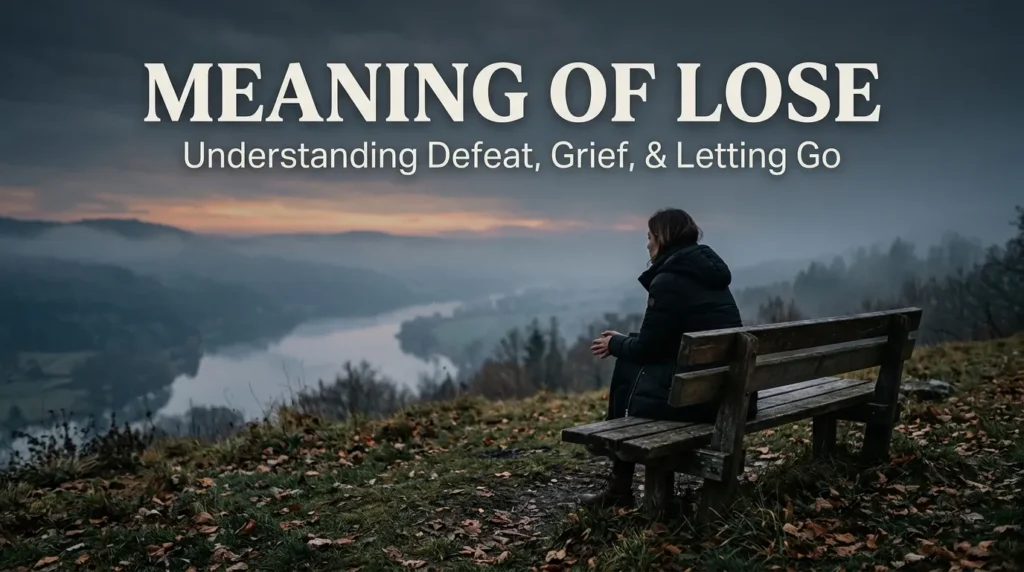
Lose means to no longer have something, be unable to find it, fail to win, or experience a reduction in something. It can describe physical objects, competitions, relationships, opportunities, and personal qualities.
For example, you might lose your wallet, lose a game, lose weight, or lose confidence.
Definition of Lose
Lose is a verb meaning to be deprived of something, become unable to find something, fail to win or retain something, or experience a decrease.
In everyday English, the word describes an action, event, or change in circumstances. Its principal forms are lose, loses, losing, and lost.
Meaning of Loose
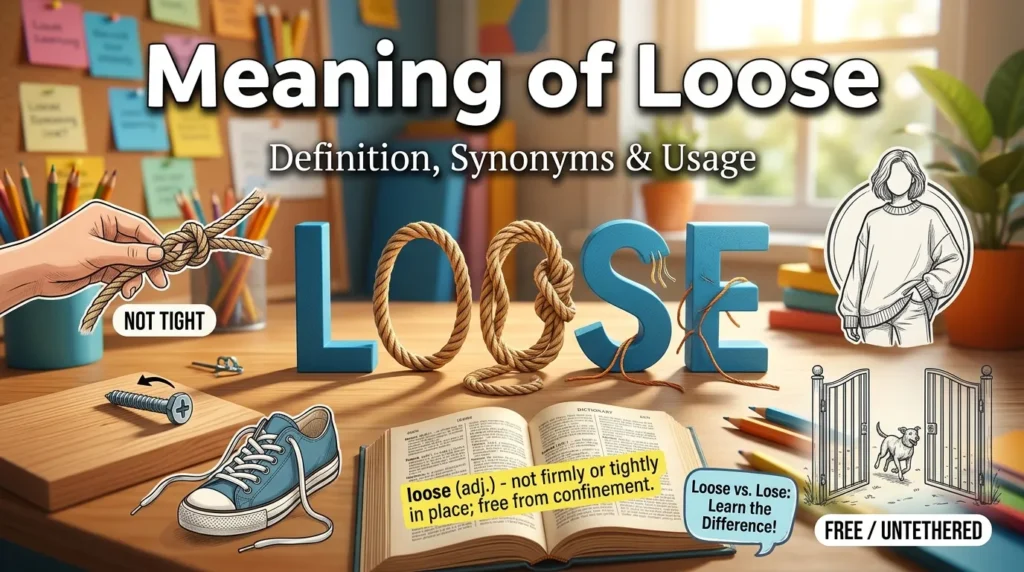
Loose means not tight, not firmly attached, or free to move. It commonly describes clothing, objects, connections, and things that are not securely fastened.
For example, a loose shirt has a relaxed fit, and a loose screw is not firmly secured.
Definition of Loose
Loose is primarily an adjective meaning not firmly fixed, fastened, confined, or tightly fitting. It can also describe something that is relaxed, approximate, or not strictly controlled.
Less commonly, loose functions as a verb meaning to release or set free, as in “The soldier loosed an arrow.”
Main Difference
The main difference between lose and loose is their meaning, pronunciation, and usual grammatical function.
| Feature | Lose | Loose |
| Pronunciation | /luːz/, rhymes with choose | /luːs/, rhymes with goose |
| Usual part of speech | Verb | Adjective |
| Main meaning | Misplace, fail to win, or no longer have | Not tight, attached, or confined |
| Past tense | Lost | Loosed, when used as a verb |
| Present participle | Losing | Loosing |
| Comparative form | Not applicable | Looser |
| Superlative form | Not applicable | Loosest |
| Example | I might lose the match. | My shirt is too loose. |
Difference in Pronunciation
Although the two words contain similar letters, they end with different sounds.
- Lose ends with a /z/ sound, like the final sound in these.
- Loose ends with an /s/ sound, like the final sound in peace.
Both words have the same long vowel sound, represented by /uː/. The difference is in the final consonant.
Difference in Grammar
Lose is primarily a verb. It expresses an action or a change, such as losing a competition or losing an important document.
Loose is primarily an adjective. It describes a condition or quality, such as loose clothing, a loose tooth, or a loose connection.
However, loose can also be a verb meaning to release something. This use is correct but less common in everyday conversation.
Which One Is Correct?
Both lose and loose are correct English spellings. Neither word is a misspelling when used in its proper context.
Choose lose when talking about losing something, failing to win, or no longer having something.
- Correct: I don’t want to lose my phone.
- Incorrect for this meaning: I don’t want to loose my phone.
Choose loose when describing something that is not tight or firmly secured.
- Correct: This jacket is too loose.
- Incorrect for this meaning: This jacket is too lose.
The correct choice depends on what you want to communicate, not on which spelling appears more familiar.
Grammar and Usage
Understanding the grammatical forms of these words makes it easier to use them correctly.
Forms of Lose
Lose is an irregular verb. Its past tense and past participle are both lost.
| Verb Form | Example |
| Base form: lose | I don’t want to lose. |
| Third-person singular: loses | She loses her keys frequently. |
| Present participle: losing | He is losing confidence. |
| Simple past: lost | We lost the game. |
| Past participle: lost | They have lost their tickets. |
Notice that the past tense is lost, not losed. Similarly, the present participle is losing, not loosing.
Forms of Loose
Loose is usually an adjective, so it does not change according to tense.
| Form | Example |
| Base adjective: loose | These trousers are loose. |
| Comparative: looser | This shirt is looser than mine. |
| Superlative: loosest | This is the loosest knot. |
| Adverb: loosely | The papers were loosely arranged. |
| Noun: looseness | The looseness of the connection caused a problem. |
When loose is used as a verb, its forms are loose, looses, loosing, and loosed.
For example: “The archer loosed an arrow.”
Common Expressions With Lose
The verb lose appears in many everyday expressions.
- Lose weight: Become lighter.
- Lose interest: Stop being interested.
- Lose control: No longer be able to manage something.
- Lose your temper: Become angry.
- Lose hope: Stop believing that something good will happen.
- Lose track of time: Become unaware of how much time has passed.
- Lose your way: Become unable to find the correct route.
- Lose sleep over something: Worry about something so much that it affects your sleep.
Strengthen your sentence structure with practical examples of correct and correctly in different grammatical contexts.
Common Expressions With Loose
The word loose also appears in familiar expressions.
- Loose change: Coins carried as small amounts of money.
- Let loose: Allow someone or something to move or act freely.
- On the loose: Free, escaped, or not under control.
- Loose ends: Unfinished details that still need attention.
- Loose fit: Clothing designed to fit without being tight.
- Play fast and loose: Act carelessly or irresponsibly, often without regard for rules or commitments.
- A screw loose: An informal expression suggesting that someone is behaving strangely or irrationally.
How to Use Lose and Loose Correctly
How to Use Lose
Use lose when describing something you cannot find, something you no longer possess, or something you fail to win.
1. To describe misplacing something
Use lose when you cannot find an item or person.
Example: “I always lose my glasses when I need them most.”
2. To describe failing to win
Use lose for games, competitions, elections, and other contests.
Example: “Our team cannot afford to lose another match.”
3. To describe a reduction
Use lose when something decreases in amount, size, or strength.
Example: “She hopes to lose a little weight through regular exercise.”
4. To describe losing an opportunity or quality
Use lose when someone no longer has an advantage, feeling, or opportunity.
Example: “Don’t lose confidence just because you made a mistake.”
How to Use Loose
Use loose when describing something that is not tight, firmly fixed, or strictly controlled.
1. To describe clothing
Use loose for clothes that fit comfortably without being tight.
Example: “He prefers loose shirts during hot weather.”
2. To describe something that is not secure
Use loose for objects that can move or become detached.
Example: “The mechanic found a loose bolt in the engine.”
3. To describe something that has been released
Use loose as a verb when something is set free or released, especially in formal or literary contexts.
Example: “The guards loosed the dogs to chase the intruder.”
In ordinary conversation, released or set free will often sound more natural.
4. To describe something approximate or flexible
Use loose when a rule, interpretation, or connection is not exact or strictly defined.
Example: “The report offers a loose interpretation of the original findings.”
Examples
Examples of Lose
- Please don’t lose the receipt before requesting a refund.
- I often lose track of time when I read a good book.
- Our school team did not lose a single game this season.
- She is afraid of losing her job.
- You should never lose hope during difficult times.
- He lost his wallet while traveling abroad.
- We have lost contact with an old friend.
- I don’t want to lose this opportunity.
- If you hurry, you won’t lose much time.
- The company could lose several important customers.
- Try not to lose your temper during the discussion.
- They may lose their seats if they arrive late.
Examples of Loose
- These shoes are too loose for running.
- The technician tightened the loose connection.
- A loose button fell off my coat.
- She prefers loose clothing when working at home.
- The dog was running loose in the park.
- Please secure the loose wires before switching on the machine.
- I found some loose change in my pocket.
- The teacher gave us a loose outline for the assignment.
- The screw came loose after several weeks of use.
- He tied the package with a loose knot.
- Several pages were loosely attached to the folder.
- The escaped animal was still on the loose.
Examples Using Both Lose and Loose
These examples show how both words can appear naturally in the same sentence.
- Be careful not to lose the loose keys in your bag.
- If you wear loose shoes, you may lose your balance.
- Tighten the loose handle so you don’t lose your grip.
- I don’t want to lose my new jacket because its pocket is loose.
- You could lose the small screw if you leave it loose on the table.
- She was worried that she might lose her ring because it felt loose.
Notice how lose describes an action or outcome, while loose describes a condition.
Common Mistakes
1. Writing Loose Instead of Lose
Incorrect: I don’t want to loose my job.
Correct: I don’t want to lose my job.
Why it happens: People often assume that loose is the correct spelling because it contains the same vowel sound and looks similar to lose.
Remember: When you mean that you might no longer have something, use lose.
2. Writing Lose Instead of Loose
Incorrect: These pants are too lose.
Correct: These pants are too loose.
Why it happens: Writers sometimes overlook the extra o needed in the adjective loose.
Remember: Use loose to describe clothing that is not tight.
3. Using Loose Instead of Losing
Incorrect: I am loose my patience.
Correct: I am losing my patience.
Why it happens: The writer confuses the adjective loose with the present participle of the verb lose.
Remember: After forms of be, use losing when describing an ongoing action, as in “I am losing patience.”
4. Using Losed Instead of Lost
Incorrect: Our team losed the final match.
Correct: Our team lost the final match.
Why it happens: Many English verbs form their past tense by adding -ed, but lose is irregular.
Remember: The correct forms are lose, losing, and lost.
5. Confusing Loosen and Loose
Incorrect: Please loose the screw a little if you want to make it easier to remove.
Correct: Please loosen the screw a little if you want to make it easier to remove.
Why it happens: Loose and loosen are related, but they have different grammatical functions.
Remember: Loose usually describes a condition, while loosen means to make something less tight.
Linguistic Insight
The confusion between lose and loose is an example of how English spelling and pronunciation do not always follow simple patterns.
Why Do Lose and Loose Sound Different?
Both words contain the long vowel sound /uː/, but their final consonants differ.
- Lose ends in the voiced consonant /z/.
- Loose ends in the voiceless consonant /s/.
A voiced consonant involves vibration of the vocal folds, while a voiceless consonant does not. You can feel the difference by placing your fingers lightly against your throat while pronouncing the final sounds.
The difference is subtle enough that some learners may not notice it immediately, especially when learning English as a second language.
Are Lose and Loose Related?
The words have related historical backgrounds, but their modern meanings and uses have developed differently.
Lose developed from Old English forms associated with loss, destruction, and being deprived of something. Loose entered English through a Scandinavian language, Old Norse, with meanings associated with being free, untied, or unconfined.
Their historical connections help explain why the words look somewhat similar. However, their present-day spelling, pronunciation, and grammatical functions distinguish them clearly.
Why Is Loose Sometimes a Verb?
Although loose is primarily an adjective, English also uses it as a verb meaning to release or set free.
This verb has appeared in contexts involving arrows, animals, and other things released from restraint. Today, it is less common in everyday conversation than expressions such as release, let go, and set free.
For example, “The archer loosed an arrow” is grammatically correct, even though “The archer released an arrow” may sound more familiar to modern readers.
Usage Tips
Use these practical techniques to remember the difference between lose and loose.
1. Remember the Extra O
Think of the extra o in loose as extra room.
- Loose: Extra room, not tight.
- Lose: One o, used when you might misplace something or fail to win.
For example, “I might lose my loose-fitting jacket.”
2. Listen to the Final Sound
Say both words aloud:
- Lose rhymes with choose and snooze.
- Loose rhymes with goose and moose.
The final /z/ sound in lose can help distinguish it from the final /s/ sound in loose.
3. Check the Word’s Function
Ask yourself whether the word describes an action or a condition.
If it describes an action such as misplacing, failing to win, or no longer having something, use lose.
If it describes something that is not tight or secure, use loose.
4. Check the Verb Form
If you are writing about the past, remember that lose becomes lost.
- Present: I lose my keys sometimes.
- Past: I lost my keys yesterday.
- Ongoing action: I am losing my keys less often now.
Do not write loosed or loosing when you mean the ordinary verb forms lost or losing.
5. Read the Whole Sentence
Sometimes the easiest way to identify the correct spelling is to consider the sentence’s meaning.
Compare these examples:
- “The rope is loose.” This describes the rope’s condition.
- “I might lose the rope.” This describes the possibility of no longer having it.
Reading the entire sentence helps you select the word that expresses the intended meaning.
Expert Suggestion
As a grammar teacher, I recommend learning lose and loose in complete phrases instead of memorizing their definitions alone.
Practice phrases such as lose a game, lose your keys, lose weight, loose clothing, a loose screw, and loose change.
If you write professionally, proofread these words carefully because spell-checking tools may accept both spellings even when one is incorrect for the sentence.
For English learners, a short daily exercise can also help. Write three sentences with lose and three with loose, then explain why each spelling is appropriate. This builds an understanding of meaning and grammar rather than relying only on memorization.
Summary
Lose and loose are both correct English words, but they are not interchangeable.
- Lose is a verb meaning to misplace something, fail to win, or stop having something. Its past tense is lost, and its present participle is losing.
- Loose is usually an adjective meaning not tight, firmly attached, or confined. It can also function as a less common verb meaning to release something.
- Pronunciation: Lose ends in a /z/ sound, while loose ends in an /s/ sound.
- Memory tip: One o in lose describes losing something. Two os in loose suggest extra room.
Choose the word that matches your intended meaning, and you will avoid one of the most common spelling mistakes in English.
Frequently Asked Questions
1. Is lose or loose correct?
Both are correct English words. Use lose to describe misplacing something or failing to win, and loose to describe something that is not tight or securely attached.
2. What is the difference between lose and loose?
Lose is primarily a verb, while loose is primarily an adjective. For example, you might lose your keys, but your keys might also be loose in a bag.
3. How do you spell lose correctly?
The correct spelling is lose, with one o, when you mean to misplace something, fail to win, or stop having something.
4. How do you spell loose correctly?
The correct spelling is loose, with two os, when you mean not tight, not firmly secured, or free from restraint.
5. Is it lose weight or loose weight?
The correct phrase is lose weight. Lose describes a reduction in body weight, while loose describes something that is not tight.
6. Is it lose your mind or loose your mind?
The standard expression is lose your mind. It is an informal expression that can mean becoming extremely upset or behaving irrationally.
7. Is it lose or loose clothing?
Use loose clothing because loose describes clothes that fit comfortably without being tight.
8. Is it lose or loose a game?
Use lose a game because lose means to fail to win.
9. Is it lose or loose your keys?
Use lose your keys when you cannot find them or no longer know where they are.
10. Is it loose or lose change?
The correct expression is loose change, which means small coins carried in a pocket, purse, or container.
11. Is loosing a real word?
Yes. Loosing is the present participle of the verb loose, which means to release or set free. However, when you mean misplacing something or failing to win, use losing.
12. Is loosed a real word?
Yes. Loosed is the past tense and past participle of the verb loose. It means released or set free. The past tense of lose is lost, not loosed.
13. Why do people confuse lose and loose?
The words look similar and share the same long vowel sound. Their meanings and final consonant sounds differ, but these distinctions can be easy to overlook when writing quickly.
14. Do lose and loose sound the same?
No. Lose ends with a voiced /z/ sound and rhymes with choose. Loose ends with an /s/ sound and rhymes with goose.
15. How can I remember the difference between lose and loose?
Remember that lose has one o and means to misplace something or fail to win. Loose has two os and usually means not tight. Think of the extra o as extra room.

