
When writing a message such as “Lets meet after work,” you might wonder whether an apostrophe is necessary. The answer depends on what you mean. Both “lets” and “let’s” are correct English forms, but they serve different grammatical purposes. Let’s is a contraction of “let us,” commonly used to make suggestions, while lets is a verb meaning “allows” or “permits.” Understanding this distinction will help you choose the correct spelling in everyday conversations, emails, schoolwork, and professional writing.
Quick Answer
Both lets and let’s are correct, but you must use them in different situations.
| Form | Meaning | Example |
| Lets | Allows or permits | She lets me borrow her laptop. |
| Let’s | Let us, usually for a suggestion | Let’s borrow a laptop. |
Remember this simple rule:
- Use lets when you mean allows or permits.
- Use let’s when you mean let us, usually to suggest or encourage an action.
For example, “He lets us leave early” means he allows us to leave early. “Let’s leave early” is a suggestion to leave early together.
Improve your grammar skills with simple ways to use their and there correctly in everyday writing.
Meaning and Definition
Meaning of Lets
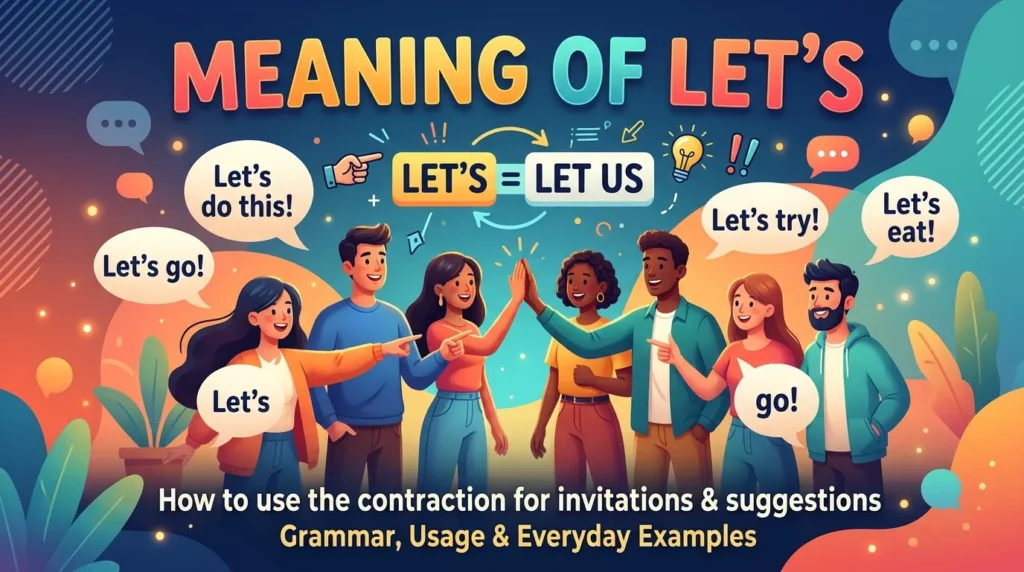
Lets means allows, permits, or gives someone permission to do something. It describes what a person, organization, rule, or thing makes possible.
For example, “My teacher lets us use calculators” means my teacher allows us to use calculators.
Definition of Lets
Lets is the third-person singular present-tense form of the verb let. It expresses permission, allowance, or the opportunity to do something.
It follows a singular subject such as he, she, it, or a singular noun.
Examples:
- The manager lets employees work remotely.
- This app lets you edit photos.
- My sister lets me borrow her books.
Meaning of Let’s
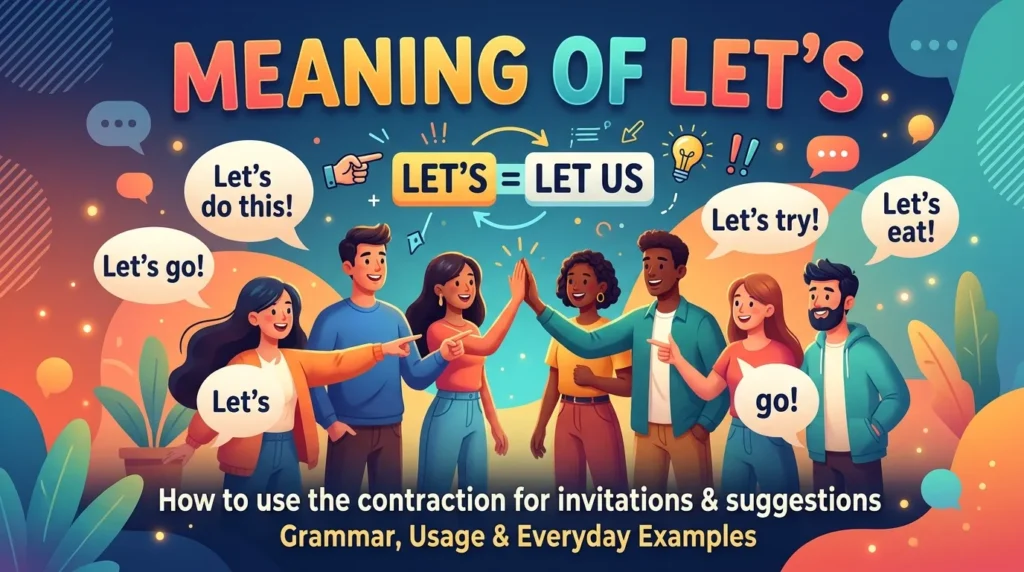
Let’s is a contraction of “let us.” It is commonly used to suggest an action, propose a plan, encourage someone, or invite others to do something with the speaker.
For example, “Let’s go for a walk” means “Let us go for a walk.” In everyday English, it usually expresses the suggestion that we should go together.
Definition of Let’s
Let’s is a contraction formed from the verb let and the pronoun us. It is commonly used in first-person plural imperative constructions, which encourage or propose an action involving the speaker and other people.
Examples:
- Let’s start the meeting.
- Let’s try another approach.
- Let’s not waste time.
The apostrophe indicates that letters have been omitted from the full expression. It does not indicate possession.
Main Difference
The main difference between lets and let’s is their grammatical function, not their pronunciation.
| Feature | Lets | Let’s |
| Grammatical role | Verb | Contraction |
| Full form | No contraction | Let us |
| Main meaning | Allows or permits | Suggests a shared action |
| Apostrophe | Not required | Required |
| Typical subject | He, she, it, or a singular noun | Usually implied we |
| Example | The rule lets us leave early. | Let’s leave early. |
The difference becomes clearer when you compare the meaning of each sentence:
- She lets me drive. She allows me to drive.
- Let’s drive. I suggest that we drive.
Both forms are pronounced /lɛts/ in ordinary speech, so you generally cannot distinguish them by sound alone. You must use the sentence’s meaning to determine the correct spelling.
Which One Is Correct?
Both forms are correct in standard English. Neither is inherently better or more grammatically correct than the other.
Choose lets when describing permission or an opportunity granted by someone or something.
- Correct: My parents let me choose my own clothes.
- Correct: My parents lets me choose my own clothes.
Choose let’s when proposing an action that includes yourself and others.
- Correct: Let’s choose our clothes before we leave.
- Incorrect for this meaning: Lets choose our clothes before we leave.
The choice depends on the intended meaning. The apostrophe is essential when you use the contraction.
Grammar and Usage
Understanding how each form works in a sentence makes the distinction easier to remember.
How Lets Works Grammatically
Lets is the simple present form of let used with a third-person singular subject.
The basic sentence pattern is:
Subject + lets + object + base verb
Examples:
- My teacher lets me ask questions.
- The software lets users save their work.
- Our supervisor lets the team finish early.
Notice that the verb following the object stays in its base form. Write “She lets me drive,” not “She lets me drives” or “She lets me to drive.”
Other forms of the verb include:
| Verb form | Example |
| Base form | I let him leave. |
| Third-person singular | She lets him leave. |
| Past tense | She let him leave. |
| Present participle | She is letting him leave. |
| Past participle | She has let him leave. |
The past tense and past participle of let are both let, not letted in standard modern English.
How Let’s Works Grammatically
Let’s is used to suggest, encourage, or propose an action involving the speaker and others.
The basic pattern is:
Let’s + base verb
Examples:
- Let’s begin the lesson.
- Let’s discuss the results.
- Let’s visit our grandparents.
- Let’s take a short break.
The verb after let’s remains in its base form. You should write “Let’s go,” not “Let’s goes” or “Let’s to go.”
Practice choosing the right word with real sentence examples of laid versus layed in everyday English.
Negative Sentences With Let’s
To suggest that a group should avoid doing something, use let’s not + base verb.
Examples:
- Let’s not argue about this.
- Let’s not forget the deadline.
- Let’s not make a decision too quickly.
The phrase “let us not” is also grammatically correct, but it often sounds more formal or ceremonial.
Lets and Let’s in Formal Writing
Lets is appropriate in both formal and informal writing when it means allows or permits.
Let’s is widely accepted in everyday writing, emails, instructions, and conversational content. In highly formal academic or legal writing, you may prefer a more formal construction when the style requires it.
For example:
- Conversational: Let’s examine the evidence.
- More formal: We should examine the evidence.
The contraction is not grammatically wrong in formal writing, but the best choice depends on the document’s tone and conventions.
How to Use Lets and Let’s
Use the meaning of the sentence to decide which form belongs in your writing.
Use Lets When Something Allows an Action
Use lets when the subject gives someone permission, makes an action possible, or allows something to happen.
Examples:
- The school lets students bring their own laptops.
- This website lets visitors create free accounts.
- Her parents let her travel with friends.
- The new policy lets employees take flexible breaks.
A useful test is to replace lets with allows. If the sentence still makes sense, lets is probably the correct choice.
Use Let’s to Make Suggestions
Use let’s when suggesting an activity, making a plan, or encouraging others to act with you.
Examples:
- Let’s go shopping this afternoon.
- Let’s review the assignment together.
- Let’s call them before we leave.
- Let’s find a better solution.
A useful test is to expand let’s to let us. If that matches the intended meaning, use the apostrophe.
Use Let’s Not to Discourage an Action
Let’s not introduces a suggestion to avoid doing something.
Examples:
- Let’s not arrive late.
- Let’s not rush the process.
- Let’s not overlook the small details.
This construction is common in everyday conversation and professional discussions.
Examples
Examples of Lets
These sentences use lets to describe permission, access, or an opportunity.
- My brother lets me use his headphones.
- The teacher lets students work in pairs.
- This key lets you open the storage room.
- The company lets employees work from home twice a week.
- Our coach lets us practice before the match.
- The new software lets users organize their files easily.
- Her busy schedule rarely lets her relax.
- The landlord lets the apartment to a young couple.
- This shortcut lets you access the settings quickly.
- The library lets visitors use its computers.
Examples of Let’s
These sentences use let’s to suggest or encourage an action.
- Let’s meet at the café after work.
- Let’s finish the project before Friday.
- Let’s ask the teacher for clarification.
- Let’s try a different recipe tonight.
- Let’s take a break before continuing.
- Let’s discuss the budget during tomorrow’s meeting.
- Let’s work together to solve the problem.
- Let’s make sure everyone understands the instructions.
- Let’s not forget to send the invitation.
- Let’s see what happens next.
Common Mistakes
1. Writing Lets Instead of Let’s in Suggestions
Incorrect: Lets go for a walk.
Correct: Let’s go for a walk.
Why it happens: Writers sometimes omit the apostrophe when typing quickly. However, the sentence expresses a suggestion, so the contraction let’s is required.
2. Writing Let’s Instead of Lets to Mean Allows
Incorrect: The app let’s you edit your photos.
Correct: The app lets you edit your photos.
Why it happens: People may assume that the apostrophe belongs in every form ending in -s. In this sentence, lets is an ordinary verb form, not a contraction.
3. Adding an Unnecessary Apostrophe After a Singular Subject
Incorrect: My teacher let’s us ask questions.
Correct: My teacher lets us ask questions.
Why it happens: The writer confuses the third-person singular verb ending with the contraction of let us.
4. Adding To After the Object
Incorrect: She lets me to borrow her car.
Correct: She lets me borrow her car.
Why it happens: Some verbs take an infinitive with to, but the permission verb let takes an object followed by the base form of the next verb.
5. Changing the Verb After Let’s
Incorrect: Let’s goes to the park.
Correct: Let’s go to the park.
Why it happens: The writer applies the third-person singular verb ending incorrectly. The verb after let’s must remain in its base form.
6. Assuming the Apostrophe Is Optional
Incorrect: Lets start the presentation.
Correct: Let’s start the presentation.
Why it happens: Both forms sound alike in ordinary speech. However, standard written English uses the apostrophe to mark the contraction.
Linguistic Insight
The difference between lets and let’s illustrates how a small spelling change can represent a major grammatical difference.
The Role of the Apostrophe
An apostrophe can indicate omitted letters in a contraction. In let’s, it represents the shortened form of let us.
English has many similar contractions:
- It’s means it is or it has.
- We’re means we are.
- They’re means they are.
- Let’s means let us.
By contrast, lets contains no omitted letters. It is formed by adding the regular third-person singular ending -s to the verb let.
Word Origin and Historical Development
The verb let comes from Old English lǣtan, which carried meanings such as allowing, leaving, or permitting. The verb has retained its basic permission-related meaning over many centuries.
The expression let us developed as a way to make proposals or express collective intentions. Its contracted form, let’s, became a convenient and familiar part of spoken and written English.
Why the Forms Sound the Same
Both forms are generally pronounced /lɛts/. Their identical pronunciation makes them homophones in ordinary usage, meaning they sound alike but have different grammatical functions or meanings.
This is why spelling mistakes can occur even when a writer knows the difference in meaning. The solution is to check the sentence’s purpose rather than rely on pronunciation.
Usage Tips
Use these practical techniques to remember the difference.
- Try the allows test: If allows fits the sentence, use lets.
- Try the let us test: If let us fits the intended meaning, use let’s.
- Look at the sentence’s purpose: Descriptions of permission generally use lets, while suggestions generally use let’s.
- Check the subject: A singular subject such as she, the teacher, or the app can take lets when describing permission.
- Remember the apostrophe: In let’s, the apostrophe marks the contraction, not possession.
- Proofread short messages: Quick messages such as “Lets talk” often need an apostrophe because they express a suggestion.
The easiest memory aid is lets = allows and let’s = let us.
Expert Suggestion
When proofreading, focus on meaning before spelling. Read the sentence and ask whether you are describing what someone permits or suggesting what people should do together.
For example, “The teacher lets us leave early” describes permission. “Let’s leave early” proposes a shared action.
If you write professional emails, articles, academic assignments, or social media posts, make this distinction part of your final editing routine. A quick check can prevent a common punctuation error without making your writing sound unnatural.
Summary
Both lets and let’s are correct English forms, but they have different meanings and grammatical functions.
- Lets is the third-person singular present form of let, meaning allows or permits.
- Let’s is a contraction of let us, usually used to make suggestions or encourage shared actions.
- Use lets in sentences such as “She lets me borrow her car.”
- Use let’s in sentences such as “Let’s borrow a car.”
- Both forms usually sound identical, so you must rely on meaning to choose the correct spelling.
Remember: lets = allows, let’s = let us.
Frequently Asked Questions
Is lets correct English?
Yes. Lets is the correct third-person singular present form of the verb let. For example, “My teacher lets us ask questions.”
Is let’s correct English?
Yes. Let’s is a standard contraction of let us. It is commonly used to make suggestions, as in “Let’s get started.”
What is the difference between lets and let’s?
Lets means allows or permits, while let’s means let us. The apostrophe distinguishes the contraction from the ordinary verb form.
Is it let’s go or lets go?
Let’s go is correct when suggesting that people leave or move somewhere together. The apostrophe is necessary because let’s means let us.
Is it lets me or let’s me?
The correct form is usually lets me when describing permission. For example, “She lets me use her computer.” Let’s me does not work in this meaning.
Is it lets us or let’s us?
Use lets us when describing what someone allows: “The teacher lets us leave early.” Use let’s when making a suggestion: “Let’s leave early.”
Is let’s a contraction of let us?
Yes. Let’s is the contraction of let us. It is commonly used in suggestions such as “Let’s begin the meeting.”
Does let’s mean we should?
Often, yes. In everyday English, “Let’s take a break” generally means “We should take a break” or expresses a proposal to take one.
Why does let’s have an apostrophe?
The apostrophe marks omitted letters in the contraction of let us. It does not show ownership or possession.
Should I use lets or let’s in formal writing?
Use lets when describing permission. Let’s is also grammatically correct, but in highly formal writing, you may prefer a phrase such as “We should” or “We propose to,” depending on the context.
Are lets and let’s pronounced the same?
Yes. Both are generally pronounced /lɛts/. Their pronunciation is usually identical, so the intended meaning determines the correct spelling.
Is let’s not grammatically correct?
Yes. Let’s not is a standard construction used to suggest avoiding an action. For example, “Let’s not delay the meeting.”
Can I write lets without an apostrophe in a text message?
Yes, when lets means allows or permits. However, if you are suggesting an action, write let’s, even in an informal text message.
What is an easy way to remember lets vs. let’s?
Replace lets with allows and let’s with let us. If the replacement preserves the intended meaning, you have probably chosen the correct form.
Is let’s possessive?
No. The apostrophe in let’s indicates a contraction of let us. It does not indicate possession, unlike the apostrophe in a phrase such as “the student’s book.”

