
Imagine checking your phone before leaving home and discovering that rain is expected today. Later, you hear someone describe your region as hot and dry for most of the year. Both statements describe atmospheric conditions, but they refer to different things. This is the key distinction in weather vs climate.
Weather describes short-term atmospheric conditions, while climate describes the long-term patterns of those conditions. Understanding the difference helps you use both terms correctly in everyday conversations, school assignments, scientific writing, and discussions about climate change.
Quick Answer
Weather refers to atmospheric conditions at a particular place and time. Climate refers to the typical range and long-term patterns of weather in a place, usually measured over 30 years or more.
| Feature | Weather | Climate |
| Meaning | Short-term atmospheric conditions | Long-term patterns of weather |
| Time frame | Minutes, hours, days, or weeks | Usually 30 years or more for standard climate averages |
| Main focus | What is happening or expected soon | What conditions are typically like |
| Examples | Rain today, strong winds tonight | Hot summers, cold winters, seasonal rainfall |
| Changes | Can change rapidly | Usually changes more gradually |
| Common use | Daily forecasts and weather reports | Climate studies and long-term planning |
Easy way to remember: Weather tells you what to expect outside today. Climate tells you what conditions are generally typical of a place over many years.
To understand casual online conversations, learn what BTW means in text messages and how people use it naturally.
Meaning and Definition
Meaning of Weather
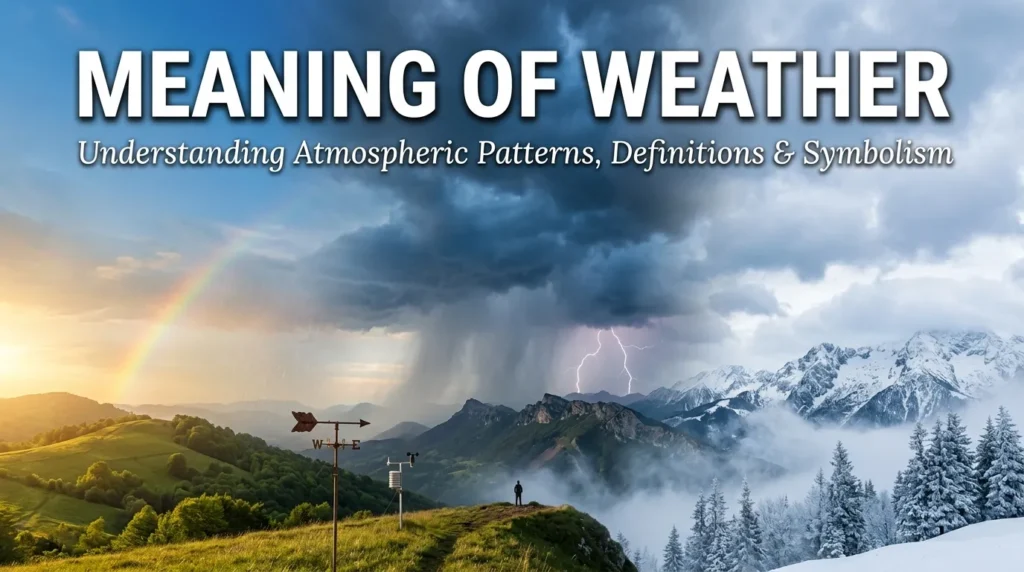
Weather describes what the atmosphere is like at a specific time and place. It includes conditions such as temperature, rainfall, sunshine, humidity, wind, cloud cover, and air pressure.
When you say it is raining, windy, sunny, or unusually cold outside, you are describing the weather.
For example, if a city experiences heavy rain on Monday and sunshine on Tuesday, its weather has changed.
Definition of Weather
Weather is the state of the atmosphere at a particular place and time, measured through conditions such as temperature, precipitation, humidity, wind, and air pressure.
In practical terms, weather describes short-term atmospheric conditions. Weather forecasts help people decide what to wear, whether to carry an umbrella, and how to plan outdoor activities.
Meaning of Climate
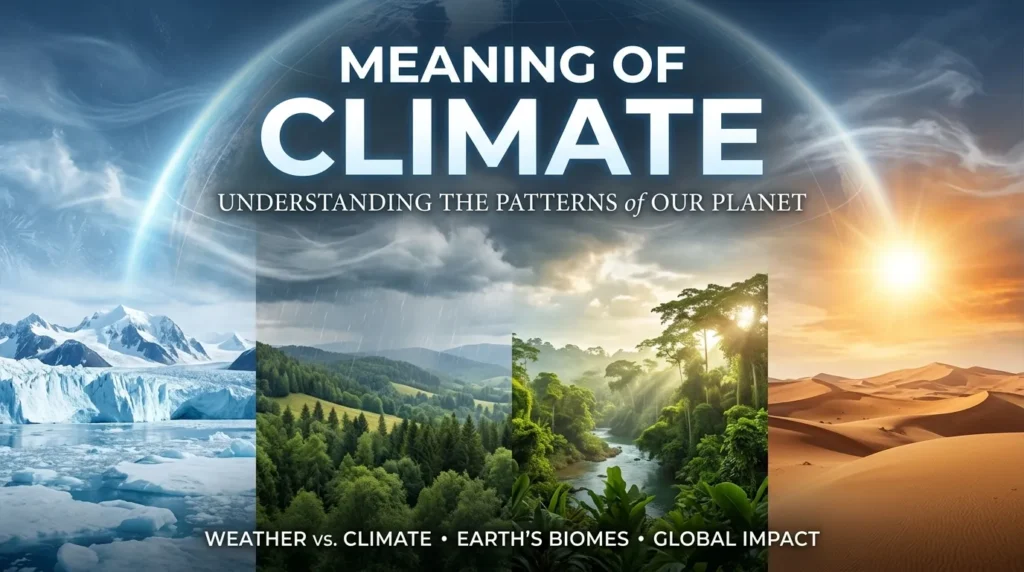
Climate describes the typical weather patterns of a place over a long period. It helps explain whether a region generally experiences hot summers, cold winters, frequent rainfall, dry seasons, or persistent humidity.
For example, a region may have a hot, dry climate even if it experiences a few rainy days each year.
Definition of Climate
Climate is the long-term pattern of weather conditions in a particular region, including typical temperatures, precipitation, humidity, wind, and the frequency of extreme events.
Scientists commonly use periods of 30 years or more to calculate standard climate averages. However, climate also includes the range and frequency of conditions, not just average temperatures or rainfall.
In everyday language, climate describes what a place is generally like over many years, rather than what happens on a particular day.
Main Difference
The main difference between weather and climate is the time scale over which atmospheric conditions are described.
Weather focuses on short-term conditions, such as today’s temperature or tomorrow’s chance of rain. Climate focuses on long-term patterns, such as the usual temperature range or rainfall levels in a region across many years.
For example, a normally hot region can experience an unusually cold day. That cold day is part of its weather, but the region’s overall climate may still be hot.
Weather vs Climate Comparison Table
| Weather | Climate |
| Describes current or short-term conditions | Describes long-term weather patterns |
| Can change within minutes or hours | Is assessed across many years |
| Helps answer, “Will it rain tomorrow?” | Helps answer, “Is this region generally rainy?” |
| Includes individual storms and heat waves | Includes typical conditions and the frequency of extremes |
| Is forecast for specific times and places | Is studied using long-term observations and statistical patterns |
Both terms describe related aspects of Earth’s atmospheric system. Climate is built from weather observations collected over time, but it involves more than simply calculating an average.
Which One Is Correct?
Both weather and climate are correct English words. Neither is a misspelling, and neither is grammatically superior to the other.
The correct choice depends on what you want to describe.
- Use weather when discussing short-term atmospheric conditions or forecasts.
- Use climate when discussing long-term patterns and the typical conditions of a region.
Examples:
- Correct: “The weather is unusually cold today.”
- Correct: “The climate in this region is generally warm.”
- Incorrect usage: “The climate forecast says it will rain this afternoon,” if you mean an ordinary daily weather forecast. In this context, weather forecast is the appropriate expression.
Grammar and Usage
Weather and climate are both nouns. They often appear in similar sentence patterns, but their meanings determine how they should be used.
1. Weather as a Noun
Weather is generally an uncountable noun when referring to atmospheric conditions.
Common expressions include:
- The weather is sunny.
- The weather forecast predicts rain.
- We had bad weather during our trip.
- The weather has improved since yesterday.
- Extreme weather can disrupt transportation.
In standard English, weather normally takes a singular verb when used in this sense.
Correct: “The weather is pleasant.”
Incorrect: “The weather are pleasant.”
Although weather can have specialized uses in technical or historical contexts, learners should generally treat it as uncountable when discussing atmospheric conditions.
2. Climate as a Noun
Climate is a noun that describes long-term atmospheric patterns.
Common expressions include:
- The local climate is dry.
- Climate conditions vary across the country.
- The region has a tropical climate.
- Climate patterns affect agriculture.
- Scientists study climate change.
Unlike weather, climate is also commonly used with an article when referring to a particular type of climate.
For example:
- “The city has a humid climate.”
- “A tropical climate often features warm temperatures throughout the year.”
The plural climates is also correct when discussing different climate types or regions.
3. Common Word Combinations
Some expressions naturally use one word rather than the other.
| With weather | With climate |
| Weather forecast | Climate change |
| Weather report | Climate pattern |
| Weather conditions | Climate zone |
| Weather warning | Climate data |
| Weather station | Climate system |
| Extreme weather | Global climate |
These combinations are useful for choosing the right word in conversations and formal writing.
How to Use Weather and Climate Correctly
The easiest way to choose between these words is to consider the period you are describing.
Use Weather for Short-Term Conditions
Choose weather when talking about what is happening now, what happened recently, or what is expected soon.
Examples of common sentence patterns include:
- The weather is + adjective: The weather is cloudy today.
- The weather will be + adjective: The weather will be warmer tomorrow.
- The weather forecast predicts + condition: The weather forecast predicts heavy rain.
- The weather has been + adjective: The weather has been unusually windy this week.
These patterns are especially useful in everyday conversations, travel planning, and weather reports.
Strengthen your grammar skills by understanding how toward and towards work in sentences and everyday conversations.
Use Climate for Long-Term Patterns
Choose climate when describing the typical conditions of a region over many years.
Common sentence patterns include:
- The climate is + adjective: The climate is generally warm and humid.
- A region has a + climate type: The region has a Mediterranean climate.
- The climate of + place: The climate of the island is tropical.
- Climate affects + noun: Climate affects the types of crops farmers can grow.
Climate is especially common in geography, environmental science, agriculture, and discussions about long-term environmental changes.
Understand the Difference Through a Real-Life Situation
Imagine that you are planning a trip to a coastal city.
You check the forecast and learn that rain is expected on Friday. This is information about the weather.
You also discover that the city generally experiences hot, humid summers and mild winters. This describes its climate.
The forecast helps you plan what to do on Friday, while the climate information helps you choose the most suitable season for your visit.
Examples
Examples of Weather
- The weather is sunny and warm this afternoon.
- We canceled the picnic because of the bad weather.
- The weather forecast predicts thunderstorms tonight.
- Strong winds made driving difficult yesterday.
- The weather has changed dramatically since morning.
- Farmers are waiting for the rainy weather to arrive.
- The weather was colder than expected during our vacation.
- Please check the weather before leaving for the airport.
- Extreme weather caused several roads to close.
- The meteorologist warned residents about the approaching storm.
Examples of Climate
- The region has a warm, humid climate.
- Climate affects the crops that farmers can grow.
- The island’s tropical climate attracts visitors throughout the year.
- Scientists analyze climate data to identify long-term trends.
- The local climate is suitable for growing citrus fruits.
- Climate change can affect rainfall patterns.
- Different climate zones support different types of vegetation.
- The country’s climate varies considerably between coastal and mountainous areas.
- Researchers are studying how the climate has changed over several decades.
- Long-term climate patterns help communities prepare for environmental risks.
Examples Comparing Weather and Climate
- Today’s cold weather does not necessarily mean the region has a cold climate.
- Weather forecasts describe upcoming conditions, while climate records show long-term patterns.
- A dry month can occur even in a region with a generally wet climate.
- Climate influences the weather patterns that are typical of a region.
- One unusually hot summer does not, by itself, establish a long-term climate trend.
- A region’s climate can change even though its weather continues to vary from day to day.
- Weather observations collected over many years help scientists understand climate.
- Climate information helps explain what conditions are typical, but it cannot tell you exactly what tomorrow’s weather will be.
Common Mistakes
1. Using Climate for a Daily Forecast
Incorrect for an ordinary daily forecast: “The climate predicts rain tomorrow.”
Correct: “The weather forecast predicts rain tomorrow.”
Why it happens: People sometimes associate climate with all atmospheric conditions, but daily forecasts focus on short-term weather.
2. Assuming One Cold Day Means the Climate Is Cold
Incorrect reasoning: “It is freezing today, so this must be a cold-climate region.”
Better statement: “It is freezing today, although the region usually has a mild climate.”
Why it happens: A single weather event does not necessarily represent a region’s long-term conditions.
3. Treating Weather and Climate as Synonyms
Incorrect: “Weather change always means climate change.”
Correct: “Weather can change from day to day, while climate change refers to significant changes in long-term patterns.”
Why it happens: Both terms describe atmospheric conditions, but they operate on different time scales.
4. Assuming Climate Means Only Temperature
Incorrect: “Climate describes only how hot or cold a place is.”
Correct: “Climate includes typical temperatures, rainfall, humidity, wind, and other conditions.”
Why it happens: Temperature is an important part of climate, but it is not the only factor.
5. Thinking Climate Never Changes
Incorrect: “The climate of a place always stays the same.”
Correct: “Climate usually changes more slowly than weather, but long-term climate patterns can change.”
Why it happens: Climate is associated with long periods, which can make its changes less obvious in everyday experience.
6. Confusing an Unusual Weather Event With a Long-Term Trend
Incorrect reasoning: “One unusually rainy week proves that the climate has become wetter.”
Better statement: “A long-term analysis of rainfall records is needed to determine whether the region’s climate is becoming wetter.”
Why it happens: Short-term events can be unusual without establishing a lasting pattern.
Linguistic Insight
Word Origins
The words weather and climate have different historical origins.
Weather comes from an Old English word related to atmospheric conditions and the state of the air. Its meaning has remained closely connected to rain, wind, temperature, and other conditions people experience outdoors.
Climate comes through Latin from the Greek word klima, which originally referred to an inclination or slope, particularly the inclination of the Earth relative to the Sun. The term later developed into a way of describing the characteristic conditions of different geographical regions.
These origins reflect the way people have long observed both immediate atmospheric conditions and broader differences between places.
Why the Terms Are Often Confused
Weather and climate are semantically related, meaning their meanings belong to the same general subject area.
Both involve temperature, rainfall, wind, humidity, and other atmospheric variables. The main distinction is how those variables are considered over time.
For example, temperature can describe either weather or climate:
- “The temperature is 35°C this afternoon” describes weather.
- “Summer temperatures typically reach 35°C in this region” describes a climate pattern.
The word itself does not determine the category. The time scale and context do.
How Weather Data Becomes Climate Information
Climate studies rely on repeated observations of weather.
Scientists collect measurements over long periods, examine averages and variations, and study the frequency of different conditions. These records help establish typical patterns and reveal whether those patterns are changing.
A single observation tells us something about the weather. A long record of observations provides evidence about the climate.
However, climate is not merely an average. It also includes variations, seasonal patterns, and the likelihood of extreme conditions.
Usage Tips
Use these practical reminders to distinguish the terms confidently.
- Think about time: Today or tomorrow usually points to weather. Typical conditions over decades point to climate.
- Think about purpose: A forecast is usually about weather. A study of long-term rainfall patterns is about climate.
- Remember that both can involve temperature: The difference is whether you describe a short-term observation or a long-term pattern.
- Use familiar expressions: Weather forecast, weather report, climate change, and climate zone are useful combinations to learn.
- Avoid judging climate from one event: One storm, heat wave, or cold spell cannot establish a long-term climate trend on its own.
- Remember the relationship: Weather observations provide the information scientists use to study climate.
A useful memory aid is: Weather is what happens; climate is what typically happens over time.
Expert Suggestion
When writing an article, school assignment, email, or scientific explanation, identify the time scale before choosing between weather and climate.
If you are describing a specific day, forecast, storm, or temperature reading, use weather. If you are discussing typical seasonal conditions, long-term averages, regional patterns, or climate change, use climate.
For English learners, practice by describing the same place in two ways. First, write a sentence about today’s conditions. Then write a sentence about what the place is generally like across the year. This simple exercise helps you understand the difference in meaning and use both words naturally.
Summary
Weather and climate are both correct English words, but they describe different time scales.
- Weather means the short-term state of the atmosphere at a particular place and time.
- Climate means the long-term patterns and typical range of weather conditions in a region.
- Weather can change quickly, while climate is generally assessed over many years, commonly using 30-year periods for standard averages.
- Use weather for forecasts, daily conditions, storms, and short-term changes.
- Use climate for regional patterns, climate zones, long-term trends, and climate change.
The simplest distinction is that weather describes what is happening, while climate describes the conditions that are typical over time.
Frequently Asked Questions
1. What is the main difference between weather and climate?
Weather describes short-term atmospheric conditions at a particular place and time. Climate describes the typical patterns and range of weather conditions over many years.
2. Is weather or climate the correct word?
Both words are correct. Use weather for short-term conditions and climate for long-term patterns.
3. What is an example of weather?
A sunny afternoon, a thunderstorm tonight, or a forecast of rain tomorrow are examples of weather.
4. What is an example of climate?
A region that generally has hot summers, mild winters, and seasonal rainfall has a characteristic climate.
5. How many years are needed to define a climate?
Standard climate averages commonly use a 30-year period. Scientists can study shorter or longer periods for particular purposes, but 30 years is a widely used standard.
6. Can weather change without climate changing?
Yes. Weather changes naturally from day to day. A short-term change does not necessarily indicate a lasting change in the climate.
7. Can climate change affect weather?
Yes. Climate influences the background conditions in which weather occurs. Climate change can alter the likelihood, intensity, or patterns of certain weather events, although individual events have multiple influences.
8. Does climate mean temperature only?
No. Climate includes temperature, precipitation, humidity, wind, seasonal patterns, and the frequency of extreme conditions.
9. Is a heat wave weather or climate?
A heat wave is a weather event because it occurs over a limited period. Scientists can study heat waves over many years to determine how their frequency or intensity relates to climate patterns.
10. Is rain part of weather or climate?
Rain can be part of both. Rain falling today is weather, while the typical amount and seasonal distribution of rainfall over many years are aspects of climate.
11. What is the difference between climate and climate change?
Climate describes the long-term patterns of weather in a place or across the planet. Climate change refers to significant, lasting changes in those patterns.
12. Are weather and climate related?
Yes. Climate is studied using long-term weather observations. Weather describes individual conditions and events, while climate provides the broader context in which they occur.
13. Which is more predictable, weather or climate?
Specific weather conditions become harder to predict as the forecast period extends. Climate patterns can often be described statistically over longer periods, although climate projections also involve uncertainty.
14. What is the difference between a weather forecast and a climate prediction?
A weather forecast estimates atmospheric conditions at a particular place and time. A climate prediction or projection describes likely long-term patterns or statistical conditions rather than the exact weather on a particular day.
15. How can I remember weather vs climate?
Remember that weather describes what happens over a short period, while climate describes what is typical over many years. A rainy day is weather; a region’s usual rainy season is climate.

