
You have finished a meeting and want to describe what happened next. Should you write “afterward” or “afterwards”? Both spellings are correct, and they have the same meaning. The main difference is regional preference: afterward is more common in American English, while afterwards is more common in British English. Understanding this distinction will help you choose the right form for essays, emails, articles, and everyday conversation.
Quick Answer
Afterward and afterwards are both correct English adverbs. They mean “at a later time” or “after something has happened.” The main difference is which spelling people tend to prefer in different varieties of English.
| Feature | Afterward | Afterwards |
| Correct spelling? | Yes | Yes |
| Meaning | At a later time | At a later time |
| Part of speech | Adverb | Adverb |
| American English | More common | Also accepted |
| British English | Also accepted | More common |
| Meaning difference | None | None |
| Example | We went home afterward. | We went home afterwards. |
Choose afterward if you are following American English conventions and afterwards if you are following British English conventions. Either spelling is grammatically correct.
Learn how to describe changing skies naturally with cloud similes with vivid imagery for stories, poems, and essays.
Meaning and Definition
Meaning of Afterward
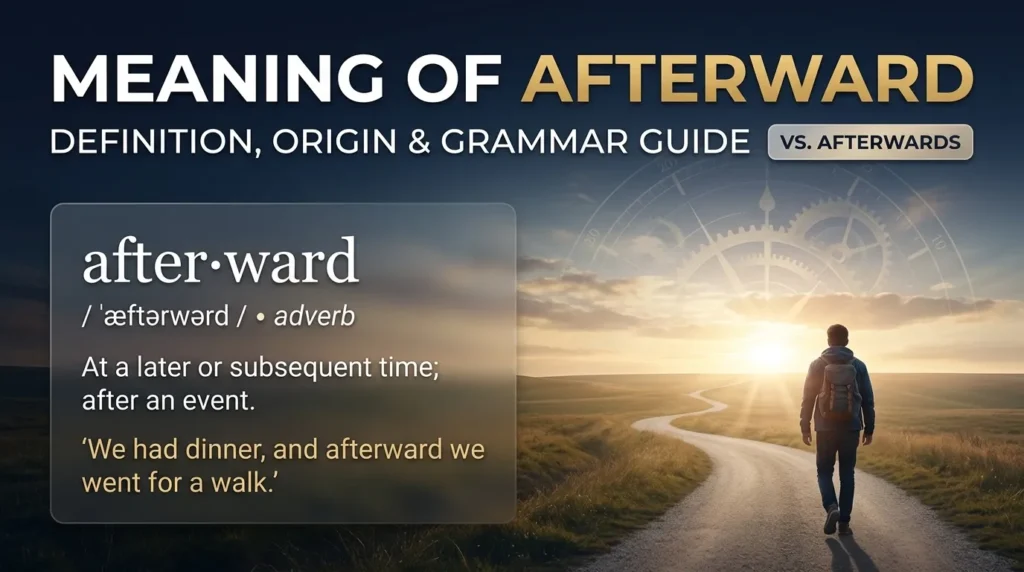
Afterward means something happens later than another event. It connects two events in time and often appears when describing what happened next.
For example, if you attend a class and visit the library when it finishes, you can say, “I went to the library afterward.”
The word helps you avoid repeating a longer phrase such as “after the class ended.”
Definition of Afterward
Afterward is an adverb meaning at a later time or after an event has taken place.
It indicates the time relationship between two actions or situations. It does not specify exactly how much time passes between them.
For example:
- We discussed the proposal and signed the contract afterward.
- She apologized afterward.
In both sentences, the word refers to something that happened after an earlier event.
Meaning of Afterwards
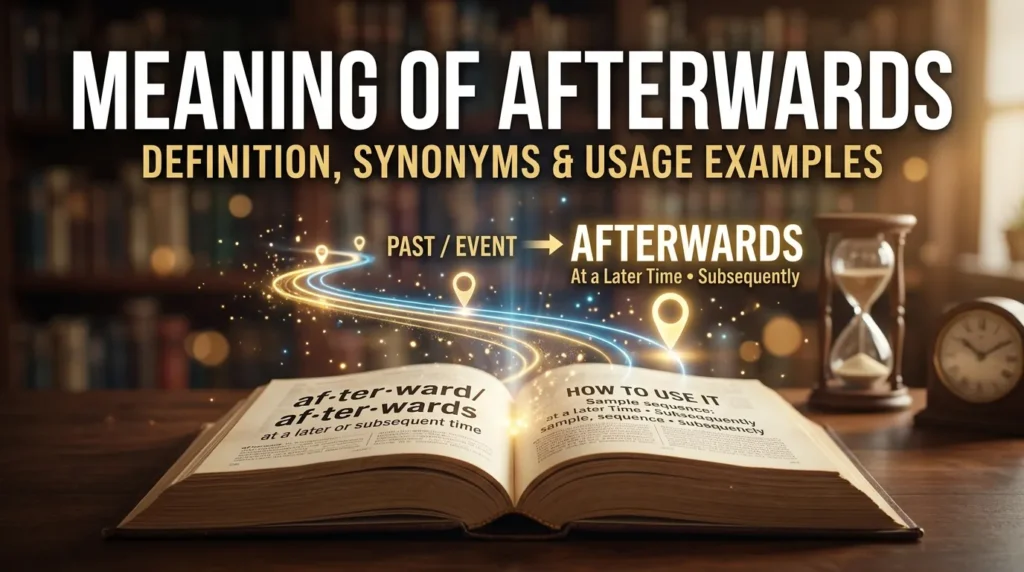
Afterwards has the same meaning as afterward. It refers to a time following an event, action, or situation.
For example, “We had dinner and watched a movie afterwards” means that watching the movie happened after dinner.
This spelling is especially familiar to readers of British English.
Definition of Afterwards
Afterwards is an adverb meaning at a later time or subsequently.
It describes an action or event that occurs after something else. Like afterward, it does not tell the reader the precise length of the interval between events.
For example:
- He completed his assignment and relaxed afterwards.
- We visited the museum and had lunch afterwards.
Both sentences use afterwards to establish the order of events.
Main Difference
The difference between afterward and afterwards is mainly regional, not grammatical. Both words refer to a later time, and neither is more formal or more accurate than the other.
| Comparison | Afterward | Afterwards |
| Meaning | Later, after that | Later, after that |
| Spelling | Ends in d | Ends in ds |
| Typical American usage | Preferred | Less common |
| Typical British usage | Less common | Preferred |
| Formal writing | Appropriate | Appropriate |
| Pronunciation | Usually ends with a /d/ sound | Usually ends with a /dz/ sound |
American English vs. British English
In American English, writers generally prefer afterward.
Example: We finished the interview and discussed the results afterward.
In British English, writers generally prefer afterwards.
Example: We finished the interview and discussed the results afterwards.
Both sentences are correct. The spelling simply reflects a common regional preference.
Does the Final S Change the Meaning?
No. Adding an s does not change the meaning, tense, or grammatical function of the word.
- She called me afterward.
- She called me afterwards.
Both sentences mean that she called at a later time.
Which One Is Correct?
Both afterward and afterwards are correct standard English. Neither is a misspelling, and you can use either one without changing the meaning of your sentence.
Choose the form that best matches your audience:
- For American English: Prefer afterward.
- For British English: Prefer afterwards.
- For international writing: Use the spelling preferred by your publication or organization.
- For school assignments: Follow your teacher’s or institution’s preferred style.
You do not need to avoid afterwards in American English or afterward in British English. Both forms are understood and accepted.
Grammar and Usage
Part of Speech
Both afterward and afterwards are adverbs. An adverb can describe when an action happens, and these words specifically indicate that something occurs later.
For example:
- We ate lunch afterward.
- They went shopping afterwards.
In each sentence, the adverb tells the reader when the next action took place.
Position in a Sentence
You can use afterward or afterwards in several positions, depending on the sentence structure.
At the beginning:
- Afterwards, we returned to the hotel.
- Afterward, she explained her decision.
At the end:
- We returned to the hotel afterwards.
- She explained her decision afterward.
In the middle:
- The team later discovered that the problem had started shortly afterward.
- He was afterwards appointed to a senior position.
The middle position is possible, although its naturalness depends on the sentence. In many everyday sentences, placing the word at the beginning or end sounds more natural.
Common Word Combinations
Both forms work with words that describe the time between events.
| Expression | Meaning |
| Shortly afterward / afterwards | Soon after an event |
| Soon afterward / afterwards | A short time later |
| Immediately afterward / afterwards | Directly after an event |
| Long afterward / afterwards | Much later |
| Not long afterward / afterwards | After a relatively short interval |
Examples:
- Shortly afterward, the manager announced the results.
- We moved to another city soon afterwards.
- The problem was resolved immediately afterward.
- Years afterward, they met again.
These combinations do not change the basic meaning of either spelling.
Formal and Informal Usage
Both words are suitable for formal and informal communication. Neither is inherently more professional or more academic.
You can use them in:
- Business emails
- Academic essays
- News articles
- Personal messages
- Reports and presentations
- Everyday conversations
The important consideration is regional consistency, not formality.
How to Use Afterward and Afterwards
Use Afterward When Following American English
Choose afterward when writing for a primarily American audience.
For example:
- I will send you the documents afterward.
- We reviewed the budget and discussed the changes afterward.
- The students completed their exams and left shortly afterward.
This spelling is a natural choice for US-focused websites, professional documents, and school assignments that follow American conventions.
Find sensitive ways to discuss difficult themes through figurative expressions about mortality suited to different writing styles.
Use Afterwards When Following British English
Choose afterwards when writing for a primarily British audience.
For example:
- We had a cup of tea afterwards.
- She spoke to her teacher shortly afterwards.
- They visited the exhibition and went to dinner afterwards.
This spelling is especially common in British writing and is equally suitable for professional or academic contexts.
Use Either Form When Regional Style Is Not Important
If your readers come from different English-speaking countries, either form is acceptable.
For example:
- The presentation ended, and everyone asked questions afterward.
- The presentation ended, and everyone asked questions afterwards.
Both versions communicate the same information. If you are writing a long article or book, choose one form and use it consistently.
Do Not Confuse Afterward With After
Although the words are related, they do not function in exactly the same way.
Afterward refers to a later time and normally functions as an adverb.
Example: We had dinner and went for a walk afterward.
After can function as a preposition, conjunction, or adverb.
Examples:
- We went for a walk after dinner. (Preposition)
- We went for a walk after we finished dinner. (Conjunction)
- I had never seen her before or after. (Adverbial use)
Use afterward or afterwards when you want to refer back to an earlier event without repeating the full time expression.
Examples
Examples of Afterward
These sentences demonstrate how afterward works in everyday, professional, and academic contexts.
- We finished our homework and played outside afterward.
- She called her parents afterward to explain what had happened.
- The manager reviewed the report and scheduled a meeting afterward.
- I realized my mistake shortly afterward.
- The researchers analyzed the data and published their findings afterward.
- We had lunch together and went shopping afterward.
- He apologized for his behavior afterward.
- The company introduced a new policy and revised its procedures shortly afterward.
- I will email you the final version afterward.
- Years afterward, she still remembered that conversation.
Examples of Afterwards
These sentences use afterwards in the same way, with a spelling common in British English.
- We watched a film and went for a walk afterwards.
- She spoke to her supervisor afterwards.
- They visited the castle and had lunch afterwards.
- He felt much better shortly afterwards.
- The students discussed the lecture afterwards.
- We can talk about the details afterwards.
- The guests arrived early and stayed for dinner afterwards.
- She completed her training and found a job soon afterwards.
- The team reviewed the results and made several improvements afterwards.
- Long afterwards, he discovered why the decision had been made.
Examples With Shortly Afterward and Shortly Afterwards
Both expressions mean soon after something happens.
- American English: The storm passed, and shortly afterward the roads reopened.
- British English: The storm passed, and shortly afterwards the roads reopened.
Neither version implies a different amount of time.
Common Mistakes
Mistake 1: Thinking Afterwards Is Incorrect in American English
Incorrect assumption: Afterwards is always grammatically wrong in American English.
Correct understanding: Afterwards is an accepted English form, although afterward is generally preferred in American usage.
Example:
- Accepted: We discussed the issue afterwards.
- Preferred in typical American usage: We discussed the issue afterward.
The difference is regional preference, not grammatical correctness.
Mistake 2: Thinking Afterward Is Incorrect in British English
Incorrect assumption: British writers must always use afterwards.
Correct understanding: Afterward is also a legitimate form of English. Afterwards is simply more common in British usage.
Example:
- Correct: We went for a walk afterward.
- Also correct: We went for a walk afterwards.
Mistake 3: Assuming the Words Have Different Meanings
Incorrect assumption: Afterward means immediately later, while afterwards means much later.
Correct understanding: Neither word specifies how much time passes.
Example:
- Correct: She called me afterward.
- Correct: She called me afterwards.
Both sentences leave the exact timing unspecified.
Mistake 4: Using Afterward and Afterwards Inconsistently
Switching between forms without a reason can make a document look inconsistent.
For example, a US-focused article might use afterward in one paragraph and afterwards in another.
Better approach: Choose one form based on your preferred variety of English and apply it consistently.
Mistake 5: Confusing Afterwards With Afterwords
Afterwords is a different word from afterwards.
- Afterwards: At a later time.
- Afterwords: Words or remarks that come after a main text or discussion, depending on context.
Example of afterward: We went home afterward.
Example of afterwords: The author included personal afterwords at the end of the collection.
Do not use afterwords when you mean that something happened later.
Linguistic Insight
Why Do Both Forms Exist?
The two forms reflect a long-standing pattern in English adverbs. Some words ending in -ward also have variants ending in -wards.
For example:
- Toward and towards
- Backward and backwards
- Forward and forwards
- Afterward and afterwards
The variants often have the same basic meaning, although regional preferences differ from word to word.
Where Did Afterwards Come From?
Afterward has historical roots in Old English. Its older form was related to the idea of being behind or following in position or time.
The form afterwards developed with an additional -s, a historical ending that appears in several English adverbs. Over time, both forms became established in English.
Today, the extra letter does not indicate a different meaning or a special grammatical function.
Why Is Afterward More Common in American English?
American English generally favors afterward, while British English generally favors afterwards. Similar patterns occur with some other -ward and -wards pairs.
These preferences developed through the history of English usage and became established through regional writing conventions. They are not rules that make one form universally correct and the other incorrect.
Is the Difference About Pronunciation?
The words are pronounced almost identically, except for the ending.
In common American pronunciation, afterward ends with a /d/ sound, while afterwards ends with a /dz/ sound. The stress generally falls on the first syllable in both forms.
The pronunciation difference is small and does not change the meaning.
Usage Tips
- Remember the regional preference: Afterward is typical of American English, while afterwards is typical of British English.
- Focus on meaning first: Both forms mean at a later time.
- Follow your style guide: If a publication has a preferred spelling, use it.
- Keep your writing consistent: Avoid switching between the two forms unnecessarily.
- Do not confuse the extra s with a plural: Afterwards is an adverb, not a plural noun.
- Check the context: If you mean a later event, afterward or afterwards may work. If you mean a time following a noun, after may be more appropriate, as in “after lunch.”
Expert Suggestion
For learners, editors, and content writers, the easiest approach is to choose the form that matches the English variety used throughout your writing.
If you write mainly for American readers, use afterward as your default. If your audience is primarily British, use afterwards.
When editing an article, search for both spellings to ensure you have followed your preferred style consistently. Do not correct a legitimate variant simply because it differs from your usual spelling.
Most importantly, remember that the choice affects regional style, not meaning or grammatical accuracy.
Summary
- Afterward means at a later time and is more common in American English.
- Afterwards has the same meaning and is more common in British English.
- Both forms are correct standard English adverbs.
- Neither form is inherently more formal than the other.
- The final s does not change the meaning.
- Choose the form that suits your audience or style guide and use it consistently.
Frequently Asked Questions
1. Is afterward or afterwards correct?
Both are correct. Afterward is more common in American English, while afterwards is more common in British English.
2. What is the difference between afterward and afterwards?
There is no difference in meaning. Both mean at a later time or after something has happened. The main distinction is regional usage.
3. Is afterward American or British English?
Afterward is especially common in American English. British writers also use it, but they generally prefer afterwards.
4. Is afterwards British or American English?
Afterwards is especially common in British English. It is also accepted in American English, although afterward is usually preferred there.
5. Can I use afterwards in American English?
Yes. Afterwards is grammatically correct in American English. However, afterward is generally the more conventional choice for US-focused writing.
6. Can I use afterward in British English?
Yes. Afterward is a legitimate English word, although afterwards is generally more common in British usage.
7. Is afterward one word or two?
Afterward is one word. It is not hyphenated or written as two separate words.
8. Is afterwards one word or two?
Afterwards is also one word. The final s is part of the spelling, not a separate word or suffix that you should write independently.
9. Is shortly afterward or shortly afterwards correct?
Both expressions are correct. They mean soon after an event. Use shortly afterward for typical American usage and shortly afterwards for typical British usage.
10. Is afterwards more formal than afterward?
No. Neither form is inherently more formal. Both are appropriate in academic, professional, and everyday writing.
11. Does afterwards mean later than afterward?
No. They mean the same thing and do not indicate different intervals of time.
12. Should I use afterward or afterwards in an essay?
Follow the English variety required by your assignment. Use afterward for typical American English and afterwards for typical British English. If your institution has a style guide, follow its recommendation.
13. Are afterward and afterwards adverbs?
Yes. Both are adverbs that indicate when something happens in relation to an earlier event.
14. What is the difference between afterward and afterwords?
Afterward means at a later time. Afterwords refers to words or remarks that follow a main text or discussion. They are different words with different meanings.
15. Is it better to use afterward or afterwards for SEO content?
Neither form is inherently better for SEO. Choose the spelling that matches your target audience and use it naturally throughout the article. Consistency and clear writing matter more than choosing one variant solely for search optimization.
Meta Description
Afterward vs Afterwards: learn which spelling is correct, how American and British usage differs, and see examples here.

