
Have you ever wondered whether to write looser or loser when describing someone or something? These words look almost identical, but one extra letter changes their meanings completely. Looser describes something that is less tight, while loser refers to someone or something that loses. Confusion often occurs in text messages, social media posts, school assignments, and everyday writing because both words have the same long vowel sound. Understanding their meanings, spelling, and usage will help you choose the correct word every time.
Quick Answer
Both looser and loser are correct English words, but they have different meanings.
| Word | Meaning | Part of speech | Example |
| Looser | Less tight or less restrictive | Comparative adjective | This shirt is looser than mine. |
| Loser | Someone or something that loses | Noun | The loser congratulated the winner. |
Remember the distinction: looser has two o’s because it comes from loose, meaning not tight. Loser has one o and comes from lose, meaning to fail to win or stop having something.
Add personality to your stories with beautiful smile similes for creative writing and everyday descriptions.
Meaning and Definition
Meaning of Looser
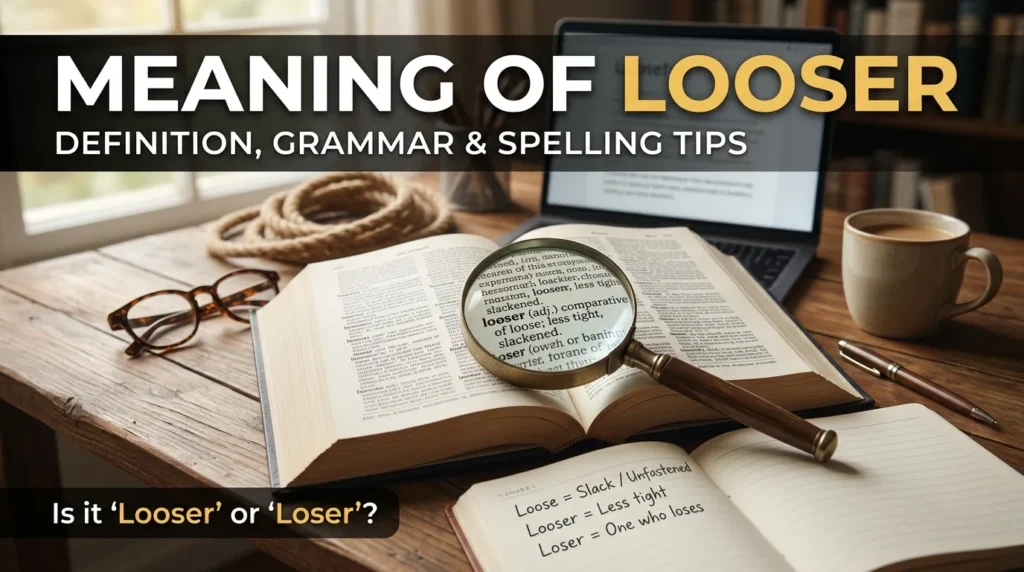
Looser means less tight, less firmly attached, or less restrictive than something else. It is the comparative form of the adjective loose.
You might use it when comparing clothing, a knot, a screw, a rule, or a schedule. For example, if one pair of jeans fits less tightly than another, you can say that the first pair is looser.
Looser can also describe something that is less strict or less controlled, such as a looser set of rules.
Definition of Looser
Looser is the comparative form of loose, meaning less tightly fastened, less firmly held, less close-fitting, or less strict.
In practical usage, it compares two things or situations according to how tight, secure, or restrictive they are.
For example:
- This belt is looser than the one I wore yesterday.
- The new policy gives employees looser restrictions on working hours.
- After I adjusted the knot, it became looser.
Meaning of Loser

Loser means a person, team, or other participant who does not win a competition, game, or contest. It can also describe someone who is unsuccessful in a particular situation.
In informal conversation, loser is sometimes used as an insult to criticize someone considered unsuccessful, unpopular, or unimpressive. However, the word does not always have a negative or insulting meaning.
For example, the loser of a chess match is simply the person who did not win. There is no need for the word to imply anything about that person’s character or abilities.
Definition of Loser
Loser is a noun referring to a person or thing that loses, is defeated, or fails to achieve a desired result.
The word can also refer to someone or something that suffers a disadvantage or an unfavorable outcome.
For example:
- The loser of the final match received a silver medal.
- The company became the biggest loser in the market downturn.
- Calling someone a loser can be hurtful, especially when used to mock their personal circumstances.
In everyday English, the exact meaning depends on the context. It may describe the result of a competition, an unsuccessful outcome, or an insulting judgment about a person.
Main Difference
The main difference between looser and loser is their meaning and grammatical function. Looser describes a comparison, while loser identifies someone or something that experiences a loss.
| Feature | Looser | Loser |
| Root word | Loose | Lose |
| Part of speech | Comparative adjective | Noun |
| Pronunciation | /ˈluːsər/ | /ˈluːzər/ |
| Meaning | Less tight or less strict | One that loses |
| Comparison | Yes | No |
| Plural form | No separate plural form as an adjective | Losers |
| Example | The knot is looser now. | He was the loser of the game. |
1. Difference in Meaning
Looser describes a change or comparison in tightness, fit, or strictness.
- My new shoes feel looser than my old ones.
- The revised rules are looser than the original rules.
Loser refers to a person or thing that loses or fails to win.
- The loser accepted the result gracefully.
- The losing team was named the loser of the tournament.
2. Difference in Pronunciation
The two words have similar vowel sounds but different final consonant sounds.
- Looser: pronounced LOO-sər, with an /s/ sound like the beginning of sun.
- Loser: pronounced LOO-zər, with a /z/ sound like the beginning of zoo.
This difference can help you identify the correct word when speaking, although the spelling is especially important in writing.
3. Difference in Spelling
The spelling difference is only one letter, but it matters.
- Looser contains two o’s and comes from loose.
- Loser contains one o and comes from lose.
The comparative ending -er is added to loose to form looser. The noun loser is formed from lose with the suffix -er, which can identify a person or thing associated with an action.
Which One Is Correct?
Both looser and loser are correct standard English words. Neither spelling is inherently incorrect. The correct choice depends on what you want to express.
Use looser when comparing how tight, secure, or restrictive something is.
- Correct: These trousers are looser than the other pair.
- Incorrect for this meaning: These trousers are loser than the other pair.
Use loser when referring to someone or something that loses.
- Correct: The loser of the competition received a certificate.
- Incorrect for this meaning: The looser of the competition received a certificate.
If you are describing a person who has been defeated, use loser. If you are describing something that is less tight, use looser.
Grammar and Usage
How Looser Functions in a Sentence
Looser is a comparative adjective. Comparative adjectives compare two people, things, conditions, or situations.
It commonly appears in these sentence patterns:
1. Noun + verb + looser + than
- This jacket is looser than my winter coat.
- The new schedule is looser than the previous one.
2. Looser + noun
- She prefers looser clothing in summer.
- The mechanic replaced the looser connection.
3. Become or get + looser
- The knot became looser after several attempts.
- These shoes get looser as I wear them.
The word can describe physical tightness or a less restrictive arrangement.
How Loser Functions in a Sentence
Loser is a countable noun. It refers to a person, team, organization, or thing that loses.
It commonly appears in these sentence patterns:
1. The loser of + noun
- The loser of the final match congratulated the champion.
- The loser of the election thanked the voters.
2. A or the + loser
- Every contest has a winner and a loser.
- The loser was disappointed but remained respectful.
3. Loser as an informal insult
- He called his classmate a loser during the argument.
- Nobody deserves to be treated like a loser because of one mistake.
When used as an insult, loser is informal and disapproving. In professional and academic writing, more specific descriptions such as unsuccessful candidate, defeated competitor, or underperforming business are often more appropriate.
Improve your descriptive vocabulary with expressive comparisons for silence that bring emotions, settings, and characters to life.
Singular and Plural Forms
The noun loser has a regular plural form:
- Singular: loser
- Plural: losers
Examples:
- One loser left the competition.
- Three losers advanced to the consolation round.
Looser does not change form to agree with a plural noun because adjectives generally do not take plural endings in English.
- The shirt is looser.
- The shirts are looser.
How to Use Looser or Loser
The easiest way to choose between the words is to identify the meaning of your sentence before spelling the word.
Use Looser for Something Less Tight
Choose looser when the sentence describes a comparison involving fit, tension, attachment, or strictness.
Examples of appropriate contexts include:
- Clothing: I need a looser shirt.
- Knots: This knot is looser than the other one.
- Rules: The organization adopted looser guidelines.
- Fit: These shoes feel looser after a few weeks.
- Control: The manager introduced a looser supervision policy.
Ask yourself whether the sentence means less tight or less strict. If it does, looser is likely the correct choice.
Use Loser for Someone or Something That Loses
Choose loser when referring to a person or thing that experiences defeat or an unfavorable outcome.
Examples of appropriate contexts include:
- Sports: The loser shook hands with the winner.
- Games: The last player standing eliminated the loser.
- Elections: The loser conceded defeat.
- Business: The company became a major loser during the downturn.
- Everyday conversation: He felt like a loser after failing the test.
Ask yourself whether the word refers to someone or something that loses. If it does, use loser.
Examples
Examples of Looser
- These jeans are looser around the waist than my old pair.
- I prefer a looser fit when exercising.
- The mechanic discovered that one bolt was looser than the others.
- After several hours, the knot became looser.
- The school introduced looser rules for extracurricular activities.
- Her new schedule is looser, allowing more time for family.
- This lid is looser than the one on the other container.
- The doctor recommended wearing looser clothing for comfort.
- The company adopted a looser dress code.
- My shoelaces became looser as I walked.
Examples of Loser
- The loser of the race congratulated the winner.
- Nobody likes losing, but being a loser in one game does not define you.
- The losing team left the field quietly.
- He was a good loser who respected the referee’s decision.
- The election loser promised to continue serving the community.
- The investor sold the stock before it became a bigger loser.
- She felt like a loser after making a mistake at work.
- The final round determined the winner and the loser.
- The company was the biggest loser in the market decline.
- Calling someone a loser is unkind and rarely helps resolve a disagreement.
Common Mistakes
1. Writing Looser When You Mean Loser
Incorrect: He is such a looser for giving up.
Correct: He is such a loser for giving up.
Why it happens: Writers may add an extra o because the words look similar and have the same vowel sound. However, the noun referring to someone who loses is spelled loser.
A more constructive alternative is: He gave up too quickly.
2. Writing Loser When You Mean Looser
Incorrect: I need a loser pair of shoes.
Correct: I need a looser pair of shoes.
Why it happens: The writer chooses loser without considering that the sentence describes the fit of the shoes rather than a person or thing that loses.
3. Confusing Looser With Loose
Incorrect: This shirt is loose than the other one.
Correct: This shirt is looser than the other one.
Why it happens: Loose is the basic adjective, while looser is its comparative form.
Use loose to describe something without making a comparison. Use looser when comparing it with something else.
- The shirt is loose.
- The shirt is looser than my other shirt.
4. Using Looser as a Noun for a Defeated Person
Incorrect: The looser received a medal.
Correct: The loser received a medal.
Why it happens: The writer mistakenly assumes that looser and loser are interchangeable spellings. They are not. The noun for someone who loses is loser.
5. Confusing Looser With Loser in Text Messages
Incorrect: You’re a looser!
Correct: You’re a loser!
Why it happens: Informal online writing encourages quick typing, and the additional letter can go unnoticed. Since the intended meaning is an insult directed at a person, loser is the appropriate spelling.
Linguistic Insight
Word Formation and Morphology
Morphology is the study of how words are formed from smaller meaningful parts. The distinction between looser and loser becomes clearer when you examine their word formation.
Looser consists of the adjective loose and the comparative suffix -er. The suffix indicates a greater degree of a quality relative to another thing.
For example:
- Loose → looser
- Small → smaller
- Fast → faster
Loser consists of the verb lose and the suffix -er. In this case, the suffix forms a noun referring to someone or something associated with the action of losing.
For example:
- Teach → teacher
- Sing → singer
- Lose → loser
Although the same letters -er appear in both words, they perform different functions because they attach to different base words and form different grammatical categories.
Why the Words Sound Similar
Both words contain the long vowel sound /uː/, as in food. Their main pronunciation difference is the final consonant before the unstressed ending.
- Looser has the voiceless /s/ sound.
- Loser has the voiced /z/ sound.
The spelling does not make this distinction immediately obvious to every learner, particularly when reading quickly or learning English as a second language.
Are Looser and Loser Related?
They are not formed from the same base word.
Looser comes from loose, which describes a lack of tightness or restriction. Loser comes from lose, which describes failing to win, misplacing something, or no longer having something.
Their similar spelling and pronunciation contribute to confusion, but their meanings and grammatical roles remain distinct.
Usage Tips
Here are practical ways to remember the difference between looser and loser.
- Think about tightness: If something is less tight, use looser.
- Think about winning: If someone loses a competition, use loser.
- Look at the base word: Loose becomes looser, while lose becomes loser.
- Listen to the final consonant: Looser has an /s/ sound, while loser has a /z/ sound.
- Check the sentence structure: A word describing clothing or rules is likely to be looser. A noun referring to a defeated person is likely to be loser.
One useful memory aid is to connect the extra o in looser with the idea of something having more room. Remember that this is only a memory trick, not a grammatical rule.
Expert Suggestion
When editing an article, email, school assignment, or social media post, check whether the word describes a quality or identifies someone who loses.
If it describes a quality such as tightness or strictness, use looser. If it identifies someone or something that loses, use loser.
For professional writing, also consider tone. Although loser is appropriate in sports reporting and competition results, using it to describe a person personally can sound insulting. Choose a more precise and respectful expression when the context calls for it.
Summary
Looser and loser are both correct English words, but they have different meanings.
- Looser is the comparative form of loose. It means less tight, less secure, or less restrictive.
- Loser is a noun referring to a person or thing that loses, is defeated, or experiences an unfavorable outcome.
Use looser when comparing tightness or strictness. Use loser when referring to someone or something that loses.
The simplest way to remember the difference is to check the base word: loose becomes looser, and lose becomes loser.
Frequently Asked Questions
1. Is looser or loser correct?
Both are correct. Looser means less tight or less restrictive, while loser refers to someone or something that loses.
2. What is the difference between looser and loser?
Looser is a comparative adjective that describes something less tight or less strict. Loser is a noun that identifies someone or something that loses.
3. Is looser a real word?
Yes. Looser is the standard comparative form of the adjective loose. For example, these pants are looser than those pants.
4. Is loser a real word?
Yes. Loser is a standard English noun referring to a person or thing that loses. It can describe someone defeated in a competition or be used informally as an insult.
5. Why do people spell loser as looser?
People often add an extra o because the words look similar and share the same vowel sound. However, loser is the correct spelling for someone who loses.
6. How do you spell loser correctly?
Spell it L-O-S-E-R, with one o. The word comes from the verb lose.
7. Does looser mean someone who loses?
No. Looser means less tight or less restrictive. The correct noun for someone who loses is loser.
8. Is looser the comparative form of loose?
Yes. Looser is the comparative form of loose, and loosest is the superlative form.
For example: loose, looser, loosest.
9. What is the plural of loser?
The plural of loser is losers. For example, the winners and losers received different awards.
10. How do you pronounce looser and loser?
Looser is pronounced /ˈluːsər/, with an /s/ sound. Loser is pronounced /ˈluːzər/, with a /z/ sound.
11. Can looser describe clothing?
Yes. Looser commonly describes clothing that fits less tightly than another garment or a previous fit. For example, I prefer looser shirts in hot weather.
12. Is calling someone a loser offensive?
It can be. Although loser has a neutral meaning in competitions, using it to criticize or mock someone is informal and often insulting.
13. Is looser or loser used in American English?
Both words are standard in American English, and the spelling distinction is the same in British English. Neither word is a regional alternative to the other.
14. Can I use loser to describe a business?
Yes. Loser can describe a business, investment, or other entity that experiences a loss or unfavorable result. For example, the company was a major loser in the stock market decline.
15. What is an easy trick to remember looser vs. loser?
Remember looser = less tight and loser = someone who loses. Connect looser with loose and loser with lose to choose the correct spelling.

