
Have you ever wondered whether to write consent or concent? These words look and sound almost identical, making them easy to confuse when writing emails, completing official documents, or communicating in English. However, they do not have the same meaning or everyday usage.
Consent is the correct and commonly used spelling when referring to permission, approval, or agreement. Concent is also a legitimate English word, but it is an extremely uncommon, archaic noun referring primarily to harmony or agreement between sounds. Understanding their meanings and differences will help you avoid spelling mistakes and choose the appropriate word in different contexts.
Quick Answer
Consent and concent are both legitimate English words, but they have different meanings and uses.
| Word | Correct? | Meaning | Main Use |
| Consent | Yes | Permission, approval, or agreement | Everyday, professional, and formal English |
| Concent | Yes | Harmony or agreement, especially between sounds | Archaic and historical English |
Consent is the word you should use when talking about permission or agreement. For example:
- She gave her consent to the proposal.
- We need written consent from the parents.
Concent is an archaic word associated with musical harmony or concord. It is rarely encountered in modern English.
For most everyday and professional writing, consent is the appropriate choice.
Avoid common grammatical errors by learning the correct forms of Kind Of and Kinds Of in different sentence structures.
Meaning and Definition
Meaning of Consent

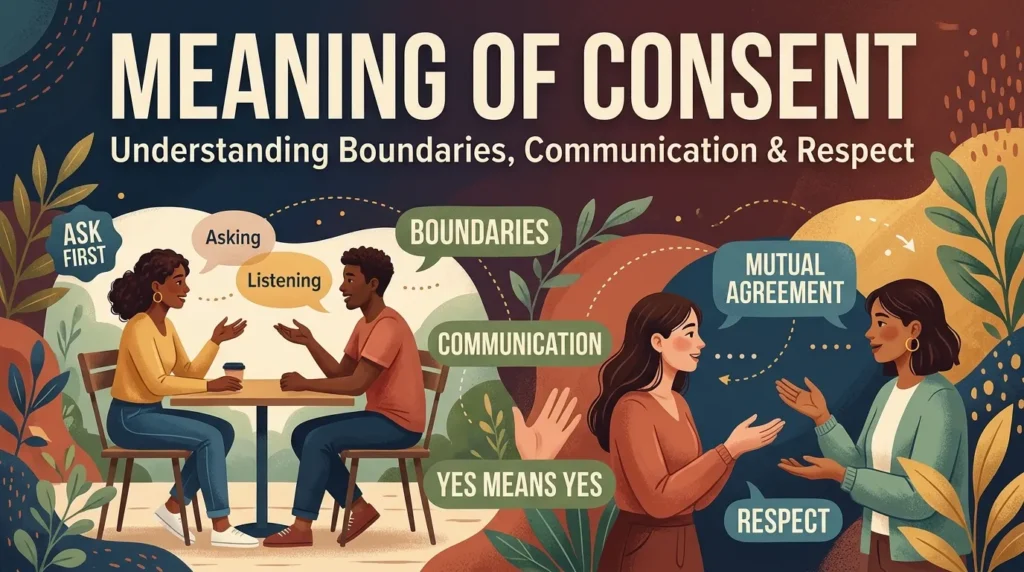
Consent means giving permission, approval, or agreement for something to happen. It indicates that someone willingly agrees to an action, decision, request, or arrangement.
People commonly use this word when discussing personal decisions, medical procedures, legal matters, relationships, and official agreements.
For example:
- My parents gave their consent to the trip.
- The doctor asked for the patient’s consent before the procedure.
- Both parties must consent to the agreement.
In everyday communication, consent communicates that someone has agreed to something or allowed it to happen.
Definition of Consent
Consent is a noun and a verb.
As a noun, it means permission, approval, or voluntary agreement given by someone.
As a verb, it means to agree to something or give permission for an action to take place.
Consider these examples:
- Noun: The company received written consent from its employees.
- Verb: She consented to participate in the interview.
The verb consent is generally used with the preposition to or an infinitive construction.
For example:
- He consented to the arrangement.
- She consented to attend the meeting.
Meaning of Concent
Concent is a rare, archaic English noun that refers to harmony, agreement, or a pleasing combination of sounds or voices.
It is primarily associated with older literary and historical writing, particularly descriptions of music, singing, and harmonious sounds.
For example, a historical writer might use concent to describe several musical voices blending together harmoniously.
Unlike consent, concent is not the standard modern word for permission or approval.
Definition of Concent
Concent is an archaic noun meaning harmony, concord, or agreement, particularly in relation to sounds and voices.
Some historical dictionary records also document broader senses involving agreement or accord.
The word comes from the Latin concentus, meaning harmonious sounds or singing together.
For example:
- The concent of the voices created a harmonious effect.
- The old poem describes the concent of musical instruments.
These examples illustrate the historical meaning of the word rather than recommended everyday usage.
In contemporary English, writers generally use words such as harmony, concord, or agreement instead.
Main Difference
The main difference between consent and concent is their meaning and modern usage.
Although they look and sound similar, they serve different purposes.
| Comparison | Consent | Concent |
| Part of speech | Noun and verb | Noun |
| Meaning | Permission, approval, or agreement | Harmony or concord |
| Pronunciation | /kənˈsent/ | /kənˈsent/ |
| Modern usage | Common | Extremely rare |
| Historical status | Established modern word | Archaic word |
| Context | Legal, medical, personal, and professional | Historical and literary descriptions |
| Example | She gave her consent. | The concent of the voices was beautiful. |
Here are the most important distinctions:
1. Meaning: Consent refers to permission or agreement, whereas concent traditionally describes harmony or concord.
2. Grammar: Consent functions as both a noun and a verb. Concent is a noun.
3. Usage: Consent is widely used in modern English. Concent is primarily encountered in historical or specialized literary contexts.
4. Context: Consent appears in everyday conversations, official documents, and professional communication. Concent belongs mainly to older descriptions of harmonious sounds.
5. Pronunciation: Both words are generally pronounced the same way, which contributes to their spelling confusion.
Therefore, although both words exist, they are not interchangeable.
Which One Is Correct?
Both consent and concent are correct English words, but they are correct in different contexts.
If you want to express permission, approval, or agreement, use consent.
If you encounter concent in historical literature, it may refer to musical harmony or concord.
Consider these examples:
- Correct: The manager gave consent to the new policy.
- Incorrect: The manager gave concent to the new policy.
The second sentence is incorrect for the intended meaning because concent does not mean ordinary permission.
However, it would also be inaccurate to call concent a completely nonexistent word. It has a recognized historical meaning.
The best choice for modern English writing is consent whenever you mean permission or agreement.
Grammar and Usage
Understanding the grammatical function of each word makes it easier to use them correctly.
Grammar of Consent
Consent functions as both a noun and a verb.
1. Consent as a noun
When used as a noun, consent refers to permission, approval, or agreement.
Examples:
- We need your consent before proceeding.
- Written consent is required for participation.
- The parents refused to give their consent.
Consent is generally an uncountable noun when referring to the concept of permission.
However, it can also be countable when referring to an individual official document or authorization.
For example:
– The clinic collected three signed consents.
2. Consent as a verb
When used as a verb, consent means to agree or give permission.
Its main verb forms are:
| Verb Form | Word |
| Base form | Consent |
| Third-person singular | Consents |
| Past tense | Consented |
| Past participle | Consented |
| Present participle | Consenting |
Examples:
- I consent to the arrangement.
- She consents to the request.
- They consented to the changes.
- He is consenting to the proposed terms.
3. Common grammatical patterns
Consent commonly appears in these sentence structures:
- Consent to something
- Consent to do something
- Give consent
- Obtain consent
- Seek consent
- Withdraw consent
- Withhold consent
- Without someone’s consent
Examples:
- The patient consented to the treatment.
- They gave consent to the investigation.
- The organization obtained consent from its members.
- You can withdraw your consent at any time.
Grammar of Concent
Concent functions as a noun.
It does not have standard verb forms such as concented or concenting in contemporary English.
Its historical usage is mainly associated with descriptions of musical harmony, voices, and agreement.
For modern writing, it is generally better to use more familiar alternatives such as:
- Harmony
- Concord
- Musical agreement
- Accord
How to Use Consent Correctly
Because consent is the standard word for permission and agreement, learning its common sentence patterns will help you use it naturally.
1. Use Consent to Express Permission
Use consent when someone gives permission for an action or decision.
Examples:
- My parents gave consent for the school trip.
- The patient provided consent for the examination.
- You cannot use this photograph without the owner’s consent.
2. Use Consent to Something
The preposition to commonly follows consent when introducing the action, proposal, or arrangement being accepted.
Examples:
- She consented to the agreement.
- The company consented to the changes.
- He refused to consent to the proposal.
Avoid common grammar mistakes by mastering the correct use of Showed and Shown in different tenses.
3. Use Consent to Do Something
You can also use consent followed by an infinitive verb.
Examples:
- She consented to participate in the research.
- They consented to attend the meeting.
- He finally consented to sign the document.
4. Use Consent in Formal and Professional Writing
Consent is especially common in legal, medical, educational, and professional contexts.
Examples:
- Written consent is required before treatment.
- The organization obtained consent from all participants.
- Employees must provide consent before their information is shared.
5. Use Consent When Discussing Mutual Agreement
Consent can also describe an agreement between two or more people.
Examples:
- The contract was terminated by mutual consent.
- Both parties reached an agreement with full consent.
- The decision was made with everyone’s consent.
Examples
The following examples demonstrate how both words can appear in their appropriate contexts.
Examples of Consent
- The school requires parental consent before organizing the trip.
- She gave her consent to the proposed changes.
- The doctor explained the procedure before requesting the patient’s consent.
- Both parties agreed to the contract by mutual consent.
- You must obtain permission and consent before using someone else’s work.
- He refused to consent to the arrangement.
- The company obtained written consent from its employees.
- The patient withdrew her consent before the procedure began.
- We cannot publish these photographs without the owner’s consent.
- The committee consented to the revised proposal.
- She finally consented to participate in the interview.
- The agreement requires the consent of all involved parties.
Examples of Concent
The following examples illustrate the archaic meaning of concent.
- The concent of the choir created a beautiful musical atmosphere.
- The poet described the concent of voices as a perfect harmony.
- The historical passage praised the concent of musical instruments.
- Their singing formed a pleasing concent of sounds.
- The old composition celebrated the concent between different musical parts.
Note: These examples demonstrate the historical or literary sense of concent. The word is not recommended for ordinary modern communication.
Common Mistakes
People sometimes confuse consent and concent because their spellings and pronunciations are very similar.
Here are the most important mistakes to avoid.
1. Using Concent Instead of Consent
Incorrect: The manager gave concent to the new policy.
Correct: The manager gave consent to the new policy.
Why it happens: Both words look and sound similar, so writers may accidentally replace the standard spelling with the less familiar one.
Remember: Use consent when referring to permission or approval.
2. Treating Concent as a Modern Synonym for Consent
Incorrect: We need your concent before starting the project.
Correct: We need your consent before starting the project.
Why it happens: Some people assume that because concent is a legitimate English word, it can replace consent in every context.
However, their meanings and established uses are different.
3. Using Concent as a Verb
Incorrect: She concented to the proposal.
Correct: She consented to the proposal.
Why it happens: Writers may incorrectly apply the regular verb pattern to concent after confusing it with consent.
Remember: Consent is the verb. Concent is an archaic noun.
4. Confusing Consent With General Agreement
Incorrect: He consented with my opinion.
Better: He agreed with my opinion.
Why it happens: Consent and agree have related meanings, but they do not always follow the same grammatical patterns.
Use agree with when expressing agreement with someone’s opinion. Use consent to when giving permission or agreeing to a proposed action.
5. Forgetting the Preposition After Consent
Incorrect: She consented the arrangement.
Correct: She consented to the arrangement.
Why it happens: Writers sometimes omit the preposition required by the sentence structure.
Remember: The usual construction is consent to something or consent to do something.
Linguistic Insight
The difference between consent and concent becomes particularly interesting when we examine their origins, spelling, pronunciation, and historical development.
1. Different Word Origins
Although the two words look similar, their historical origins are different.
Consent comes from the Latin consentire, meaning to feel together, think together, or agree.
The word combines:
- Con- meaning together.
- Sentire meaning to feel or think.
This origin helps explain why consent developed its modern meaning of agreement and permission.
Concent, on the other hand, comes from the Latin concentus, meaning harmonious sounds or singing together.
It is connected with concinere, meaning to sing or sound together.
Its historical meaning is therefore closely associated with musical harmony and concord.
2. Why Do They Sound the Same?
Both words are generally pronounced:
/kənˈsent/
The first syllable is unstressed, while the second syllable receives the main stress.
Because the letters s and c can represent different sounds depending on their position and surrounding letters, similar-looking words do not always have predictable spelling relationships.
In these particular words, however, the pronunciation is effectively identical in standard modern dictionary transcriptions.
This makes them examples of homophones: words that share the same pronunciation but have different spellings and meanings.
3. Historical Spelling Confusion
The spelling history of these words is more complicated than a simple modern spelling mistake.
Older English records document forms of consent that were spelled concent.
Historical dictionaries also record periods when the two spellings were confused.
At the same time, concent developed as a separate word referring to harmony.
Consequently, the historical relationship between these spellings does not mean they are interchangeable in contemporary English.
4. Morphological Differences
Morphology is the study of how words are formed and how their forms change.
The word consent has several grammatical forms:
- Consent
- Consents
- Consented
- Consenting
These forms allow it to function as both a noun and a verb.
Concent is primarily a noun and does not have an equivalent set of commonly used modern verb forms.
This grammatical difference is another useful way to distinguish them.
5. Semantic Differences
Semantics refers to the study of meaning in language.
The semantic difference between these words is straightforward:
- Consent: Permission, approval, or agreement.
- Concent: Harmony or concord, especially between sounds.
Although both words have historical associations with agreement or accord, their modern relevance is very different.
Consent remains an important word in contemporary English, while concent is largely historical.
Usage Tips
Remembering the distinction between consent and concent becomes easier when you focus on their meanings and grammatical functions.
Here are some practical tips.
1. Associate Consent With Permission
Think of consent forms, medical consent, parental consent, and written consent.
These familiar expressions will help you remember the correct spelling.
2. Remember That Concent Is Historical
If you encounter concent, think about musical harmony, voices, and historical literature rather than everyday permission.
3. Learn Common Expressions
Memorize these frequently used combinations:
- Give consent
- Obtain consent
- Seek consent
- Withdraw consent
- Written consent
- Informed consent
- Mutual consent
- Without consent
Learning these expressions will help you recognize the correct word in different contexts.
4. Pay Attention to Grammar
Remember that consent can function as both a noun and a verb, whereas concent is an archaic noun.
5. Check the Meaning Before Writing
If you are discussing permission, approval, or agreement to an action, choose consent.
If you are discussing historical musical harmony, concent may be appropriate.
Expert Suggestion
As a grammar teacher, I recommend remembering consent as the standard modern word for permission and agreement.
Although concent is a genuine English word, its archaic meaning makes it unsuitable for most everyday writing.
If you are an ESL learner, student, professional writer, or content creator, focus on learning common expressions such as give consent, obtain consent, written consent, and withdraw consent.
These expressions will help you use the word naturally and avoid spelling confusion.
Before submitting an official document, writing an email, or publishing an article, check whether you are discussing permission or musical harmony. This simple distinction will help you choose the correct word.
Summary
Consent and concent are both legitimate English words, but they have different meanings and grammatical functions.
- Consent means permission, approval, or agreement. It functions as both a noun and a verb and is widely used in modern English.
- Concent is an archaic noun that primarily refers to harmony or concord, especially between musical sounds or voices.
- Both words are generally pronounced /kənˈsent/.
- Consent comes from the Latin consentire, while concent comes from concentus.
- The words are not interchangeable in modern writing.
The key takeaway: Use consent when referring to permission, approval, or agreement. Reserve concent for its rare historical or literary meaning.
Frequently Asked Questions
1. Is it consent or concent?
Both are legitimate English words, but they have different meanings. Consent means permission or agreement, while concent is an archaic noun referring primarily to harmony. Use consent in everyday and professional writing.
2. Is concent a real word?
Yes. Concent is a real but extremely uncommon English word. It is an archaic noun meaning harmony, concord, or a combination of harmonious sounds or voices.
3. What does consent mean?
Consent means permission, approval, or voluntary agreement. It can function as a noun or a verb. For example, someone may give consent to a medical procedure or consent to participate in an activity.
4. What does concent mean?
Concent means harmony or concord, particularly involving musical sounds or voices. It is mainly found in historical and literary contexts rather than everyday modern English.
5. Is concent a misspelling of consent?
Not always. Concent is an established historical English word with its own meaning. However, when someone intends to express permission or approval, writing concent instead of consent is a spelling mistake.
6. Are consent and concent pronounced the same?
Yes. Both words are generally pronounced /kənˈsent/, with stress on the second syllable. Their identical pronunciation can make it difficult for learners to distinguish their spellings.
7. Is consent a noun or a verb?
Consent can be both a noun and a verb. As a noun, it means permission or agreement. As a verb, it means to agree to something or give permission for an action.
8. Is concent a noun or a verb?
Concent is an archaic noun. It refers primarily to harmony or concord, especially between musical sounds or voices. It is not normally used as a verb in contemporary English.
9. What is the past tense of consent?
The past tense of consent is consented.
For example: She consented to the proposed changes.
The present participle is consenting, and the third-person singular form is consents.
10. Should I use consent or concent in formal writing?
Use consent when referring to permission, approval, or agreement. It is the standard modern form used in legal documents, professional emails, medical records, and academic writing.
Concent is generally unsuitable for ordinary formal communication.
11. What is the difference between consent and agreement?
Consent generally means giving permission or willingly agreeing to an action or arrangement. Agreement is a broader term that can refer to sharing an opinion, accepting a proposal, or reaching common terms.
For example, two people can agree about an idea, while someone may consent to allow a particular action.
12. What is informed consent?
Informed consent is permission given after someone has received and understood relevant information about a decision, procedure, or activity.
The expression is particularly common in medical care and research, where people should understand what they are agreeing to before giving permission.
13. What is the opposite of consent?
Depending on the context, opposites of consent include refusal, disagreement, denial, and withholding permission.
For example, if someone refuses to allow an action, they do not give consent.
14. Can concent be used instead of consent?
No, not when you mean permission or approval. Although concent is a legitimate historical word, its established meaning is different. Using it instead of consent in modern communication is incorrect.
15. Why do people confuse consent and concent?
People confuse these words because they have similar spellings and identical standard pronunciations. Historical spelling variations also contribute to the confusion. Understanding their different meanings and grammatical functions helps prevent mistakes.

