
Have you ever wondered whether to write “I showed him the picture” or “I have shown him the picture”? Both showed and shown are correct English words, but they serve different grammatical purposes. Because they are different forms of the verb show, choosing the wrong one can make a sentence sound unnatural or grammatically incorrect.
This confusion often occurs in everyday conversations, professional emails, academic writing, and English-language exams. Understanding the difference between the simple past tense and the past participle makes it much easier to use these words correctly.
Quick Answer
Showed is the simple past tense of show, while shown is its standard past participle. Use showed for a completed past action and shown primarily with helping verbs in perfect tenses and passive constructions.
| Form | Correct? | Grammatical Function | Example |
| Showed | Yes | Simple past tense | She showed me the photograph. |
| Shown | Yes | Past participle | She has shown me the photograph. |
The main verb forms are:
- Present: Show
- Simple past: Showed
- Past participle: Shown
- Present participle: Showing
Remember: Say “I showed him the results” but “I have shown him the results.” Although showed is also accepted as a past participle in some active constructions, shown is the usual and preferred form.
Understand the distinction between Based Off and Based On to make more accurate grammatical choices in everyday English.
Meaning and Definition
Meaning of Showed
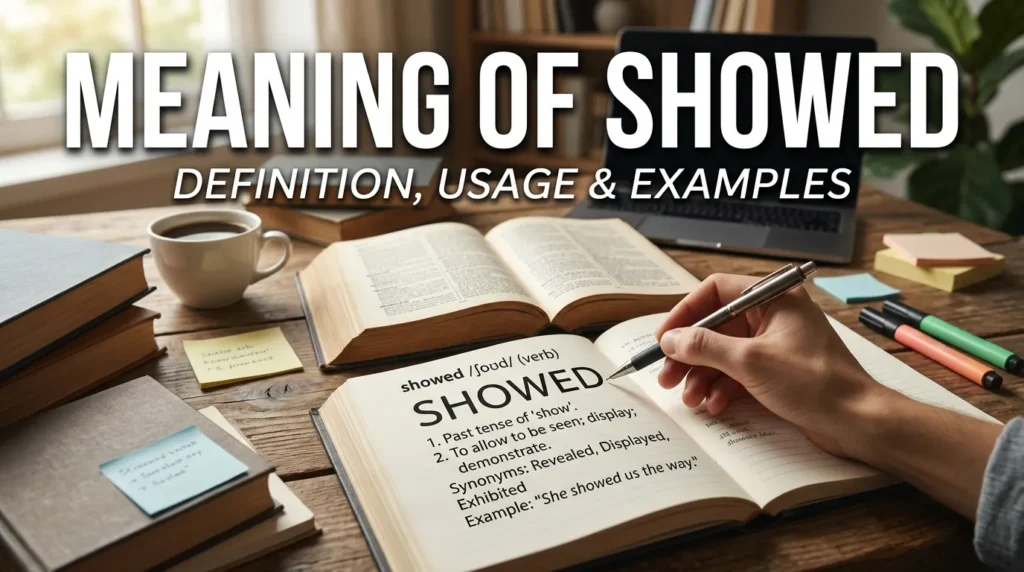
Showed means presented, displayed, revealed, demonstrated, or made something visible in the past. It describes an action that someone completed before the present moment.
For example, if a teacher explained a mathematical problem by demonstrating each step yesterday, you could say, “The teacher showed us how to solve the problem.”
The word indicates that the action happened in the past.
Definition of Showed
Showed is the simple past tense of the verb show. It describes an action of making something visible, presenting information, demonstrating an activity, or revealing something that occurred at an earlier time.
In practical English, it commonly appears as the main verb in statements about completed past events.
Examples:
- She showed me her new apartment.
- The manager showed the employees the updated schedule.
- His actions showed that he cared about the project.
Meaning of Shown
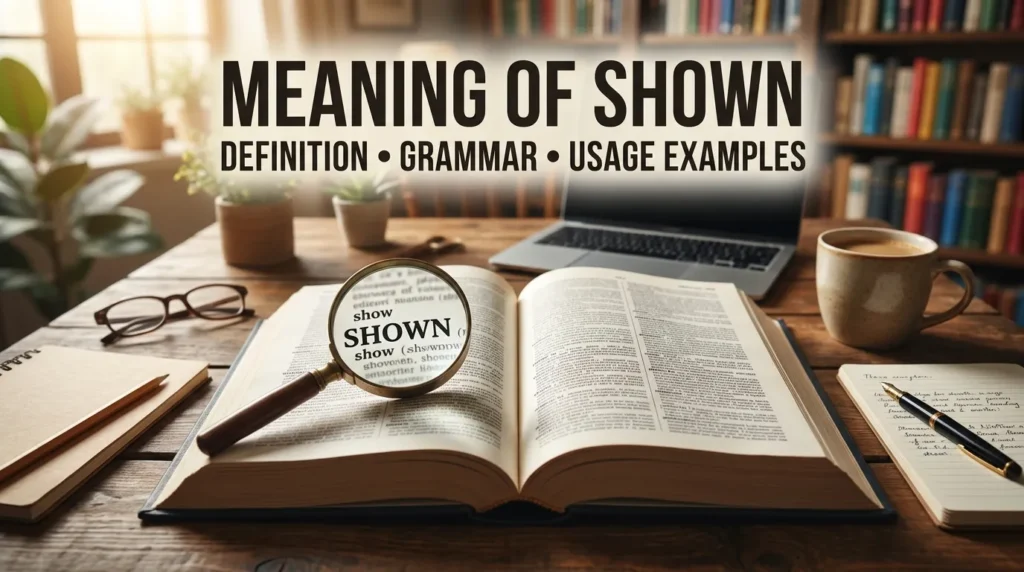
Shown means displayed, presented, revealed, or demonstrated. It describes the result of an action or something that has been made visible.
Unlike showed, which normally describes a completed past action, shown is primarily used as the past participle of show. It commonly appears with helping verbs such as has, have, had, is, and was.
For example, “The results have been shown to the research team” indicates that the results were presented to the team.
Definition of Shown
Shown is the standard past participle of the irregular verb show. It is used to construct perfect tenses and passive-voice sentences.
In practical usage, it helps describe something that someone has displayed, demonstrated, or revealed, without necessarily emphasizing who performed the action.
Examples:
- The company has shown impressive growth.
- The documentary was shown on television.
- The evidence has shown a different result.
Main Difference
The main difference between showed and shown is their grammatical function. Although both come from the verb show, they are generally used in different verb constructions.
1. Showed as the Simple Past Tense
Use showed when describing an action that happened and finished in the past.
It does not normally require a helping verb to express the simple past tense.
Sentence pattern:
Subject + showed + object
Examples:
- My father showed me how to drive.
- The teacher showed us the correct answer.
- They showed their new product at the exhibition.
- She showed great confidence during the interview.
2. Shown as the Past Participle
Use shown primarily with helping verbs to form perfect tenses and passive constructions.
Common sentence patterns:
- Has + shown
- Have + shown
- Had + shown
- Was + shown
- Were + shown
- Has been + shown
- Will be + shown
Examples:
- She has shown considerable improvement.
- They have shown us the new design.
- He had shown me the document before the meeting.
- The results were shown on the screen.
- The film has been shown in several countries.
Comparison Table
| Feature | Showed | Shown |
| Base verb | Show | Show |
| Part of speech | Verb form | Verb form |
| Main grammatical role | Simple past | Past participle |
| Perfect tenses | Less usual alternative | Standard, preferred form |
| Passive voice | Generally avoided | Standard form |
| Can stand alone as simple past? | Yes | No |
| Formal writing | Correct | Correct |
| Pronunciation (US) | /ʃoʊd/ | /ʃoʊn/ |
Important distinction: The difference is not simply that showed is correct and shown is incorrect, or vice versa. Both are legitimate forms. Their grammatical functions determine which one normally belongs in a sentence.
Which One Is Correct?
Both showed and shown are correct English words. However, they are not normally interchangeable.
Use showed for the simple past tense:
- Correct: He showed me his identification.
- Incorrect: He shown me his identification.
Use shown for the standard past participle:
- Correct: He has shown me his identification.
- Incorrect in standard usage: He has showned me his identification.
There is one additional point worth understanding: showed is also accepted as an alternative past participle in some dictionaries and varieties of English, particularly in active constructions.
For example:
- She has shown remarkable patience.
- She has showed remarkable patience.
Both forms have a history of accepted usage, although the first is more conventional and widely preferred.
In passive constructions, however, shown is the standard choice:
- Correct: The document was shown to the manager.
- Avoid: The document was showed to the manager.
For formal, academic, and professional writing, choosing shown as the past participle is the safest approach.
Understand the difference between Seating and Sitting to choose the right word in everyday conversations and written English.
Grammar and Usage
Understanding the grammatical structure of these words will help you use them correctly in different types of sentences.
1. Verb Forms of Show
The verb show has several forms that perform different grammatical functions.
| Verb Form | Word | Example |
| Base form | Show | Please show me your work. |
| Third-person singular | Shows | She shows great leadership. |
| Present participle | Showing | He is showing his new design. |
| Simple past | Showed | He showed his new design. |
| Past participle | Shown | He has shown his new design. |
These forms are useful in everyday communication, formal writing, and academic English.
2. Showed in the Simple Past Tense
The simple past describes an action that occurred at a completed time in the past.
You can use showed without a helping verb.
Examples:
- I showed her the photographs yesterday.
- The company showed its latest technology last week.
- Our teacher showed us an interesting experiment.
- The report showed a significant increase in sales.
Notice that showed carries the past meaning by itself.
3. Shown in the Present Perfect Tense
The present perfect connects a past action or experience with the present.
Its structure is:
Subject + has/have + shown + object
Examples:
- I have shown him the correct procedure.
- She has shown excellent communication skills.
- We have shown our commitment to the project.
- The results have shown a clear improvement.
Use has with singular third-person subjects and have with I, you, we, and they.
4. Shown in the Past Perfect Tense
The past perfect describes an action completed before another past event.
Its structure is:
Subject + had + shown + object
Examples:
- She had shown me the invitation before the event.
- They had shown their proposal to the director.
- The experiment had shown promising results before the study ended.
The word had is followed by the past participle shown in the standard construction.
5. Shown in Passive Voice
Passive voice emphasizes the person or thing receiving an action rather than the person performing it.
Its structure commonly includes:
Subject + form of be + shown
Examples:
- The photographs were shown during the presentation.
- The new policy was shown to all employees.
- The results are shown in the following table.
- The documentary will be shown next week.
In these sentences, shown is the standard past participle used to form the passive construction.
6. Shown as a Participle Describing a Noun
Shown can also appear before or after a noun to identify something that has been displayed or presented.
Examples:
- The information shown above is important.
- Please review the figures shown in the report.
- The picture shown on the website is outdated.
Here, shown is a participial form modifying a noun.
7. American and British English Usage
The distinction between showed and shown is generally the same in American and British English.
Both varieties use:
- Showed as the simple past.
- Shown as the usual past participle.
- Showed as an alternative past participle in some accepted active constructions.
There is no general rule requiring American speakers to use showed and British speakers to use shown.
For consistency and clarity, use shown in perfect tenses and passive constructions, especially in formal writing.
How to Use Showed and Shown
The easiest way to choose between these forms is to examine the sentence structure.
When to Use Showed
Use showed when describing something that happened in the past.
Common situations include:
1. Describing a past action
- She showed me her wedding photographs.
- He showed his passport at the airport.
2. Explaining a past event
- The investigation showed several problems.
- The presentation showed how the system worked.
3. Describing someone’s behavior
- He showed kindness to everyone.
- The employee showed great dedication.
4. Talking about a past demonstration
- The instructor showed us how to use the equipment.
- My brother showed me how to repair the bicycle.
When to Use Shown
Use shown when your sentence requires a past participle.
Common situations include:
1. With has
- She has shown remarkable progress.
- He has shown an interest in learning English.
2. With have
- They have shown their support.
- We have shown that the method works.
3. With had
- I had shown her the documents before the meeting.
- The teacher had shown us the example earlier.
4. With was or were
- The painting was shown at the gallery.
- The students were shown how to complete the assignment.
5. With has been or have been
- The results have been shown to the research team.
- The new feature has been shown to customers.
6. In descriptions and reports
- The data shown in this chart represents annual sales.
- The examples shown below explain the process.
Examples
Here are practical examples that demonstrate how to use both forms naturally.
Examples of Showed
- She showed me her new phone yesterday.
- The teacher showed the students how to solve the equation.
- My parents showed great support during my studies.
- The manager showed us around the new office.
- He showed his driving license to the police officer.
- The presentation showed the company’s financial performance.
- They showed their appreciation by sending a thank-you message.
- My friend showed me an interesting photograph.
- The doctor showed me the results of my examination.
- The team showed remarkable determination during the competition.
- Sarah showed her colleagues how to use the software.
- The documentary showed the effects of climate change.
Examples of Shown
- She has shown excellent leadership skills.
- The results have shown a noticeable improvement.
- He had shown me the photograph before.
- The movie was shown at the local theater.
- The documents have been shown to the director.
- Research has shown that regular exercise supports overall health.
- The information shown on the website is outdated.
- The students were shown how to complete the experiment.
- His actions have shown that he is trustworthy.
- The report had shown several important findings.
- The new collection will be shown at the fashion exhibition.
- The evidence has shown a different perspective.
Examples of Showed vs Shown in Similar Sentences
Comparing similar sentences makes the grammatical difference easier to recognize.
| Showed | Shown |
| She showed me the letter. | She has shown me the letter. |
| He showed his talent. | He has shown his talent. |
| They showed the results. | They have shown the results. |
| The teacher showed us the method. | The teacher had shown us the method. |
| The company showed its new product. | The new product was shown to customers. |
The meaning may be similar, but the verb structure changes.
Common Mistakes
English learners sometimes confuse showed and shown because both describe actions related to displaying, presenting, or revealing something.
Here are some common mistakes and their corrections.
1. Using Shown Without a Helping Verb
Incorrect: She shown me her new dress.
Correct: She showed me her new dress.
Why it happens: Learners sometimes assume that shown can replace showed in every past-tense sentence.
Explanation: In standard English, shown is a past participle, not the simple past form. Use showed when there is no auxiliary construction requiring a past participle.
2. Using Showed Instead of Shown in Passive Voice
Incorrect: The report was showed to the employees.
Correct: The report was shown to the employees.
Why it happens: Writers may confuse the simple past with the past participle.
Explanation: Passive constructions require a past participle after the appropriate form of be. Shown is the standard form here.
3. Using Showed in the Present Perfect Without Considering the Preferred Form
Less preferred: She has showed considerable improvement.
Preferred: She has shown considerable improvement.
Why it happens: Some speakers extend the regular-looking -ed ending to the participle.
Explanation: Although showed is accepted as an alternative participle in some active constructions, shown is the conventional choice and is preferable in formal writing.
4. Writing Showned Instead of Shown
Incorrect: He has showned me the results.
Correct: He has shown me the results.
Why it happens: Learners may think every past form needs an -ed ending.
Explanation: Show has an established irregular participle, shown. Adding another past-tense ending creates a nonstandard form.
5. Confusing Simple Past and Past Perfect
Incorrect: She had showed me the photographs before the event.
Preferred: She had shown me the photographs before the event.
Why it happens: Both forms can occur in active perfect constructions, so writers may not recognize the conventional preference.
Explanation: Use had shown as the standard past perfect construction.
6. Using Shown After Did
Incorrect: Did she shown you the document?
Correct: Did she show you the document?
Why it happens: Learners sometimes use a past verb form after the auxiliary did.
Explanation: The auxiliary did already marks the past tense, so the main verb must return to its base form, show.
7. Using Showed After Has Been in Passive Voice
Incorrect: The video has been showed to the students.
Correct: The video has been shown to the students.
Why it happens: Writers may confuse active and passive verb constructions.
Explanation: The standard passive perfect construction uses has been shown.
Linguistic Insight
The difference between showed and shown is an example of how English verbs can develop different forms to express grammatical relationships.
1. Show Is an Irregular Verb
An irregular verb does not always follow the usual pattern of adding -ed to form its past participle.
The verb show has this traditional pattern:
- Show: Base form
- Showed: Simple past
- Shown: Past participle
Although showed looks like the past tense of a regular verb, shown is the established irregular participle.
2. Why Does Show Have Two Past Forms?
English has developed several patterns for forming past-tense and past-participle forms.
Some verbs use the same form for both:
- Work, worked, worked
- Play, played, played
Others use different forms:
- Speak, spoke, spoken
- Break, broke, broken
- Write, wrote, written
- Show, showed, shown
This explains why showed and shown have different grammatical functions.
3. The Historical Development of Shown
The verb show has a long history in English. Its earlier forms included spellings such as shew and shewed.
Over time, shown developed as an established past participle and became the predominant form in modern English.
The older participle showed did not disappear completely. It continues to appear in some active constructions, although shown remains the preferred form.
4. Morphology: Understanding the Word Forms
Morphology is the study of how words are formed and how their parts contribute to grammatical meaning.
In this case, showed and shown are different inflected forms of the same verb.
Their endings and structures help indicate their grammatical roles:
- Showed marks the simple past.
- Shown marks the standard past participle.
Recognizing these forms helps learners understand why the two words cannot normally replace each other.
5. Syntax: Why Helping Verbs Matter
Syntax refers to the way words are arranged to form grammatically correct sentences.
The words surrounding showed and shown determine which form is appropriate.
Compare:
- She showed the photograph.
- She has shown the photograph.
- The photograph was shown yesterday.
In the first sentence, showed forms the simple past.
In the second, has shown forms the present perfect.
In the third, was shown forms the passive voice.
The helping verbs provide important grammatical information and help determine the correct verb form.
Usage Tips
Remembering a few simple patterns can help you avoid confusing showed and shown.
1. Remember the Three Main Verb Forms
Memorize this sequence:
Show → Showed → Shown
This is the most useful starting point.
2. Use Showed for Completed Past Actions
When describing something that happened yesterday, last week, or at another completed time, showed is generally the right choice.
Examples:
- He showed me the picture yesterday.
- They showed us the new office last week.
3. Use Shown After Has, Have, and Had
In standard English, these helping verbs are normally followed by shown when using the verb show in perfect constructions.
Examples:
- She has shown great patience.
- We have shown our commitment.
- They had shown their interest.
4. Choose Shown in Passive Sentences
When the subject receives the action, use shown.
Examples:
- The results were shown to everyone.
- The film was shown at the festival.
5. Do Not Add -Ed to Shown
Avoid forms such as showned and showned.
The correct past participle is simply shown.
6. Read the Entire Sentence
Do not choose a verb form just because it sounds familiar.
Look at the helping verbs, sentence structure, and intended meaning before deciding.
Expert Suggestion
As a grammar teacher, I recommend learning showed and shown as parts of one verb rather than memorizing them as unrelated words.
For students and ESL learners, the most reliable approach is to practice these three patterns:
- Simple past: I showed him the document.
- Present perfect: I have shown him the document.
- Passive voice: The document was shown to him.
For professional writers and content creators, using shown as the standard past participle is particularly helpful because it is widely accepted in formal and academic writing.
Remember that showed can also function as an alternative participle in some active constructions. However, choosing shown avoids unnecessary uncertainty and follows the most familiar standard usage.
Summary
The difference between showed vs shown is mainly grammatical.
- Showed is the simple past tense of show. Use it to describe completed actions in the past.
- Shown is the standard past participle of show. Use it in perfect tenses, passive constructions, and participial descriptions.
- Both forms are legitimate English words.
- Showed is also accepted as an alternative past participle in some active constructions, but shown is more conventional.
- In passive sentences, shown is the standard choice.
The easiest way to remember the difference is:
Show = Present
Showed = Simple Past
Shown = Past Participle
For example, say “She showed me the photograph yesterday” and “She has shown me the photograph before.”
Frequently Asked Questions
1. Is showed or shown correct?
Both are correct English forms of the verb show. However, showed is the simple past tense, while shown is the standard past participle.
2. What is the difference between showed and shown?
Showed describes a completed past action, while shown is primarily used with helping verbs in perfect tenses and passive constructions.
3. Is shown the past tense of show?
No. Showed is the simple past tense of show. Shown is its standard past participle.
4. Is showed a past participle?
Yes. Although shown is the usual past participle, showed is also accepted as an alternative in some active constructions.
5. Should I say I showed him or I shown him?
Say I showed him when describing a completed past action.
For example: “I showed him the new design yesterday.”
6. Is it has shown or has showed?
Has shown is the conventional and preferred form in standard English.
Example: “She has shown excellent progress.”
Although has showed occurs as an accepted alternative in some active constructions, has shown is the safer choice.
7. Is it have shown or have showed?
Have shown is the standard and preferred construction.
Example: “We have shown our commitment to the project.”
Have showed is also documented as an alternative past participle in some active uses, but it is less conventional.
8. Is it had shown or had showed?
Had shown is the standard and preferred past perfect construction.
Example: “He had shown me the documents before the meeting.”
Had showed is also found in some active constructions, but had shown is more widely preferred.
9. Is was showed or was shown correct?
Was shown is the standard construction.
Example: “The documentary was shown on television.”
Use shown rather than showed in ordinary passive-voice sentences.
10. Can shown be used without a helping verb?
Yes, shown can appear without an immediately preceding helping verb when it functions as a participial modifier.
Example: “The information shown in the report is accurate.”
However, it cannot normally replace showed as the simple past tense.
11. Is shown an irregular verb?
Shown is the irregular past participle of the verb show. The simple past form is showed.
12. What are the three forms of show?
The three main forms are:
- Present: Show
- Past: Showed
- Past participle: Shown
13. Is shown used in American and British English?
Yes. Both American and British English use shown as the standard past participle and showed as the simple past tense. The alternative participle showed also occurs in both varieties.
14. Is showed formal or informal?
Showed is a standard English word and is appropriate in both formal and informal writing when used as the simple past tense.
It can also occur as an alternative past participle in some active constructions, although shown is generally preferred in formal writing.
15. What is the easiest way to remember showed and shown?
Remember the sequence show, showed, shown. Use showed for a completed past action and shown for standard perfect-tense and passive constructions.


1 thought on “Showed vs Shown: Difference, Meaning & Usage”