
When writing sentences such as “What kind of music do you like?” or “What kinds of books do you read?”, it is easy to wonder whether to use kind of or kinds of. Both expressions are correct in English, but they follow different number patterns. The choice depends on whether you are referring to one category or multiple categories. Understanding this distinction will help you write more naturally, form grammatically correct questions, and avoid common subject-verb agreement mistakes.
Quick Answer
Kind of is used when referring to one type, category, or variety of something. Kinds of is used when referring to multiple types or categories.
| Expression | Correct? | Main meaning | Example |
| Kind of | Yes | One type or category | What kind of food do you like? |
| Kinds of | Yes | Multiple types or categories | What kinds of food do you like? |
Examples:
- What kind of movie do you enjoy? (Asks about one category or type.)
- What kinds of movies do you enjoy? (Asks about several categories or types.)
Both expressions are standard English. The important rule is to match kind or kinds with the number of categories you mean.
There is also an informal use of kind of meaning “somewhat” or “rather,” as in “I kind of like this song.” This meaning has a different grammatical function and should not be confused with the plural noun phrase kinds of.
Understand the difference between Looser and Loser to avoid confusing these commonly misspelled words in everyday English.
Meaning and Definition
Meaning of Kind Of
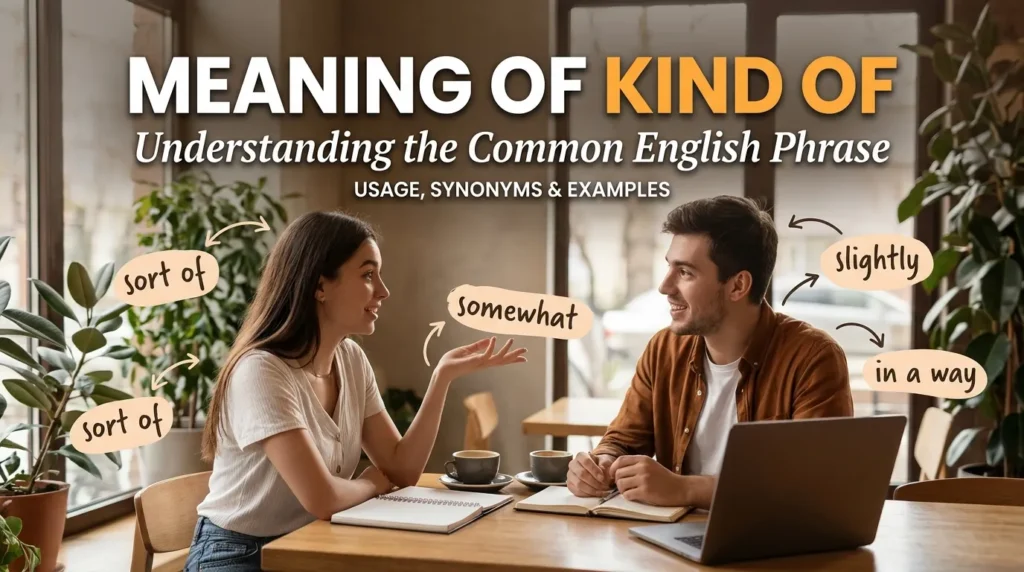
Kind of refers to one type, variety, or category of something. It is commonly used when identifying or asking about a particular group or classification.
For example:
- What kind of phone do you use?
- This kind of exercise improves flexibility.
- I enjoy this kind of music.
In informal conversation, kind of can also mean “somewhat,” “rather,” or “to some extent.”
For example:
- I am kind of tired.
- The movie was kind of interesting.
- She seemed kind of nervous.
The intended meaning depends on the sentence.
Definition of Kind Of
Kind of is a noun phrase consisting of the singular countable noun kind followed by the preposition of. It refers to one category, type, or variety of something.
In informal English, kind of also functions as an adverbial expression meaning to some extent or somewhat.
Examples:
- What kind of animal is that?
- This kind of problem requires attention.
- I kind of understand the instructions.
Meaning of Kinds Of

Kinds of refers to two or more types, varieties, or categories of something. It is used when discussing multiple classifications rather than a single category.
For example:
- There are many kinds of flowers in the garden.
- Different kinds of exercise offer different benefits.
- We sell several kinds of coffee.
The expression emphasizes variety or diversity.
Definition of Kinds Of
Kinds of is a plural noun phrase formed from the plural countable noun kinds and the preposition of. It refers to multiple types, categories, or varieties of a particular thing.
Examples:
- These kinds of questions require careful answers.
- Several kinds of birds live in this forest.
- Different kinds of software are used in modern businesses.
The plural noun kinds indicates that more than one category is being discussed.
Main Difference
The main difference between kind of and kinds of is the grammatical number of the noun kind and the number of categories being discussed.
1. Singular vs. Plural
- Kind of: Refers to one type or category.
- Kinds of: Refers to multiple types or categories.
Examples:
- This kind of book is popular among students.
- These kinds of books are popular among students.
The first sentence refers to one category of book, while the second refers to several categories.
2. Use with Demonstrative Words
The words this, that, these, and those should normally agree with kind or kinds.
| Singular form | Plural form |
| This kind of book | These kinds of books |
| That kind of animal | Those kinds of animals |
| This kind of question | These kinds of questions |
| That kind of problem | Those kinds of problems |
Avoid mixing singular and plural forms in formal standard English.
3. Use with Countable and Uncountable Nouns
The noun following of can be singular, plural, or uncountable, depending on its meaning.
With singular countable nouns:
- This kind of car is expensive.
- That kind of flower grows in warm climates.
With plural countable nouns:
- These kinds of cars are expensive.
- Different kinds of flowers grow in this garden.
With uncountable nouns:
- There are several kinds of music.
- Different kinds of information are available online.
- We use various kinds of equipment.
Notice that uncountable nouns such as music, information, and equipment do not normally take a plural ending, even after kinds of.
4. Use in Questions
Both expressions are natural in questions, but they ask about different ranges of categories.
- What kind of food do you prefer? (Asks about a particular type or category.)
- What kinds of food do you enjoy? (Allows for several types or categories.)
The singular version is useful when asking someone to identify a type. The plural version is useful when asking about variety.
Which One Is Correct?
Both kind of and kinds of are grammatically correct. Neither expression is inherently wrong. The correct choice depends on whether you mean one category or multiple categories.
Use kind of when:
- Referring to one type or category.
- Using this or that before the expression.
- Asking about a particular category.
- Describing something as one variety of a larger group.
Use kinds of when:
- Referring to multiple types or categories.
- Using these or those before the expression.
- Talking about variety or diversity.
- Using plural quantity words such as many, several, and different to describe multiple categories.
Compare these examples:
- Correct: This kind of movie is entertaining.
- Correct: These kinds of movies are entertaining.
- Incorrect in standard formal English: These kind of movies are entertaining.
- Incorrect in standard formal English: This kinds of movie is entertaining.
There is one additional point worth understanding: kind of can be followed by a plural noun in some established and informal constructions, such as “What kind of books do you read?” This is common in everyday English. However, when using demonstratives, the clearest formal patterns are this kind of book and these kinds of books.
Canada.ca+2
Grammar and Usage
Part of Speech
In the expressions kind of and kinds of, the word kind is a countable noun.
- Kind is singular.
- Kinds is plural.
- Of is a preposition.
Together, they form a noun phrase that identifies or classifies something.
For example:
- This kind of flower attracts butterflies.
- Several kinds of flowers attract butterflies.
Subject-Verb Agreement
In standard constructions, the verb agrees with the grammatical subject.
With singular kind:
- This kind of food is healthy.
- That kind of exercise helps improve fitness.
With plural kinds:
- These kinds of foods are popular.
- Different kinds of exercise help improve fitness.
Remember that the noun after of does not automatically determine the verb.
For example:
- This kind of information is useful.
- These kinds of information are useful.
The second sentence is awkward because information is uncountable. A more natural version is:
– Different kinds of information are useful.
Demonstrative Agreement
Use singular demonstratives with kind and plural demonstratives with kinds.
| Singular | Plural |
| This kind | These kinds |
| That kind | Those kinds |
Examples:
- This kind of work requires patience.
- These kinds of activities encourage creativity.
- That kind of behavior is unacceptable.
- Those kinds of decisions can affect everyone.
Quantifiers
Certain words naturally indicate whether kind should be singular or plural.
| Word or expression | Preferred construction |
| This | This kind of |
| That | That kind of |
| These | These kinds of |
| Those | Those kinds of |
| Many | Many kinds of |
| Several | Several kinds of |
| Different | Different kinds of |
| Various | Various kinds of |
| All | All kinds of |
| Every | Every kind of |
| Each | Each kind of |
Examples:
- Every kind of student deserves support.
- Many kinds of plants grow in tropical regions.
- Each kind of material has different properties.
- All kinds of people attended the event.
American and British English
The expressions kind of and kinds of are used in both American and British English.
There is no major regional difference in their singular and plural grammar.
However, kind of also has an informal meaning of “somewhat” or “rather.” This use is especially common in American English, while British English often uses sort of in similar situations.
Examples:
- American English: I’m kind of tired.
- British English: I’m sort of tired.
Both expressions are understandable in both varieties of English.
Build your vocabulary with the plural form of Gas and understand how this noun changes in English.
How to Use Kind Of and Kinds Of
How to Use Kind Of
Use kind of when identifying one particular type, variety, or category.
Common sentence patterns:
1. This kind of + singular noun
Example: This kind of technology is changing education.
2. That kind of + singular noun
Example: That kind of behavior is unacceptable.
3. What kind of + noun?
Example: What kind of career would you like to pursue?
4. Every kind of + noun
Example: Every kind of business needs a good strategy.
5. A kind of + noun
Example: A dolphin is a kind of mammal.
You can also use kind of informally to soften a statement.
Example: I kind of agree with your suggestion.
How to Use Kinds Of
Use kinds of when discussing more than one category, variety, or type.
Common sentence patterns:
1. These kinds of + plural noun
Example: These kinds of problems require immediate attention.
2. Those kinds of + plural noun
Example: Those kinds of opportunities do not come often.
3. Many kinds of + noun
Example: Many kinds of birds migrate during winter.
4. Different kinds of + noun
Example: Different kinds of exercise improve physical fitness.
5. Several kinds of + noun
Example: The store sells several kinds of tea.
6. All kinds of + noun
Example: We discussed all kinds of subjects during the meeting.
How to Choose Between Them
Before writing, ask yourself whether you are describing one category or several.
- One category: Use kind of.
- Multiple categories: Use kinds of.
For example:
- I prefer this kind of music.
- I enjoy different kinds of music.
Both sentences are correct, but the second emphasizes variety.
Examples
Examples of Kind Of
- This kind of weather makes me feel relaxed.
- What kind of books do you enjoy reading?
- I have never seen that kind of bird before.
- Every kind of student needs encouragement.
- This kind of information is useful for beginners.
- She prefers this kind of clothing for work.
- What kind of job are you looking for?
- That kind of decision requires careful consideration.
- A whale is a kind of mammal.
- This kind of software is commonly used in businesses.
- I don’t like that kind of behavior.
- Every kind of experience can teach us something.
Examples of Kinds Of
- There are many kinds of flowers in the park.
- These kinds of questions are common in examinations.
- Different kinds of animals live in the forest.
- The restaurant serves several kinds of pasta.
- Those kinds of mistakes can damage your reputation.
- Many kinds of businesses operate online.
- We discussed various kinds of solutions.
- There are different kinds of learning styles.
- All kinds of people use social media.
- These kinds of activities help children develop creativity.
- The library contains several kinds of reference books.
- Different kinds of information can help researchers reach better conclusions.
Examples of Kind Of as Somewhat or Rather
In informal English, kind of can express uncertainty, approximation, or a reduced degree of something.
- I am kind of nervous about the interview.
- The movie was kind of interesting.
- She seems kind of upset today.
- I kind of understand what you mean.
- This situation is kind of complicated.
- He was kind of surprised by the announcement.
In these examples, kind of does not refer to a category or variety. It functions as an informal adverbial expression.
Common Mistakes
1. Using These Kind Of Instead of These Kinds Of
Incorrect: These kind of books are expensive.
Correct: These kinds of books are expensive.
Why it happens: Writers sometimes use the plural demonstrative these but forget to make the noun kind plural.
2. Using This Kinds Of Instead of This Kind Of
Incorrect: This kinds of food is delicious.
Correct: This kind of food is delicious.
Why it happens: The demonstrative this requires a singular noun in this construction. Therefore, kind should remain singular.
3. Using Many Kind Of Instead of Many Kinds Of
Incorrect: There are many kind of animals in the zoo.
Correct: There are many kinds of animals in the zoo.
Why it happens: The word many refers to more than one category, so it should be followed by the plural noun kinds.
4. Using Every Kinds Of Instead of Every Kind Of
Incorrect: Every kinds of student needs encouragement.
Correct: Every kind of student needs encouragement.
Why it happens: Every refers to individual members of a group and takes a singular noun in this construction.
5. Confusing Kind Of With Kinds Of
Incorrect: I enjoy different kind of music.
Correct: I enjoy different kinds of music.
Why it happens: The adjective different indicates multiple varieties in this context, making the plural kinds appropriate.
6. Confusing the Number of Kind With the Number of the Following Noun
Incorrect: These kind of equipment are expensive.
Correct: These kinds of equipment are expensive.
Why it happens: Some writers assume that the noun after of determines whether kind should be singular or plural. However, the expression must also reflect the number of categories being discussed.
Remember that equipment is uncountable, so it does not become equipments in standard English.
7. Treating Kind Of as a Plural Expression
Incorrect: This kind of books are useful.
Better: This kind of book is useful.
Alternative: These kinds of books are useful.
Why it happens: Writers sometimes confuse the plural meaning of the following noun with the grammatical number of the expression kind of. The clearest standard constructions keep the number consistent.
8. Using Kinds Of With Every or Each
Incorrect: Each kinds of flower has a different color.
Correct: Each kind of flower has a different color.
Why it happens: Each focuses on one member or category at a time, so it takes the singular form kind.
Linguistic Insight
The Morphology of Kind and Kinds
The difference between kind and kinds is an example of English plural morphology.
Morphology is the study of how words change their forms to express grammatical information.
In this case, adding -s changes the singular noun kind into the plural noun kinds.
- Kind: One category or variety.
- Kinds: More than one category or variety.
This is a regular plural formation, similar to:
- Book → Books
- Type → Types
- Category → Categories
- Variety → Varieties
The Syntax of Kind Of and Kinds Of
Syntax refers to how words are arranged to form grammatical phrases and sentences.
In kind of, the noun kind acts as the central element of the phrase, while of introduces the thing being classified.
Consider:
- This kind of fruit is sweet.
- These kinds of fruits are popular.
The first construction identifies one category, while the second identifies multiple categories.
The distinction also affects the demonstrative words and verb agreement.
Why People Confuse the Expressions
There are several reasons English learners and native speakers confuse these forms.
1. The noun after of can be plural.
In everyday English, people commonly say “What kind of books do you read?” This can make learners wonder whether kind should also be plural.
2. Spoken English is less formal.
Some speakers use expressions such as “these kind of things” in casual conversation. Although this construction occurs in real speech, it is generally avoided in formal standard writing.
3. The meaning and grammatical number are different concepts.
A sentence may refer to several individual objects while describing only one category. For example, “This kind of book” can refer to many books belonging to one particular category.
The Difference Between Kind, Type, and Sort
The words kind, type, and sort have similar meanings when they refer to categories or varieties.
Examples:
- This kind of problem is difficult.
- This type of problem is difficult.
- This sort of problem is difficult.
Their plural forms follow the same general pattern:
- These kinds of problems
- These types of problems
- These sorts of problems
All three expressions are widely used in English.
Regional and Historical Usage
The singular and plural forms of kind have long been part of English grammar. Their basic distinction has remained consistent in both American and British English.
However, informal expressions such as these kind of things have appeared in spoken and written English for a long time. Their existence does not mean that they are the preferred forms in edited standard English.
For clear formal communication, use this kind of thing or these kinds of things.
Usage Tips
Here are some practical ways to remember the difference between kind of and kinds of.
- Remember the singular rule: Use kind when referring to one category.
- Remember the plural rule: Use kinds when referring to multiple categories.
- Match demonstratives: Use this kind and that kind, but these kinds and those kinds.
- Pay attention to quantity words: Use many kinds, several kinds, and different kinds.
- Remember every and each: Both normally take kind in this expression.
- Check the verb: Use a singular verb with a singular subject and a plural verb with a plural subject.
- Do not pluralize uncountable nouns: Write kinds of information, not kinds of informations.
- Distinguish the informal meaning: In “I kind of like it,” the expression means “somewhat,” not a category.
- Use consistent structures in formal writing: Prefer this kind of book and these kinds of books.
Expert Suggestion
As a grammar teacher, I recommend focusing on the number of categories rather than simply counting the objects mentioned in a sentence.
For example, you might have hundreds of books belonging to one category. In that situation, this kind of book can be appropriate. If you are discussing several categories of books, use these kinds of books.
For professional writers, students, and ESL learners, the safest approach is to follow these two patterns:
- One category: This kind of + singular noun.
- Multiple categories: These kinds of + plural noun.
Also, remember that kind of has a separate informal meaning of “somewhat.” Understanding the context will help you choose the correct interpretation.
Summary
Both kind of and kinds of are correct English expressions, but they serve different purposes.
- Kind of refers to one type, category, or variety.
- Kinds of refers to multiple types, categories, or varieties.
- Use this kind and that kind with singular demonstratives.
- Use these kinds and those kinds with plural demonstratives.
- Use many kinds, several kinds, and different kinds when referring to multiple categories.
- Both expressions can introduce countable or uncountable nouns, depending on the context.
- Informal kind of can also mean “somewhat” or “rather.”
The easiest way to remember the distinction is to use kind for one category and kinds for multiple categories.
Frequently Asked Questions
1. Is Kind Of or Kinds Of correct?
Both are correct. Use kind of for one category and kinds of for multiple categories.
2. What is the difference between Kind Of and Kinds Of?
Kind of refers to one type or category, whereas kinds of refers to multiple types or categories.
3. Should I use This Kind Of or These Kinds Of?
Use this kind of for one category and these kinds of for multiple categories.
Examples:
- This kind of book is interesting.
- These kinds of books are interesting.
4. Is These Kind Of grammatically correct?
These kind of is generally considered nonstandard in formal English. The preferred expression is these kinds of.
5. Is This Kinds Of grammatically correct?
No, not in standard English. Use this kind of instead because this takes a singular noun in this construction.
6. Should I say Many Kind Of or Many Kinds Of?
Use many kinds of because many refers to multiple categories.
Example: Many kinds of birds live in this area.
7. Should I use Every Kind Of or Every Kinds Of?
Use every kind of because every takes a singular noun.
Example: Every kind of student deserves equal opportunities.
8. Can Kind Of be followed by a plural noun?
Yes. Expressions such as “What kind of books do you like?” are common and accepted in everyday English. However, this kind of book is the clearest formal construction when referring to one category.
9. Is Kinds Of followed by a singular or plural noun?
It depends on the noun.
- Plural countable noun: Different kinds of books.
- Uncountable noun: Different kinds of music.
The noun following of does not always need to be plural.
10. Is Kind Of informal English?
It depends on its meaning. When kind of means “somewhat” or “rather,” it is informal.
Example: I am kind of tired.
When it means a category or type, it is also appropriate in formal English.
11. Can I use Different Kind Of in a sentence?
When referring to multiple categories, use different kinds of.
Example: Different kinds of flowers grow in this garden.
When referring to one particular category, you can use a different kind of.
Example: I would like to try a different kind of coffee.
12. What is the difference between All Kind Of and All Kinds Of?
All kinds of is the standard plural construction when referring to multiple varieties.
Example: The store sells all kinds of products.
All kind of is generally avoided in standard English.
13. Is Kind Of the same as Sort Of?
They have similar meanings when referring to types or categories. Both can also mean “somewhat” or “rather” in informal English.
Example:
- This kind of food is popular.
- This sort of food is popular.
14. Do Kind Of and Kinds Of have different pronunciations?
The main difference is the final /s/ sound in kinds.
- Kind: /kaɪnd/
- Kinds: /kaɪndz/
The pronunciation of of is often reduced in natural speech, but the singular and plural distinction remains.
15. How can I remember when to use Kind Of or Kinds Of?
Remember this simple rule:
- One category = kind of
- Multiple categories = kinds of
Also remember the matching patterns: this kind, that kind, these kinds, and those kinds.


1 thought on “Kind Of or Kinds Of: Meaning, Difference & Usage”