
Imagine seeing a snake on a hiking trail. Would you call it poisonous or venomous? Both words describe something that can cause harm through toxic substances, so it is easy to confuse them. You may also encounter this distinction when reading about spiders, frogs, plants, or dangerous marine animals. The key difference is how the harmful substance enters the body. Understanding poisonous vs venomous will help you choose the correct word in everyday conversation, science writing, and English grammar.
Quick Answer
Poisonous describes something that can cause harm when its toxic substances are swallowed, inhaled, or absorbed through the skin. Venomous describes an animal that delivers venom through a bite, sting, or another mechanism that introduces venom into another organism’s tissues.
| Word | Meaning | Common examples |
| Poisonous | Harmful through ingestion, inhalation, or absorption | Poisonous mushrooms, poison dart frogs, pufferfish |
| Venomous | Delivers venom through a bite, sting, or similar mechanism | Venomous snakes, scorpions, wasps |
| Both | Can harm through passive exposure and also inject venom | Certain snakes, such as the tiger keelback |
Easy way to remember: If you bite it and become poisoned, it is poisonous. If it bites you and injects venom, it is venomous. This is a useful rule of thumb, although some organisms can be both.
Learn when to use Momma or Mama to address your mother naturally in different conversations and writing styles.
Meaning and Definition
Meaning of Poisonous
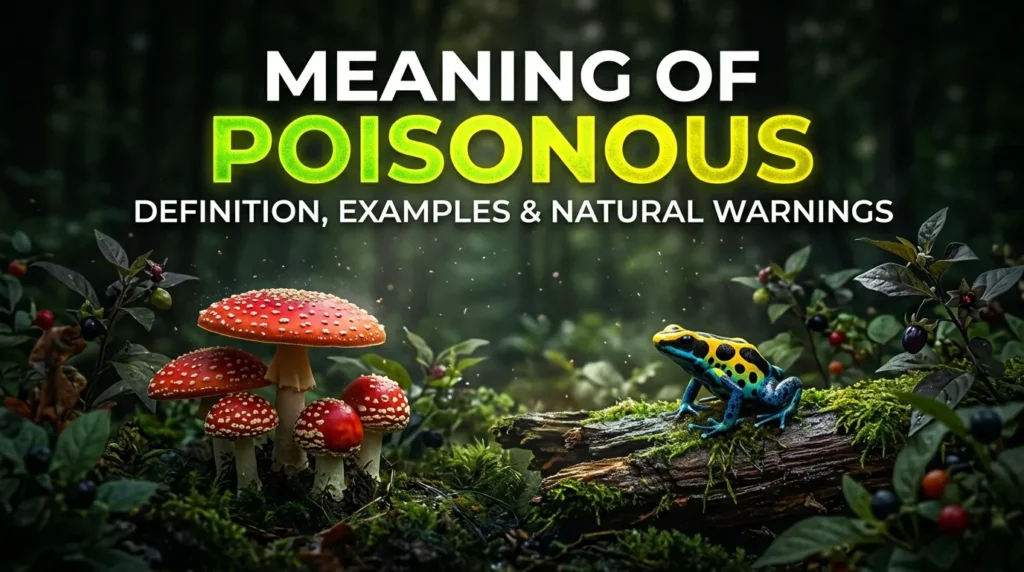
Poisonous means containing or producing a substance that can harm a living organism when it enters the body. Depending on the substance, exposure may happen through eating, breathing, or skin contact.
For example, some mushrooms are poisonous because eating them can cause serious illness. Poison ivy is another example because contact with its leaves can cause an irritating skin reaction in susceptible people.
In everyday English, the word can describe plants, animals, chemicals, food, and other substances that may cause poisoning.
Definition of Poisonous
Poisonous is an adjective meaning capable of causing illness, injury, or death through the effects of a poison.
The word describes a potentially harmful property rather than a particular delivery method involving a bite or sting.
Examples:
- Some wild mushrooms are poisonous to humans.
- The plant has poisonous leaves.
- The laboratory stores poisonous chemicals in a secure cabinet.
The severity of poisoning depends on factors such as the substance, the amount, and the route of exposure.
Meaning of Venomous
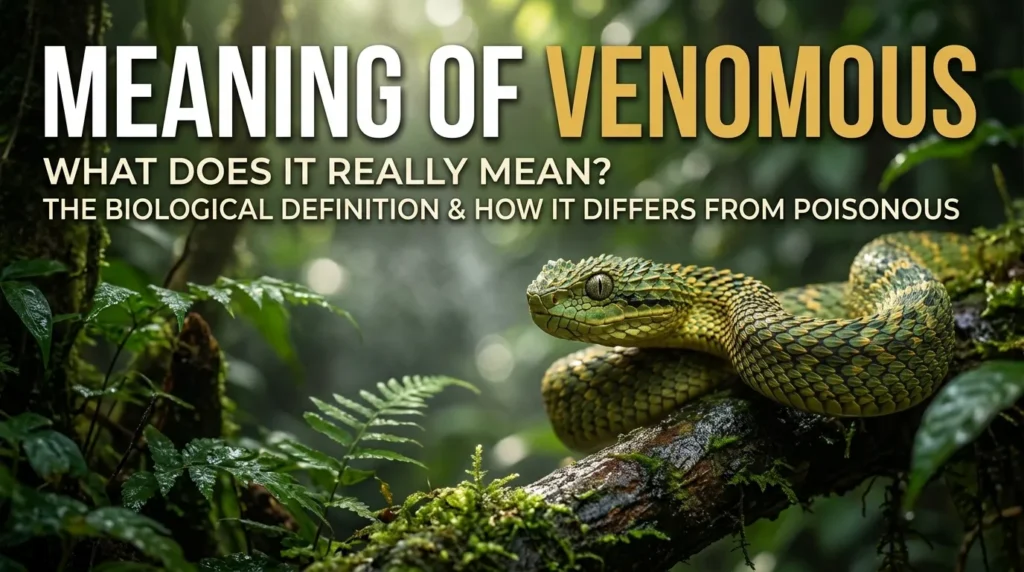
Venomous means producing or possessing venom that can be delivered to another organism, usually through a bite, sting, or specialized body part.
For example, a venomous snake can inject venom through its fangs. A venomous scorpion uses its stinger to deliver venom, while a venomous wasp can inject venom when it stings.
In ordinary conversation, the word most often describes animals that use venom to defend themselves or capture prey.
Definition of Venomous
Venomous is an adjective meaning capable of producing or delivering venom, a toxic substance used to affect another organism through a specialized delivery mechanism.
Venom typically enters the victim’s tissues through a wound created by a bite, sting, spine, or similar structure. Some animals can also deliver venom in other ways, including spraying it into an attacker’s eyes.
Examples:
- The venomous snake retreated into the grass.
- A venomous scorpion can inject venom through its stinger.
- Researchers studied the venomous marine animal.
The word does not automatically mean that an animal is deadly to humans. Venom varies considerably in its effects, and the risk also depends on the species, the exposure, and the person affected.
Main Difference
The main difference between poisonous and venomous is the way a harmful substance is delivered to another organism. Poisonous organisms generally harm others through contact, ingestion, or other passive exposure, while venomous animals actively deliver venom through specialized mechanisms.
| Feature | Poisonous | Venomous |
| Part of speech | Adjective | Adjective |
| Related noun | Poison | Venom |
| Main meaning | Containing or producing poison | Producing or delivering venom |
| Typical exposure | Eating, inhaling, or touching | Bites, stings, or venom-delivering structures |
| Common examples | Poisonous mushrooms, poison dart frogs | Venomous snakes, scorpions, wasps |
| Main purpose in nature | Often defense against predators | Often defense or capture of prey |
| Can the same organism be both? | Yes | Yes |
1. Difference in Delivery
A poisonous substance can cause harm when it enters the body through an appropriate route, such as ingestion, inhalation, or skin absorption.
Venom, by contrast, is generally delivered through a wound or another specialized mechanism that introduces it into the victim’s tissues.
For example:
- A person who eats a poisonous mushroom may become seriously ill.
- A person bitten by a venomous snake may experience the effects of injected venom.
2. Difference in Usage
Use poisonous when emphasizing that something contains or produces a harmful substance.
Use venomous when describing an animal that produces or delivers venom.
Compare these sentences:
- The poisonous berries can make people sick.
- The venomous snake injected venom through its fangs.
Both sentences are correct, but the adjectives describe different ways of causing harm.
3. Can an Animal Be Both Poisonous and Venomous?
Yes. Some animals have both passive toxin defenses and a mechanism for injecting venom.
For example, the tiger keelback snake can deliver venom through a bite and accumulate toxins from poisonous prey in its body for defense.
This example shows why the distinction depends on how the harmful substances are stored and delivered, rather than simply on whether an animal is dangerous.
Which One Is Correct?
Both poisonous and venomous are correct English words. Neither is a misspelling, and neither is inherently more correct than the other.
The appropriate choice depends on what you want to describe.
- Use poisonous for a plant, mushroom, chemical, or animal that can harm an organism through toxic exposure.
- Use venomous for an animal that produces or delivers venom, typically through a bite or sting.
- Use both when an organism has both kinds of toxic defense.
In casual conversation, people sometimes call a venomous snake poisonous. This usage is understandable and occurs in everyday English, but venomous snake is the more precise expression in scientific writing.
The distinction is about meaning, not American versus British spelling. Both words are accepted in standard American and British English.
Grammar and Usage
Both poisonous and venomous are adjectives. They describe nouns by providing information about a harmful property or characteristic.
1. Using the Words Before Nouns
Both adjectives can appear directly before a noun.
Examples:
- A poisonous plant grows beside the fence.
- A venomous spider was found in the garage.
- The researchers examined a poisonous fish.
- The hikers avoided a venomous snake.
This is one of the most common grammatical patterns for both words.
Improve your writing accuracy by comparing Axle versus Axel with practical examples from everyday and specialized language.
2. Using the Words After Linking Verbs
You can also use both adjectives after linking verbs such as be, seem, and become.
Examples:
- Some wild berries are poisonous.
- The snake appears venomous.
- The substance became poisonous after contamination.
- The animal may be venomous, but its species has not been identified.
In these sentences, the adjective describes the subject rather than appearing directly before a noun.
3. Using Prepositions
The preposition to is useful when explaining what an organism or substance can harm.
Examples:
- This chemical is poisonous to fish.
- The plant is poisonous to dogs.
- The substance may be toxic to humans.
For venomous, you will often see the preposition of in descriptions of an animal’s behavior or characteristics, although sentence structure varies.
Examples:
- The venomous nature of the snake makes careful identification important.
- The effects of the venomous animal’s bite were investigated.
4. Comparative and Superlative Forms
Both adjectives can form comparisons using more and most.
| Form | Example |
| Positive | This mushroom is poisonous. |
| Comparative | This mushroom is more poisonous than the other one. |
| Superlative | It is the most poisonous mushroom in the collection. |
| Positive | This snake is venomous. |
| Comparative | This species is more venomous than the one previously studied. |
| Superlative | It is the most venomous species in the group. |
In scientific contexts, be careful with claims about which organism is the most poisonous or venomous. Toxicity depends on the substance, the dose, and the method of exposure. Venom potency alone does not determine how dangerous a bite will be to a person.
5. Related Nouns and Word Forms
Understanding the related nouns makes it easier to use the adjectives correctly.
| Word | Part of speech | Example |
| Poison | Noun or verb | The poison affected the animal. |
| Poisonous | Adjective | The plant is poisonous. |
| Poisonously | Adverb | The character spoke poisonously. |
| Venom | Noun | The snake delivered venom. |
| Venomous | Adjective | The snake is venomous. |
| Venomously | Adverb | The character glared venomously. |
The adverbs poisonously and venomously are grammatically correct, but they are less common in literal descriptions of animals than the corresponding adjectives.
How to Use Poisonous and Venomous
The easiest way to choose between these words is to identify what you are describing and how the harmful substance reaches another organism.
When to Use Poisonous
Use poisonous when describing something that can cause poisoning or harm through toxic exposure.
Common contexts include:
- Plants: poisonous leaves, poisonous berries
- Fungi: poisonous mushrooms
- Animals: poisonous frogs, poisonous fish
- Chemicals: poisonous gas, poisonous substances
- Figurative language: poisonous remarks, poisonous relationships
Examples:
- The children were warned not to eat the poisonous berries.
- Some poisonous mushrooms resemble edible varieties.
- The cleaning product contains poisonous chemicals.
- His poisonous comments damaged their friendship.
The word can describe literal physical danger as well as figurative emotional or social harm.
Strengthen your vocabulary by exploring practical examples of Drier versus Dryer in everyday English.
When to Use Venomous
Use venomous when describing an animal or another relevant biological subject associated with the production or delivery of venom.
Common contexts include:
- Snakes: venomous snakes, venomous fangs
- Spiders: venomous spiders, venomous bites
- Insects: venomous wasps, venomous stings
- Marine animals: venomous fish, venomous marine creatures
- Figurative language: venomous criticism, venomous remarks
Examples:
- The wildlife expert identified a venomous snake.
- Some spiders use venom to subdue their prey.
- The diver avoided touching the venomous marine animal.
- The politician responded with a venomous remark.
The adjective can also describe hostile or hateful behavior when used figuratively.
Examples
Examples of Poisonous
- The gardener removed the poisonous plant from the backyard.
- Some mushrooms are poisonous even when they look harmless.
- The warning label states that the chemical is poisonous if swallowed.
- Poisonous berries can pose a serious risk to curious children.
- The fish may be poisonous if certain parts are eaten.
- The poisonous fumes forced the workers to leave the building.
- The farmer checked whether the plant was poisonous to livestock.
- Never assume that a wild mushroom is safe to eat.
- The documentary explained how poisonous frogs protect themselves from predators.
- Her poisonous comments made the discussion unnecessarily hostile.
Examples of Venomous
- The venomous snake remained hidden beneath a rock.
- A venomous spider was discovered near the storage room.
- Some wasps are venomous and can inject venom when they sting.
- The researchers collected samples from the venomous animal.
- A venomous bite can require urgent medical attention.
- The guide warned visitors not to approach the scorpion.
- Certain marine animals use venom to capture their prey.
- The scientist studied the effects of venom on laboratory samples.
- The venomous snake uses its fangs to deliver venom.
- She described his response as a venomous attack on her character.
Examples Comparing Poisonous and Venomous
- The mushroom is poisonous, but it does not inject venom.
- The snake is venomous because it can deliver venom through a bite.
- A poison dart frog can be poisonous without injecting venom.
- The pufferfish is known for its poisonous tissues, while certain other marine animals deliver venom through specialized structures.
- The researcher explained why the same animal can sometimes be both poisonous and venomous.
- In technical writing, the term venomous is generally more precise than poisonous when describing a snake that injects venom.
Common Mistakes
1. Calling Every Dangerous Animal Poisonous
Incorrect or imprecise: The venomous snake is poisonous.
More precise: The venomous snake can inject venom through its bite.
The first sentence is not necessarily ungrammatical, and poisonous is sometimes used broadly in everyday English. However, venomous is the better choice when the intended meaning concerns venom delivery.
2. Assuming Venomous Means Deadly
Incorrect assumption: Every venomous animal can kill a human.
Correct understanding: Venomous animals vary in their effects on humans. Some cause relatively mild symptoms, while others can cause severe or life-threatening injury.
The mistake occurs when people confuse the ability to deliver venom with the severity of its effects.
3. Assuming Poisonous Means Dangerous to Touch
Incorrect assumption: Every poisonous plant is dangerous whenever someone touches it.
Correct understanding: Different poisons have different exposure routes. Some substances are dangerous when swallowed, some can harm through skin contact, and others may require a different form of exposure.
For example, poison ivy can cause a skin reaction through contact, while certain poisonous mushrooms primarily pose a risk when eaten.
4. Treating Poisonous and Venomous as Interchangeable in Scientific Writing
Imprecise: The biologist studied the poisonous snake’s venom delivery system.
More precise: The biologist studied the venomous snake’s venom delivery system.
The distinction matters because technical writing aims to describe the organism’s actual biological mechanism.
5. Thinking Venom and Poison Are Completely Unrelated
Incorrect assumption: Venom is not a type of poison.
Correct understanding: Venom is a toxic substance, and the term distinguishes it by its biological production and delivery mechanism. The words overlap in their general sense of harmful substances, but they are not interchangeable in every context.
6. Assuming the Most Venomous Animal Is Always the Most Dangerous
Incorrect assumption: The animal with the most potent venom must always pose the greatest risk to humans.
Correct understanding: Actual risk also depends on factors such as the amount delivered, the exposure circumstances, the effects of the venom, and access to medical treatment.
Linguistic Insight
The distinction between poisonous and venomous is an example of how English uses related words to express different meanings within the same general category.
1. Word Formation
Both words contain the adjective-forming suffix -ous, which often means having, containing, or being characterized by something.
- Poison + -ous = poisonous
- Venom + -ous = venomous
The suffix helps transform the nouns poison and venom into adjectives that describe a quality or characteristic.
2. Word Origins
The word poison entered English through Old French and ultimately comes from Latin potio, meaning a drink or potion. Its meaning developed to include a harmful or deadly substance.
The word venom came into English through Anglo-French and Old French forms related to Latin venenum, meaning poison or a potion.
Although their histories overlap, modern biological usage distinguishes the terms mainly by how the harmful substance is delivered.
3. Semantic Differences
In linguistics, semantics is the study of meaning.
The semantic difference between these adjectives is more specific than the general idea of danger:
- Poisonous emphasizes the presence or harmful properties of poison.
- Venomous emphasizes an animal’s ability to produce or deliver venom.
This difference allows speakers to communicate more accurately without explaining the entire biological process in every sentence.
4. Literal and Figurative Meanings
Both words can be used figuratively.
A poisonous comment is a remark intended to hurt, damage, or undermine someone. A venomous comment usually emphasizes intense hostility, bitterness, or malice.
Compare:
- Her poisonous attitude affected the entire team.
- He made a venomous remark about his opponent.
The meanings overlap, but venomous often conveys a particularly fierce or hateful quality.
5. Why People Confuse Them
People confuse poisonous and venomous because both relate to toxic substances and potentially harmful organisms. Everyday conversation also uses poison as a broad term for many harmful substances, including venom.
The confusion becomes more understandable when you consider that both kinds of toxic substances can cause severe injury or death. The biological distinction concerns delivery, not simply the outcome.
Usage Tips
Use these practical tips to remember the difference between poisonous and venomous.
- Remember the delivery method. Poisonous substances generally cause harm through ingestion, inhalation, or absorption. Venom is generally delivered through a bite, sting, or similar mechanism.
- Connect venomous with fangs and stingers. This association can help you remember which adjective usually describes snakes, scorpions, and wasps.
- Use poisonous for plants and mushrooms. These are common examples of organisms that can harm people through toxic exposure.
- Do not judge by appearance. A colorful animal is not automatically poisonous, and an ordinary-looking animal is not necessarily harmless.
- Use the more precise term in science writing. If an animal injects venom, describe it as venomous unless there is a specific reason to use another term.
- Remember that both categories can overlap. Some animals have both injected venom and toxins that can harm a predator through ingestion or contact.
- Check figurative meaning. When describing a hostile remark or attitude, both words can work, but consider the degree and type of hostility you want to convey.
Expert Suggestion
As a grammar teacher, I recommend learning the distinction through examples rather than memorizing two isolated definitions.
When you encounter an unfamiliar animal, ask yourself two questions:
- Can it harm another organism through a toxic substance that is swallowed, inhaled, or absorbed?
- Can it deliver venom through a bite, sting, or specialized mechanism?
The answers help you determine whether poisonous, venomous, or both terms are appropriate.
For students, ESL learners, and content writers, the most important principle is to choose the word that describes the mechanism accurately. Use poisonous for the general property of containing or producing poison, and venomous for the specific ability to deliver venom.
When writing about a real animal, verify its biology instead of assuming that every snake, spider, or colorful frog belongs to a particular category.
Summary
Poisonous vs venomous is a comparison between two correct English adjectives with related but distinct meanings.
- Poisonous describes something that can cause harm through toxic exposure, such as ingestion, inhalation, or skin absorption.
- Venomous describes an animal that produces or delivers venom, usually through a bite, sting, or another specialized mechanism.
- Both words are correct, but they are not always interchangeable.
- Some animals can be both poisonous and venomous.
- In scientific writing, venomous snake is more precise than poisonous snake when referring to a snake that injects venom.
- Both adjectives can also describe harmful or hostile behavior in figurative language.
The simplest rule is to focus on how the harmful substance reaches the victim. That distinction will help you choose the correct word in most situations.
Frequently Asked Questions
1. What is the difference between poisonous and venomous?
Poisonous describes something that can harm an organism through toxic exposure, while venomous describes an animal that delivers venom through a bite, sting, or similar mechanism.
2. Is a snake poisonous or venomous?
A snake that produces and delivers venom through its bite is correctly described as venomous. Some snakes can also be poisonous if they contain toxins that harm predators when the snakes are eaten.
3. Is poisonous a correct English word?
Yes. Poisonous is a standard English adjective meaning capable of causing harm through poison. It can describe plants, mushrooms, chemicals, animals, and figuratively harmful behavior.
4. Is venomous a correct English word?
Yes. Venomous is a standard English adjective commonly used for animals that produce or deliver venom. It can also describe hostile or hateful behavior.
5. Can an animal be both poisonous and venomous?
Yes. Some animals can inject venom and also contain toxins that harm predators through ingestion or contact. Certain snakes, including the tiger keelback, are examples.
6. Is a poisonous snake the same as a venomous snake?
In casual English, the expressions may refer to the same animal. In scientific and precise writing, venomous snake is preferred when the snake delivers venom through a bite.
7. Is a poison dart frog poisonous or venomous?
Poison dart frogs are generally described as poisonous because certain species carry toxins in their skin. They do not typically inject venom through a bite or sting.
8. Is a pufferfish poisonous or venomous?
Certain pufferfish are poisonous because their tissues can contain toxins that cause serious illness if eaten. They are not generally classified as venomous because they do not inject those toxins through a venom-delivery mechanism.
9. Does venom mean poison?
Venom is a toxic substance associated with biological delivery, typically through injection into another organism. In casual conversation, people may call venom poison, but technical usage distinguishes the terms by their delivery mechanisms.
10. Which word should I use in formal writing?
Use poisonous when describing something that contains or produces poison, and venomous when describing an animal that delivers venom. In scientific writing, the more specific term improves accuracy.
11. Are poisonous and venomous synonyms?
They overlap in general meaning because both relate to harmful substances, but they are not exact synonyms in biological contexts. Venomous specifically emphasizes venom production or delivery, while poisonous has a broader range of uses.
12. What is the difference between poison, venom, and toxin?
A poison is a substance that can harm an organism. Venom is a toxic substance delivered through a specialized biological mechanism, usually a bite or sting. A toxin is a harmful substance produced by a living organism.
13. Can a poisonous animal hurt you by touching it?
Yes, some poisonous animals can harm people through skin contact. However, the risk depends on the species, the substance involved, and the type of exposure. Not every poisonous animal is dangerous to touch.
14. Is venomous more dangerous than poisonous?
No. Neither word automatically indicates greater danger. The severity of an exposure depends on the substance, the dose, the delivery method, and the organism affected.
15. Can poisonous and venomous describe people or behavior?
Yes. Both can be used figuratively. Poisonous behavior suggests harmful or destructive conduct, while venomous language often suggests intensely hostile, bitter, or hateful speech.

