
You are writing about the weather becoming less humid, or perhaps telling someone to put wet clothes in a machine. Should you write drier or dryer? Both are correct English words, and they are pronounced almost identically, but they usually serve different purposes. Understanding their meanings and grammatical roles will help you choose the right spelling in everyday conversations, emails, academic writing, and professional documents.
Quick Answer
Drier is the standard comparative form of dry, meaning more dry or less wet. Dryer usually refers to a machine or device that removes moisture, such as a clothes dryer or hair dryer.
| Word | Main use | Example |
| Drier | Comparative adjective | The weather is drier today. |
| Dryer | Noun for a machine or device | The clothes are in the dryer. |
| Drier | Alternative noun spelling in some contexts | The old drier needs replacing. |
The easiest rule to remember is: use drier when describing something that is becoming less wet, and dryer when referring to a drying appliance. Although the two spellings overlap in some noun uses, this distinction works well for most everyday writing.
Improve your spelling skills by learning how goodbye differs from good-bye in modern written English.
Meaning and Definition
Meaning of Drier
Drier means more dry or containing less moisture than something else. It is most commonly used as the comparative form of the adjective dry.
You can use it to describe weather, soil, clothes, skin, food, hair, and other things that contain moisture.
For example, if one towel contains less water than another, you can say that the first towel is drier.
Definition of Drier
Drier (adjective): The comparative form of dry, meaning having less moisture or being less wet than another person, object, place, or condition.
In practical use, drier describes a difference in dryness. It can also describe conditions with less humidity or environments with less available moisture.
Examples:
- The air feels drier in winter.
- This towel is drier than the one on the chair.
- The soil becomes drier during a long period without rain.
Drier can also function as a noun meaning a person, substance, machine, or device that dries something. This noun use is legitimate, although dryer is generally the more familiar spelling for household appliances.
Meaning of Dryer
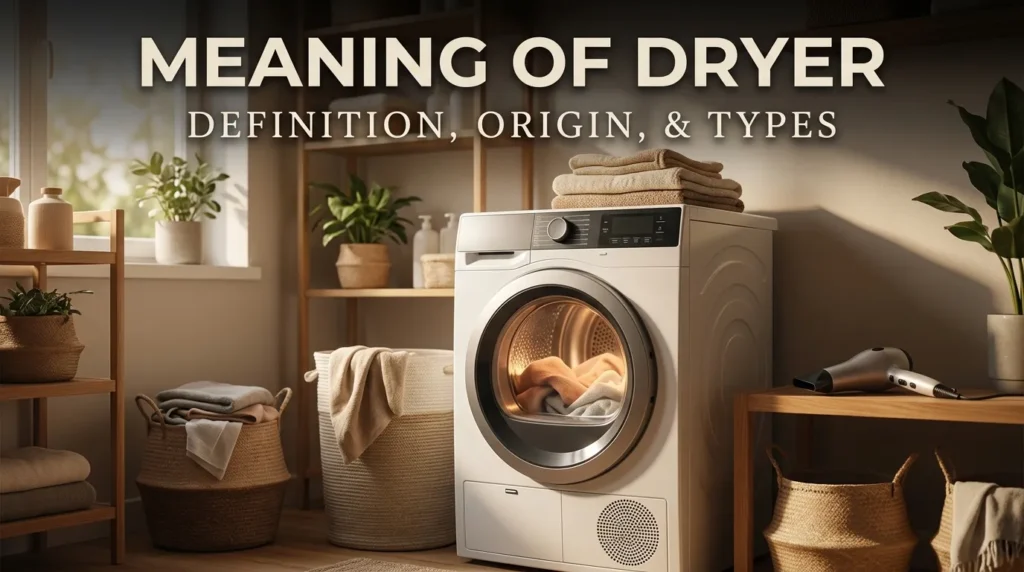
Dryer usually means a machine or device used to remove moisture from something. Common examples include a clothes dryer, hair dryer, hand dryer, and industrial dryer.
For example, when someone says, “The dryer has stopped working,” they are usually referring to an appliance used to dry clothes.
Definition of Dryer
Dryer (noun): A machine or device designed to remove moisture from an object or material.
In everyday English, the word most often refers to an appliance that dries wet clothing or hair. In industrial and technical settings, it can describe equipment that dries grain, food, wood, or other materials.
Examples:
- I bought a new clothes dryer last month.
- She used a hair dryer before leaving.
- The factory installed a grain dryer.
Dictionaries also recognize drier as an alternative spelling of the noun in certain contexts. Therefore, drier is not universally incorrect when referring to drying equipment, but dryer is usually the clearest and most conventional choice for an appliance.
Main Difference
The main difference between drier and dryer is their usual grammatical function and meaning. One generally describes a level of dryness, while the other names something that dries.
| Feature | Drier | Dryer |
| Usual part of speech | Adjective | Noun |
| Primary meaning | More dry or less wet | A machine or device that dries |
| Common context | Weather, skin, soil, clothes | Laundry, hair care, industrial drying |
| Example | The climate is drier here. | The dryer is full of clothes. |
| Alternative uses | Can be a noun | Can occasionally appear as a comparative spelling |
Consider these two sentences:
- The towels are drier now.
- The towels are in the dryer.
In the first sentence, drier describes the condition of the towels. In the second, dryer identifies the machine holding them.
The distinction is not absolute because English dictionaries also accept drier as a noun for drying equipment. However, when you are describing something as more dry, drier is the conventional spelling. When naming a household appliance, dryer is the usual choice.
Which One Is Correct?
Both drier and dryer are correct English words, but they are generally used differently.
Choose the spelling that matches the meaning you intend.
- Use drier when comparing dryness: “The air is drier today than it was yesterday.”
- Use dryer when referring to a machine: “The clothes are in the dryer.”
- Recognize that drier can also be a valid noun spelling in some contexts, although dryer is more conventional for everyday appliances.
Neither spelling is inherently wrong in every situation. The surrounding sentence determines which form is appropriate.
Grammar and Usage
Understanding how each word functions in a sentence makes the spelling distinction easier to apply.
Drier as a Comparative Adjective
An adjective describes a quality or condition. Drier compares the dryness of two things or describes something that has become less wet.
The basic adjective forms are:
- Positive: dry
- Comparative: drier
- Superlative: driest
Use drier when comparing two things, often with the word than.
Examples:
- This shirt is drier than that one.
- The western region is drier than the eastern region.
- My skin feels drier in cold weather.
You can also use drier without explicitly naming the comparison.
Example: “The air is getting drier.”
Here, the comparison is implied by a change over time.
Dryer as a Noun
A noun names a person, place, thing, or idea. Dryer names a machine or device that removes moisture.
It can appear as a subject, object, or part of a compound noun.
As a subject:
“The dryer needs to be repaired.”
As a direct object:
“We purchased a new dryer.”
In a compound noun:
“She ordered a replacement hair dryer.”
The plural form is dryers.
Examples include clothes dryers, hair dryers, and hand dryers.
American and British English
The basic distinction between drier as a comparative adjective and dryer as an appliance name is useful in both American and British English.
British English often uses tumble dryer for the appliance that dries clothes by circulating warm air. American English commonly uses clothes dryer or simply dryer.
Both varieties use drier as the comparative form of dry. The noun spelling drier is also recognized, so the distinction is a matter of conventional usage rather than an absolute rule that the alternative form cannot exist.
Strengthen your vocabulary by learning how to describe anger with similes in conversations, stories, and everyday situations.
Pronunciation
In standard American English, drier and dryer are generally pronounced alike, approximately DRY-er. British pronunciation also commonly gives the two words the same or very similar pronunciation.
Because the words sound alike, listeners usually rely on context to understand their meaning. In writing, however, the spelling helps distinguish a comparison from a machine.
How to Use Drier or Dryer
Use the meaning of your sentence to decide which spelling fits.
Use Drier to Describe Less Moisture
Choose drier when something contains less water or moisture than another thing, or when its moisture level decreases.
Common combinations include:
- Drier weather
- Drier air
- Drier soil
- Drier skin
- Drier clothes
- Drier conditions
Examples:
“The garden needs less water because the soil is drier this week.”
“After a few hours in the sun, the towels became drier.”
Use Dryer to Name an Appliance
Choose dryer when you mean a machine or device that dries something.
Common combinations include:
- Clothes dryer
- Hair dryer
- Hand dryer
- Grain dryer
- Industrial dryer
Examples:
“The hotel bathroom has a powerful hair dryer.”
“We need to clean the lint filter in the clothes dryer.”
Check the Meaning by Replacing the Word
A simple editing technique is to substitute a phrase for the word in question.
If you can replace it with more dry, drier is usually the appropriate choice.
Example: “The ground is drier today.”
The sentence means that the ground is more dry today.
If you can replace it with a machine that dries, dryer is usually the right choice.
Example: “The dryer is making a strange noise.”
The sentence refers to a machine, not a level of dryness.
This test is especially useful when proofreading articles, school assignments, business emails, and product descriptions.
Examples
Examples of Drier
These sentences use drier as a comparative adjective.
- The weather is drier this month than it was last month.
- This towel feels drier than the one hanging outside.
- The soil becomes drier when the temperature rises and rainfall decreases.
- My hands feel drier after washing dishes without gloves.
- The air inside the room is drier than the air outdoors.
- The eastern side of the garden stays wetter, while the western side is drier.
- Her hair became drier after repeated exposure to heat.
- The bread was drier than we expected.
- The forecast predicts drier conditions over the weekend.
- This moisturizer helps prevent my skin from becoming drier during winter.
In each example, drier describes a condition involving less moisture.
Examples of Dryer
These sentences use dryer as a noun.
- Please put the wet towels in the dryer.
- My hair dryer stopped working this morning.
- The new clothes dryer uses less energy than our old one.
- Remember to empty the lint filter before using the dryer.
- The hotel provides a hair dryer in every room.
- We bought two hand dryers for the public restrooms.
- The farmer invested in a grain dryer to protect the harvest.
- The repair technician examined the dryer before replacing the faulty part.
- She packed her hair dryer in her suitcase.
- The laundry room has a washer and a dryer.
In these examples, dryer names equipment used to remove moisture.
Examples Showing Both Words
The following sentences show how the meaning changes with the spelling.
- The towel is drier now that it has been in the dryer.
- My hair feels drier after using the hair dryer.
- The dryer stopped working, so the clothes remained wet instead of becoming drier.
- The air is drier today, but the clothes still need to go into the dryer.
- We replaced the old dryer because it could no longer dry the clothes effectively.
These examples demonstrate why context matters more than pronunciation.
Common Mistakes
1. Using Dryer Instead of Drier in a Comparison
Incorrect for conventional edited usage: The weather is dryer than yesterday.
Correct and preferred: The weather is drier than yesterday.
Why it happens: Both words sound alike, so writers may choose dryer even when describing a change in moisture.
The conventional comparative spelling is drier, although dryer as a comparative variant can occur in English.
2. Using Drier for a Household Appliance
Less conventional: I need to buy a new drier for my laundry room.
Preferred: I need to buy a new dryer for my laundry room.
Why it happens: Dictionaries recognize drier as an alternative noun spelling, but dryer is the more familiar spelling for household appliances.
3. Assuming Drier Is Always an Adjective
Incorrect assumption: Drier can never refer to a machine.
Correct understanding: Drier can function as a noun in some contexts, including as an alternative spelling of dryer.
Why it happens: The basic teaching rule emphasizes the difference between the comparative adjective and the appliance noun. That rule is useful, but it does not cover every accepted noun usage.
4. Confusing Drier With the Past Tense of Dry
Incorrect: The clothes drier after an hour in the sun.
Correct: The clothes dried after an hour in the sun.
Why it happens: Drier describes a comparative condition, while dried is the past tense and past participle of the verb dry.
5. Writing Dryer When You Mean Dried
Incorrect: The clothes are dryer by the time we arrive.
Correct: The clothes are dried by the time we arrive.
Why it happens: Dryer and dried are related to the same root word, but they have different grammatical functions. Dried can describe the result of a drying process, while dryer usually names the equipment.
Linguistic Insight
The difference between drier and dryer illustrates how English spelling reflects word formation and grammatical function.
How the Words Are Formed
Both words are derived from the adjective dry, but they developed different common uses.
For the comparative adjective, English typically changes the final y to i before adding -er:
- Dry → drier
- Easy → easier
- Happy → happier
- Busy → busier
This is a common spelling pattern for adjectives ending in a consonant followed by y.
The word dryer, by contrast, is a noun formed with the suffix -er. This suffix often identifies a person or thing that performs an action.
For example:
- Teach → teacher
- Print → printer
- Dry → dryer
A dryer is something that dries, such as a machine or device.
Why the Words Sound the Same
In modern English, drier and dryer are generally homophones, meaning they sound alike but have different spellings and typical meanings.
This similarity creates confusion in writing because pronunciation does not reliably tell you which spelling to choose.
The distinction becomes clear when you examine the sentence’s meaning and grammatical structure.
Why Both Spellings Exist as Nouns
English spelling is not always perfectly consistent. Words formed with the same ending can develop alternative spellings over time, and dictionaries may preserve more than one accepted form.
Consequently, drier can appear as a noun referring to drying equipment or a drying substance. Nevertheless, dryer remains the more recognizable choice for common appliances such as hair dryers and clothes dryers.
The key lesson is to distinguish a word’s usual function from every possible dictionary-recognized use.
Usage Tips
- Think about the meaning first. If you mean more dry, choose drier. If you mean a drying appliance, choose dryer.
- Remember the spelling pattern. Dry becomes drier when forming the usual comparative adjective.
- Look for comparison words. Words such as than, much, and even can help identify a comparative adjective, as in “much drier than before.”
- Learn common compound nouns. Remember hair dryer, clothes dryer, and hand dryer.
- Check the whole sentence. Since both words are legitimate, a spell-checker may not identify a contextually inappropriate choice.
- Do not confuse related forms. Drier, dryer, dried, and drying have different typical grammatical roles.
Expert Suggestion
For students, ESL learners, and professional writers, the most reliable approach is to identify the intended meaning before choosing the spelling.
When editing an article, ask whether the word describes a condition or names equipment. Use drier for comparisons involving dryness and dryer for the appliance.
If you are writing a technical document where drier is an established term for a drying substance or device, follow the terminology used in that field. Consistency and clarity matter more than applying a simplified rule to every possible context.
Summary
Drier and dryer are both correct English words, but their usual meanings differ.
- Drier is the standard comparative form of dry, meaning more dry or less wet.
- Dryer usually refers to a machine or device that removes moisture.
- Drier is also accepted as an alternative noun spelling in some contexts.
- Both words are generally pronounced alike, so context determines the appropriate spelling.
- For ordinary writing, use drier weather and clothes dryer.
Remember the practical distinction: drier describes dryness, while dryer usually names the machine that removes moisture.
Frequently Asked Questions
Is drier or dryer correct?
Both are correct. Drier is the standard comparative form of dry, while dryer usually refers to a machine or device that dries something.
What is the difference between drier and dryer?
Drier means more dry or less wet. Dryer usually means a machine that removes moisture, such as a clothes dryer or hair dryer.
Is drier a real word?
Yes. Drier is a standard English word. It is the usual comparative form of dry and can also function as a noun in certain contexts.
Is dryer a real word?
Yes. Dryer is a standard English noun that commonly refers to a machine or device used to dry clothes, hair, or other materials.
Is it drier or dryer weather?
Drier weather is the conventional choice because drier compares the amount of moisture in the air or the conditions in a particular place.
Is it clothes drier or clothes dryer?
Clothes dryer is the more conventional spelling for a household appliance. Clothes drier also occurs, but clothes dryer is generally the clearest choice.
Is it hair drier or hair dryer?
Hair dryer is the usual spelling for the appliance used to dry hair. Although hair drier is possible as an alternative noun spelling, hair dryer is more widely recognized.
Is drier the comparative form of dry?
Yes. The usual forms are dry, drier, and driest. For example, “This towel is drier than the other one.”
Can dryer be used to mean more dry?
Dryer is occasionally used as a comparative variant, but drier is the conventional spelling in standard edited English when describing something as more dry.
Are drier and dryer pronounced the same?
Generally, yes. They are pronounced alike or very similarly in standard American and British English, which is why the difference can be difficult to hear.
What is the plural of dryer?
The plural is dryers. For example, “The store sells several models of clothes dryers.”
What is the superlative form of drier?
The superlative form is driest. Use it when describing the greatest degree of dryness, as in “This is the driest month of the year.”
Is drier American or British English?
Drier is used in both American and British English as the comparative form of dry. It is not restricted to either variety.
How can I remember drier versus dryer?
Remember that dry becomes drier when comparing dryness. Use dryer for a machine, as in hair dryer or clothes dryer.
Can a spell-checker tell the difference between drier and dryer?
Not always. Both are valid spellings, so a spell-checker may accept either one. Review the meaning and grammatical role of the word to choose correctly.

