
Imagine writing an email and typing, “There are to many problems with this plan.” You may wonder whether to many or too many is correct because both expressions sound alike. The answer depends on what you mean. Use “too many” to describe an excessive number, but “to many” can be correct when “to” serves its normal grammatical function. This guide explains the difference, the grammar rules, and how to use each form correctly.
Quick Answer
Both “to many” and “too many” can be correct, but they have different meanings and grammatical functions.
| Form | Correct? | Meaning | Example |
| Too many | Yes | More than needed, wanted, or acceptable | There are too many people here. |
| To many | Yes, in specific contexts | Connects an action or idea to a large number of people or things | I sent invitations to many guests. |
Remember this simple rule:
- Too many expresses excess, as in too many mistakes or too many meetings.
- To many appears when to functions as a preposition, as in important to many people.
- To many is incorrect when you intend to express an excessive number.
To understand the difference between similar verb forms, learn when to use Flew vs Flown in everyday English sentences.
Meaning and Definition
Meaning of Too Many

Too many means that the number of people or things is greater than what is needed, wanted, acceptable, or manageable. It often suggests a problem, although the exact meaning depends on the situation.
For example, if you have too many assignments, you may have more work than you can comfortably finish.
Definition of Too Many
Too many is a quantity expression consisting of the adverb too and the determiner many. It indicates an excessive number of countable people or things.
In practical use, place too many before a plural countable noun.
Examples include:
- Too many books
- Too many questions
- Too many customers
- Too many responsibilities
It can also stand alone when the noun is already understood: “I ordered six chairs, but that was too many.”
Meaning of To Many
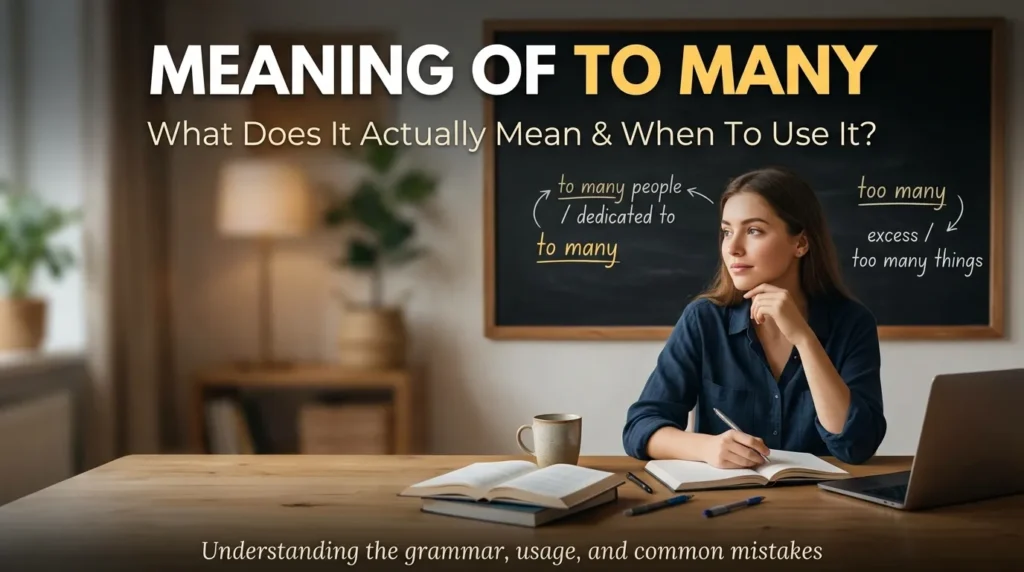
To many is a sequence of two words that can appear naturally in English sentences. It does not mean an excessive number. Instead, to connects an action, feeling, or relationship with many people or things.
For example, in “The announcement was important to many employees,” the phrase identifies the employees for whom the announcement was important.
Definition of To Many
To many is not a fixed quantity expression with the meaning of excess. It is a grammatical sequence in which to usually functions as a preposition and many indicates a large number of people or things.
Examples include:
- I spoke to many students.
- She sent the documents to many clients.
- The change matters to many families.
The word to introduces a recipient or indicates a relationship, while many refers to a large number.
Main Difference
The main difference between to many and too many is their meaning and grammatical function.
| Feature | Too Many | To Many |
| Main function | Expresses an excessive number | Connects an action or relationship to many people or things |
| Meaning of the first word | Too means more than necessary or desirable | To indicates a relationship, recipient, or direction |
| Typical pattern | Too many + plural countable noun | Verb or adjective + to many + noun |
| Example | We received too many applications. | We sent the forms to many applicants. |
| Suggests excess? | Yes | No |
Consider these sentences:
- There are too many emails in my inbox. The number of emails is excessive.
- I sent emails to many customers. The emails went to a large number of customers.
Both sentences are grammatically correct, but they communicate different ideas. The surrounding sentence determines which spelling you need.
Which One Is Correct?
“Too many” is correct when you mean more than necessary, wanted, or acceptable. However, “to many” is also correct when to has a separate grammatical role.
Use too many in sentences such as:
- There are too many cars on this road.
- I made too many spelling mistakes.
- We scheduled too many meetings this week.
Use to many in sentences such as:
- The teacher spoke to many students.
- The company sent invitations to many customers.
- The new policy is important to many families.
Do not automatically treat to many as a spelling error. Check the intended meaning and the sentence structure before deciding which form is correct.
Grammar and Usage
Understanding how to and too function in a sentence makes this distinction much easier.
How to Use Too Many
The usual grammatical pattern is:
Too many + plural countable noun
A countable noun refers to something that can be counted individually, such as books, people, chairs, or mistakes.
Examples:
- Too many books
- Too many people
- Too many phone calls
- Too many expenses
You can use this expression as part of a sentence or on its own when the context is clear.
- We have too many orders to process today.
- There were too many people waiting outside.
- How many cookies did you eat? Too many!
Strengthen your understanding of English conditionals with hypothetical sentences using was and were in natural examples.
How to Use To Many
The sequence to many normally appears within a larger sentence. Here, to is a preposition that connects words or ideas.
Common patterns include:
Verb + to many + noun
- She explained the rules to many students.
- We offered discounts to many customers.
Adjective + to many + noun
- The change seemed unfair to many employees.
- This problem is familiar to many readers.
Noun + to many + noun
- His success was an inspiration to many young athletes.
- The announcement came as a surprise to many people.
In each example, to establishes a relationship. It does not indicate an excessive quantity.
Too Many vs. Too Much
Another important distinction is the difference between too many and too much.
| Expression | Used with | Example |
| Too many | Plural countable nouns | Too many books |
| Too much | Uncountable nouns | Too much information |
| Too much | Uncountable nouns | Too much water |
For example:
- Correct: There are too many chairs in the room.
- Correct: There is too much furniture in the room.
- Incorrect: There are too many furniture items in the room, if the intended noun is simply furniture.
The last example should be written as “There is too much furniture in the room.” However, too many pieces of furniture is also correct because pieces is countable.
How to Use Too Many and To Many Correctly
The easiest way to choose the right expression is to identify the meaning you want to communicate.
Use Too Many to Express Excess
Choose too many when a number exceeds what is needed, desired, or manageable.
Examples:
- I have too many tasks to finish today.
- There are too many advertisements on this website.
- She bought too many vegetables for one meal.
- We received too many applications for the available positions.
The number does not have to be objectively large. It only needs to be excessive in the particular situation.
For example, five guests might be too many for a tiny room but perfectly reasonable for a large hall.
Use To Many When Referring to a Group
Use to many when the preposition to connects an action or relationship with a large number of people or things.
Examples:
- The manager sent the updated schedule to many employees.
- I have spoken to many people about this issue.
- The decision was disappointing to many supporters.
- This book introduces important concepts to many beginners.
In these examples, to many is not an alternative spelling of too many. The words perform different grammatical jobs.
Examples
Examples of Too Many
- There are too many people waiting outside the store.
- I made too many mistakes in my first draft.
- She has too many appointments scheduled for Friday.
- We bought too many groceries for the weekend.
- Too many students missed the morning lecture.
- The company received too many complaints about its service.
- I have too many browser tabs open on my computer.
- He spends too much time worrying about problems and takes on too many responsibilities.
- There were too many questions to answer before the meeting ended.
- I invited too many guests to fit comfortably around the table.
Examples of To Many
- The teacher gave extra worksheets to many students.
- We sent the invitation to many business partners.
- The new policy is important to many families.
- She explained the process to many first-time applicants.
- The charity distributed food to many communities.
- His advice was helpful to many young professionals.
- The announcement came as a surprise to many employees.
- I have written to many publishers about my manuscript.
- The documentary introduced the issue to many viewers.
- The opportunity was available to many qualified candidates.
Common Mistakes
Mistake 1: Using To Instead of Too to Express Excess
Incorrect: There are to many people in the waiting room.
Correct: There are too many people in the waiting room.
Why it happens: The words to and too sound alike in ordinary speech, so writers may choose the wrong spelling.
Mistake 2: Using Too Instead of To Before a Recipient
Incorrect: She sent the report too many clients.
Correct: She sent the report to many clients.
Why it happens: The writer may confuse the preposition to with the adverb too.
Mistake 3: Using Too Many With an Uncountable Noun
Incorrect: We received too many information about the project.
Correct: We received too much information about the project.
Why it happens: The writer focuses on the quantity rather than whether the noun is countable.
Mistake 4: Assuming To Many Is Always Incorrect
Incorrect reasoning: Every sentence containing “to many” must be a spelling mistake.
Correct example: The change was meaningful to many people.
Why it happens: Learners often memorize too many as a fixed expression without recognizing that to and many can occur next to each other for a different grammatical reason.
Mistake 5: Confusing Too Many With So Many
Incorrect for the intended meaning: I have so many assignments that I cannot manage them, so I should always write “too many assignments.”
Correct alternatives:
- I have too many assignments to finish tonight.
- I have so many assignments that I cannot finish them tonight.
Why it happens: Both expressions can refer to a large quantity, but they emphasize different things. Too many signals excess, while so many emphasizes quantity and often introduces a consequence.
Linguistic Insight
Why To and Too Are Confused
The confusion between to and too is an example of a homophone-related spelling error. Homophones are words that sound alike but have different meanings or grammatical functions.
In many English accents, to and too can have the same pronunciation, particularly when to is stressed. In everyday speech, to is also often pronounced with a reduced vowel, which can make it sound different depending on the sentence.
Because pronunciation does not reliably distinguish the words, writers must use context and meaning to select the correct spelling.
The Grammatical Role of Too
In too many, the word too is an adverb expressing excess. It modifies the quantity expression many, which is used with plural countable nouns.
For example, in “There are too many cars,” the speaker indicates that the number of cars exceeds an acceptable or desirable limit.
The limit is contextual rather than fixed. What counts as too many depends on the situation and the speaker’s judgment.
The Grammatical Role of To
In expressions such as give something to many people or important to many readers, the word to is a preposition.
It introduces a recipient or establishes a relationship between parts of the sentence. The word many indicates a large number of people or things.
This difference explains why the two expressions cannot be substituted for each other simply because they sound similar.
Usage Tips
- Remember the extra o: In too many, the extra letter can remind you of something extra or excessive.
- Check the meaning: If you mean more than necessary, use too many.
- Look at the sentence structure: If to introduces a recipient or relationship, to many may be correct.
- Check the noun: Use too many with plural countable nouns and too much with uncountable nouns.
- Read the whole sentence: Do not decide based on the two words alone. Their grammatical role depends on the surrounding words.
- Proofread professional writing: Pay particular attention to these words in emails, reports, essays, and website content because spelling mistakes can change the intended meaning.
Expert Suggestion
As a grammar teacher, I recommend using a simple meaning test whenever you are unsure about to many and too many.
Ask yourself: Am I describing an excessive number, or am I connecting an action or idea to a group?
If you mean excess, write too many. If to introduces a recipient or relationship, write to many.
For example, “I sent the message to many colleagues” describes the recipients, while “I sent too many messages” describes an excessive quantity.
This approach is more reliable than memorizing one expression as correct and the other as incorrect. It also helps you distinguish similar expressions such as to, too, and two in everyday writing.
Summary
- Too many means more than is needed, wanted, suitable, or manageable.
- To many is correct when to functions as a preposition connecting an action or relationship with a large number of people or things.
- Use too many with plural countable nouns, such as too many books or too many questions.
- Use too much with uncountable nouns, such as too much water or too much information.
- The correct choice depends on meaning and grammatical function, not pronunciation alone.
Frequently Asked Questions
Is It To Many or Too Many?
Both can be correct, depending on the sentence. Use too many to express an excessive number, as in “There are too many cars.” Use to many when to introduces a recipient or relationship, as in “I spoke to many customers.”
Is To Many Grammatically Correct?
Yes. For example, “The new rules apply to many employees” is grammatically correct. Here, to is a preposition, not an expression of excess.
What Does Too Many Mean?
Too many means more than is needed, wanted, suitable, or manageable. For example, “I have too many assignments” means the number of assignments is excessive for the situation.
Why Do People Confuse To and Too?
The words often sound alike in speech, so their pronunciation may not reveal which spelling is correct. Their meanings and grammatical functions determine the right choice.
Is It Too Many People or To Many People?
Both are possible in different sentences. “There are too many people here” expresses excess, while “I spoke to many people” describes an action involving a large number of people.
Is It Too Many Times or To Many Times?
Use too many times when an action has happened more often than desired. For example, “I have explained the rule too many times.”
Should I Use Too Many or Too Much?
Use too many with plural countable nouns, such as books, chairs, and questions. Use too much with uncountable nouns, such as water, money, and information.
Is Too Many Correct in Formal Writing?
Yes. Too many is standard English and is appropriate in academic, professional, and formal writing whenever it expresses an excessive number.
Can I Start a Sentence With Too Many?
Yes. For example, “Too many people arrived before the doors opened.” The phrase can appear at the beginning of a sentence when it functions as the subject’s quantity expression.
Is Too Many Always Negative?
Not necessarily. It usually indicates excess relative to a particular situation, but it does not always express strong criticism. The tone depends on context.
What Is the Difference Between Too Many and So Many?
Too many suggests an excessive number, while so many emphasizes a large number and can introduce a consequence. For example, “There are too many cars” indicates excess, while “There are so many cars that we cannot find parking” emphasizes quantity and its result.
Is To Many a Spelling Mistake?
Not always. It is a mistake when used to express excess, as in “There are to many errors.” However, it is correct when to has a separate grammatical function, as in “The message was sent to many people.”
How Can I Remember the Correct Spelling?
Associate the extra o in too with something extra. When you mean an excessive number, choose too many. When to connects an action or idea to a group, use to many.

